
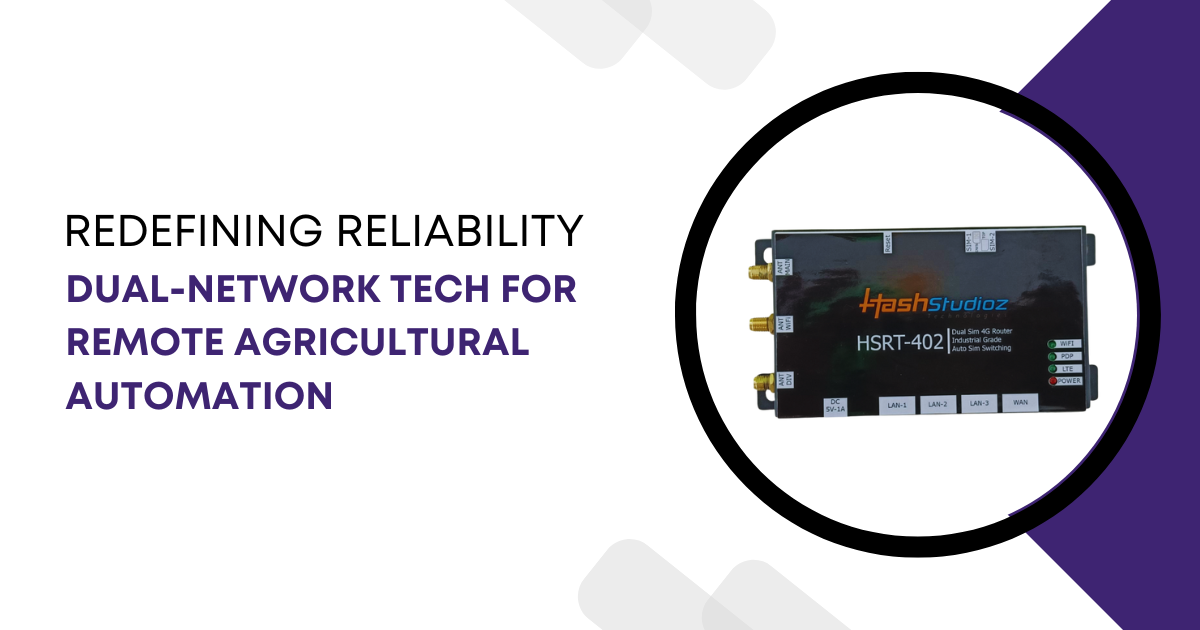
Modern agriculture relies on remote automation to feed a growing global population. Farmers use sensors, drones, and robotic systems to manage land. These tools provide data on soil health, moisture, and crop growth. However, this technology depends on stable internet connectivity. In many rural areas, network infrastructure is sparse. When a connection fails, automated systems stop. This downtime leads to resource waste and crop loss.
Redefining reliability in this sector requires better networking hardware. The use of an Industrial Router with failover capabilities is now a necessity. Specifically, the Dual Sim Industrial Router offers a solution to rural signal drops.
The Challenge of Remote Connectivity
Remote agricultural sites face unique environmental hurdles. Unlike a climate-controlled office, a farm exposes gear to heat, dust, and moisture. Conventional consumer routers cannot survive these conditions. Furthermore, single cellular networks often have dead zones. They also experience outages during storms.
Research shows that many farmers lack access to smart systems due to infrastructure barriers. High-frequency bands like 5G are often impractical for large fields. These bands require expensive infrastructure.
Why Single Networks Fail in Farming
- Topography: Hills and trees block signals.
- Weather: Heavy rain interferes with cellular transmissions.
- Provider Limits: One carrier may not cover every corner of a large farm.
- Network Congestion: Towers may become overloaded during harvest times.
Defining the Dual Sim Industrial Router
A Dual Sim Industrial Router is a rugged device built for constant uptime. It contains two separate slots for SIM cards from different providers. If the primary network loses signal, the router switches to the backup. This process is called failover. It happens in seconds.
These devices use aluminum or steel housings. They operate in temperatures from -40°C to 75°C. This durability is vital for equipment on irrigation pivots or tractors.
Core Features of Industrial Routers
- Redundancy: Dual SIM slots provide a backup path.
- Rugged Design: Resistance to vibration, shock, and interference.
- Wide Voltage Input: Capability to run on various power sources.
- Remote Management: Experts can troubleshoot the device from a distance.
Technical Advantages of Dual-Network Systems
Reliability is about data integrity. Agricultural robots use mapping to navigate fields. If the connection drops, the robot might lose its position. It might even stop for safety.
1. Reduced Latency for Real-Time Tasks
Real-time tasks require low-latency responses. An example is automated irrigation shut-off during rain. A Dual Sim Industrial Router selects the strongest signal to minimize delays. Fog-Cloud architectures also improve this by processing data near the sensors. Fog-based systems have much lower latency than pure Cloud systems.
2. Higher Packet Success Rates
Connectivity in open fields is often shaky. Even with a clear view, packet loss is common. By switching to a stable network, an Industrial Router keeps loss low. This ensures that commands for spraying or harvesting are received.
3. Load Balancing
High-end Industrial Routers do more than just failover. They can use both SIM cards at once. This load balancing increases total bandwidth. This helps when streaming video from crop-monitoring drones.
Real-World Impact and Statistics
Automated systems have a measurable impact on farm productivity. Precision technology allows for targeted work. This boosts efficiency across the board.
| Metric | Impact of Automation |
| Water Usage | Reduced by up to 2,500 Liters per hectare |
| Chemical Input | Significant reduction via precision spraying |
| Productivity | Enhanced via labor substitution |
| Signal Range | 250m to 750m depending on nodes |
These gains only happen if the network stays active. For example, weeding robots use image recognition to find weeds. Without a reliable Industrial Router, these machines become useless.
Integration with Emerging Tech
Modern agricultural intelligence follows a specific framework.
- Perception: Sensors and cameras gather data.
- Decision: AI models analyze data to plan actions.
- Execution: Robots or actuators perform the task.
The Dual Sim Industrial Router is the central nervous system. It carries data from the Perception stage to the cloud. It then brings instructions back to the hardware.
Cost-Benefit Analysis
An Industrial Router costs more than a home router. However, the investment pays for itself. The cheap approach often fails in professional farming. Weak routers lead to high maintenance costs.
Why the Investment Matters
- Labor Shortages: Automation solves the lack of human labor.
- Resource Efficiency: Precision irrigation reduces waste.
- Carbon Footprint: Autonomous electric machinery lowers emissions.
Enhancing Security in Agricultural Networks
Security is a major concern for remote automation. Agricultural data is valuable. Hackers could disrupt irrigation or steal crop yield data. An Industrial Router provides advanced security features. These include hardware firewalls and encrypted VPN tunnels.
A Dual Sim Industrial Router adds an extra layer of safety. If one network is compromised, the system can switch to a secure backup. This ensures that the farm stays protected from cyber threats.
Security Features to Look For:
- VPN Support: Secure data transmission between the farm and the office.
- Firewall: Blocks unauthorized access to farm equipment.
- Authentication: Ensures only verified users can change settings.
Future Trends in Dual-Network Tech
Technology is always changing. Future Industrial Routers will integrate with satellite networks. This includes systems like Starlink. A router could use a cellular SIM and a satellite link. This would provide 100% coverage even in the most remote areas.
AI will also play a role inside the router. Future devices will predict network failures before they happen. They will switch providers based on weather patterns or tower maintenance schedules. This proactive approach will redefine reliability once again.
Scalability and Long-Term Value
Farms grow over time. A good networking solution must be scalable. You can add more Industrial Routers to create a mesh network. This extends coverage to new fields or buildings.
The long-term value of a Dual Sim Industrial Router is clear. It prevents expensive downtime. It allows for the use of the latest AI tools. It protects the farm’s digital assets.
In a world of unpredictable weather and labor markets, reliability is king. Dual-network technology provides that reliability. It allows farmers to focus on growing food rather than fixing internet connections.
Environmental Sustainability
Reliable networks contribute to a greener planet. When an automated system works perfectly, it saves resources. Precision farming prevents over-fertilization. This stops chemicals from leaking into local water supplies.
A Dual Sim Industrial Router ensures these green systems never go offline. If the connection breaks, the precision stops. The farm might revert to old, wasteful methods. Therefore, reliable hardware is a pillar of sustainable agriculture.
Environmental Benefits:
- Less Fuel: Robots replace heavy, fuel-burning tractors.
- Less Water: Sensors ensure irrigation only happens when needed.
- Better Soil: Targeted treatment keeps soil healthy.
The Role of Edge Computing
Edge computing is changing how we use an Industrial Router. Instead of sending all data to a far-away server, the router does some work locally. This is vital for tasks like fruit picking. A robot must decide to pick a fruit in milliseconds.
A Dual Sim Industrial Router with edge capabilities makes this possible. It manages the local network while maintaining a cloud connection for big-picture data. This hybrid approach is the future of the smart farm.
Conclusion
Redefining reliability in remote agriculture starts with the network. A Dual Sim Industrial Router provides the necessary backbone for modern automation. By offering dual-network redundancy and rugged durability, these devices ensure that farms stay smart. As AI continues to transform farming into a data-driven industry, the value of constant connectivity will only grow.
Farmers must prioritize hardware that can withstand the environment. They must choose systems that provide a fail-safe connection. Only then can the true potential of autonomous harvesting be reached. Reliability is not just a feature; it is a requirement for the future of food.
