
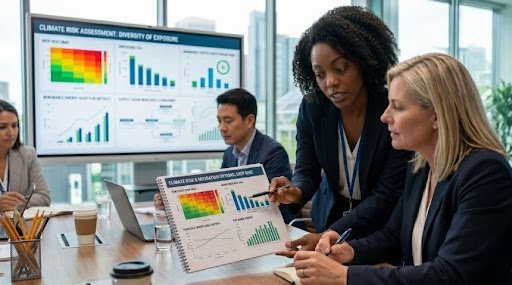
Modern industries are increasingly operating in an environment where climate variability, resource constraints, and regulatory expectations directly influence long-term business stability. As a result, climate risk management has become an essential part of enterprise planning rather than a standalone sustainability initiative. Organizations today are expected to understand how climate-related disruptions can impact supply chains, infrastructure, operations, and financial performance.
Unlike traditional risk frameworks focused on financial or operational risks, climate risk management requires a more integrated approach combining data analysis, scenario planning, and long-term resilience. This shift is driving the adoption of structured sustainability systems aligned with business continuity and environmental responsibility.
Understanding Climate Risk in Industrial Systems
Climate risk in modern industries generally falls into three interconnected categories that together influence operations, planning, and long-term resilience.
- Physical Risks (floods, heatwaves, storms, droughts)
- Transition Risks (policy shifts, carbon regulations, market changes)
- Operational Risks (supply chain disruptions, infrastructure stress)
Each of these risks affects industries differently depending on geography, sector, and operational scale. For example, manufacturing units may face energy-efficiency pressures, while logistics networks may experience route disruptions due to extreme weather.
Understanding these categories helps organizations prioritize where resilience investments are most needed.
Why Climate Risk Management Has Become Strategic
Industries are no longer viewing climate-related risks as distant or occasional events. Instead, they are being treated as ongoing operational factors that influence business continuity.
Key reasons for this shift include:
- Increasing frequency of extreme weather events
- Stricter environmental compliance requirements
- Investors focus on ESG performance
- Rising operational costs linked to resource scarcity
- Global supply chain vulnerabilities
Because of these factors, climate resilience is now closely tied to competitiveness and long-term financial stability.
Building a Structured Risk Assessment Framework
A strong climate risk strategy begins with a structured assessment. This involves identifying vulnerabilities across all operational layers and mapping how environmental changes could affect them over time.
Organizations typically focus on:
- Asset-level climate exposure mapping
- Supply chain vulnerability analysis
- Energy consumption profiling
- Water usage dependency studies
- Geographic risk classification
This structured evaluation helps decision-makers prioritize adaptation efforts instead of reacting to disruptions after they occur.
Role of Data and Predictive Modeling
One of the most important developments in modern sustainability planning is the use of predictive data systems. Climate risk is no longer assessed only through historical patterns but also through forward-looking models.
These systems help organizations:
- Simulate climate scenarios
- Predict operational disruptions
- Estimate the financial impact of environmental events
- Identify long-term infrastructure risks
By integrating climate data with operational analytics, businesses can make more informed investment and planning decisions.
Integrating Climate Resilience into Supply Chains
Supply chains are among the most sensitive areas to climate-related disruptions. Modern industries are now focusing on building flexible and diversified supply networks.
Key approaches include:
- Multi-region supplier sourcing
- Localized production strategies
- Inventory buffer optimization
- Transport route diversification
- Supplier sustainability evaluation
These strategies help ensure that operations remain stable even when specific regions experience environmental or logistical disruptions.
Climate Adaptation in Infrastructure Planning
Industrial infrastructure is also being redesigned to handle long-term environmental variability. This includes both physical and digital infrastructure systems.
Common adaptation measures include:
- Climate-resistant building materials
- Energy-efficient facility design
- Flood and heat-resistant infrastructure planning
- Smart monitoring systems for utilities
- Renewable energy integration
These measures reduce operational vulnerability while improving long-term resource efficiency.
Amid these evolving strategies, many organizations are increasingly aligning their sustainability planning with structured climate risk management frameworks to ensure consistency in evaluation and execution across operational units.
Financial Implications of Climate Risk
Climate risks are no longer just environmental concerns; they directly affect financial performance. Industries are now incorporating climate variables into financial forecasting models.
Key financial impacts include:
- Increased insurance costs
- Asset depreciation risks
- Operational downtime losses
- Resource price volatility
- Compliance-related expenditures
Because of this, financial planning now often includes climate-adjusted scenarios to better prepare for long-term uncertainties.
Technology-Driven Climate Monitoring
Technology plays a central role in modern climate risk strategies. Industries are increasingly using digital tools to track environmental indicators and operational exposure in real time.
These include:
- Satellite-based environmental monitoring
- IoT-enabled sensor systems
- AI-based climate forecasting tools
- Digital twin simulations of infrastructure
- Real-time emissions tracking platforms
These technologies help organizations move from reactive responses to proactive decision-making models.
Governance and Regulatory Alignment
Governments and global institutions are placing stronger emphasis on environmental accountability. This means organizations must now align internal policies with external regulatory expectations.
Key governance elements include:
- Emissions reporting standards
- Sustainability disclosure frameworks
- Carbon reduction targets
- Environmental audit systems
- Compliance documentation processes
Strong governance ensures that climate strategies are transparent, measurable, and aligned with global sustainability goals.
Workforce Awareness and Organizational Change
Climate resilience is not only a technical or strategic issue; it also involves organizational culture. Employees across all levels need awareness of sustainability practices and their role in implementation.
Companies are focusing on:
- Sustainability training programs
- Cross-department collaboration
- Leadership engagement in climate strategy
- Operational responsibility alignment
- Internal reporting systems
This helps ensure that climate strategies are effectively implemented across the organization rather than limited to policy documents.
Comparative View of Climate Risk Approaches
Modern industries are shifting from reactive methods toward more structured climate strategies. The comparison below shows how each approach differs in focus and outcome:
- Reactive response: Focuses on post-event handling, with recovery after a disruption occurs, usually leading to short-term solutions.
- Preventive planning: Focuses on anticipating risks in advance to reduce the likelihood and impact of disruptions.
- Predictive modeling: Uses data-driven forecasting to identify risks early and support proactive planning.
- Integrated strategy: Connects systems across operations to ensure alignment and long-term sustainability.
Final Thoughts
Climate resilience is becoming a defining factor in how modern industries operate and grow. Organizations that invest in structured climate strategies are better positioned to manage uncertainty, maintain operational stability, and support long-term sustainability goals.
In today’s evolving business environment, structured compliance systems are essential for sustainable growth. If you are looking for professional support in quality management, compliance training, and certification services, KBS Certification Services Limited is a globally recognized organization offering certification, auditing, validation, verification, inspection, assurance, and training services across more than 60 countries, supporting quality, safety, sustainability, environmental management, compliance systems, and climate action solutions.