
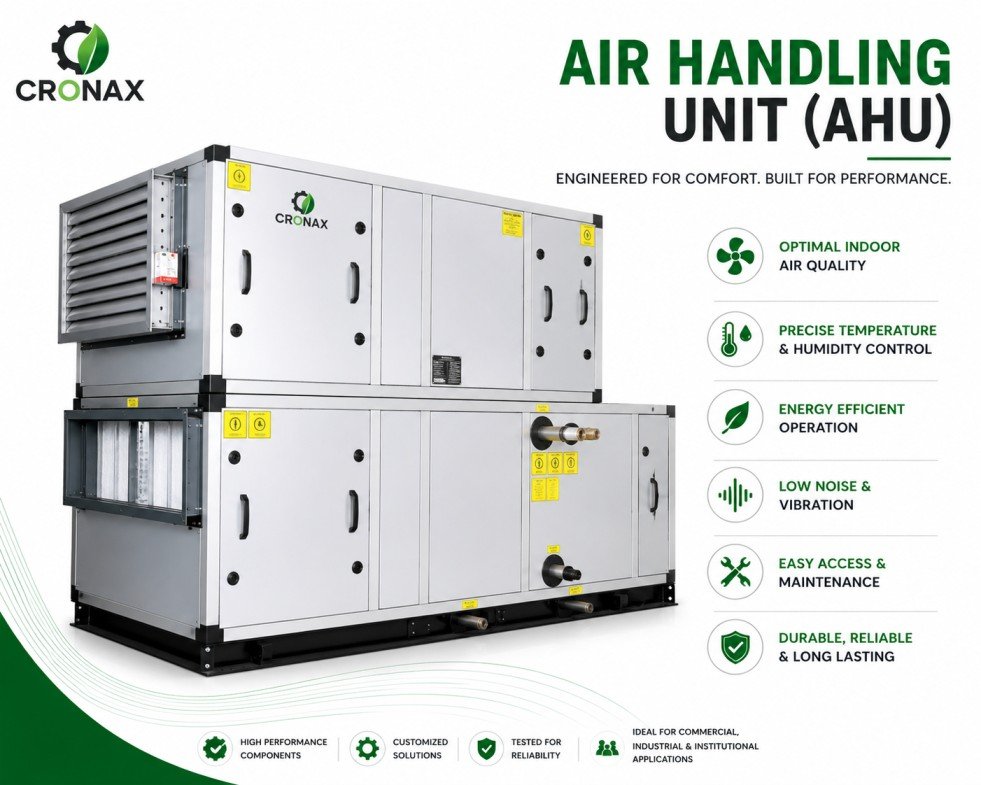
Most people think an air handling unit just moves air around.
It doesn’t. It conditions air — filters it, cools or heats it, controls its moisture content, and delivers it precisely to every zone in the building. Done right, this is what makes a hospital ward breathable, a pharmaceutical cleanroom compliant, and a commercial office genuinely comfortable year-round.
Done wrong — or with a poorly specified system — it’s what causes failed audits, product rejections, mould in ceiling voids, and HVAC bills that make no sense.
Temperature and humidity control are the two most critical outputs of any AHU system. Understanding how they work — and what can go wrong — is the difference between a building that performs and one that keeps creating problems.
The AHU Working Principle — Explained Simply
Before getting into temperature and humidity specifically, it helps to understand the AHU working principle at a system level.
An air handling unit draws in two streams of air: fresh outdoor air and return air recirculated from inside the building. Motorised dampers control how much of each enters the mixing chamber — balancing indoor air quality against energy efficiency.
From there, the mixed air moves through the unit in sequence:
Filtration removes particulates — pre-filters for large dust, fine filters for smaller pollutants, HEPA or ULPA for cleanroom-grade applications.
Cooling or heating coils bring the air to the target supply temperature. Chilled water coils cool the air; hot water, steam, or electric heating coils warm it.
Humidity control either adds moisture (humidifier) or removes it (dehumidification coil or desiccant system).
The supply fan then pushes the conditioned air through the ductwork to every zone in the building.
That’s the complete AHU working principle — intake, filter, condition, distribute. Simple in concept. Precise in execution.
Temperature Control — How It Actually Works
Temperature control inside an AHU happens at the coil stage.
Cooling coils receive chilled water from a central chiller plant (or refrigerant in DX systems). As air passes over the coil surface, heat transfers from the air to the chilled medium — the air temperature drops to the required supply temperature, typically 12°C to 16°C for comfort cooling.
Heating coils work in reverse — hot water or steam heats the coil, and air picks up heat as it passes through. In Indian climates, heating coils are relevant in northern regions during winter, in cold storage vestibules, and wherever reheating is needed after dehumidification.
The control system — whether a standalone PLC or a BMS-integrated controller — reads the supply air temperature downstream of the coil and modulates the chilled water valve to maintain the setpoint. If the supply air temperature rises above the setpoint, the valve opens further. If it drops below, the valve closes.
In a well-commissioned system, supply air temperature holds within ±0.5°C of setpoint continuously. In a poorly commissioned or badly maintained system, it hunts — swinging above and below setpoint — which leads to inconsistent zone temperatures and unnecessary energy consumption.
Humidity Control — The More Complex Challenge
Temperature is relatively straightforward to control. Humidity is harder — and in regulated environments, it’s equally critical.
Why Humidity Matters So Much
In pharmaceutical manufacturing, relative humidity (RH) directly affects product stability, tablet compression behaviour, and packaging integrity. GMP guidelines specify tight RH bands — typically 45% to 60% RH — that must be maintained continuously and documented.
In electronics assembly and semiconductor manufacturing, humidity affects electrostatic discharge risk and component reliability. In hospitals, low humidity dries out mucous membranes and increases infection transmission risk. High humidity promotes mould growth in building fabric.
Getting humidity wrong isn’t a comfort issue. In regulated environments, it’s a compliance failure.
How the AHU Controls Humidity
Dehumidification happens at the cooling coil. When air is cooled below its dew point, moisture condenses on the coil surface and drains away. This is why cooling coils have drain pans underneath them — they’re actively removing moisture from the air, not just cooling it.
The degree of dehumidification depends on how far the coil cools the air below the dew point. Overcooling removes more moisture but drops the temperature too far — which is why dehumidification is often followed by reheat, bringing the supply air back up to the correct delivery temperature.
Humidification adds moisture when the air is too dry. Steam humidifiers inject clean steam directly into the airstream — hygienic, controllable, and immediate in response. Evaporative or ultrasonic humidifiers are alternatives for applications where steam isn’t practical.
The control loop reads RH from a sensor in the supply duct or the served zone and adjusts the humidifier output or cooling coil operation to maintain the setpoint. In sophisticated systems, multiple zone humidity sensors feed back to the AHU controller, which calculates the supply air humidity ratio needed to satisfy the most demanding zone.
The AHU Room — Why the Physical Space Matters
The AHU itself is only as effective as the room it sits in.
A poorly designed AHU room creates problems that no amount of controls tuning can fully resolve:
Insufficient clearance around the unit means filter changes, coil inspection, and component access become difficult — leading to deferred maintenance that gradually degrades performance.
Poor vapour sealing in the AHU room allows moisture infiltration from the building envelope, which the humidity control system then has to continuously fight against.
Vibration transmission from the AHU to the building structure is a noise and structural concern — particularly in buildings with noise-sensitive spaces above or adjacent to the plant room.
Access for maintenance is the most commonly overlooked design element. Every component that needs periodic attention — filters, coil access panels, drain pans, humidifier electrodes, fan belts, motor connections — needs accessible clearance around it. This isn’t a luxury in design; it’s what determines whether maintenance actually gets done on schedule.
A well-designed AHU room accounts for all of this before the unit goes in — not after.
Common Problems and What Causes Them
Supply temperature drifting above setpoint — usually indicates a chilled water valve that’s not closing properly, a fouled cooling coil reducing heat transfer efficiency, or insufficient chiller capacity during peak load.
Humidity persistently above setpoint — often a drain pan issue (blocked drain allowing standing water to re-evaporate), a coil that isn’t cooling below dew point sufficiently, or an oversized humidifier that overshoots setpoint before the control loop corrects.
Humidity below setpoint in winter — cold, dry outdoor air in northern India during December to February needs humidification. If the humidifier capacity isn’t matched to the outdoor air fraction being brought in, the system can’t maintain setpoint under cold dry conditions.
Uneven zone temperatures — often a duct balancing issue rather than an AHU problem. The unit is producing correctly conditioned air; it’s not being distributed evenly across zones.
High energy consumption — frequently caused by simultaneous heating and cooling (the reheat system working against the cooling coil). Proper sequencing of heating and cooling setpoints, and regular review of control logic, resolves most of these cases.
Cronax Industries — AHU Systems That Get Temperature and Humidity Right
For facilities that need air handling units with genuine temperature and humidity control capability — not just air movement — Cronax Industries is a manufacturer worth knowing.
Cronax Industries designs and builds AHU systems for the full range of Indian industrial and commercial applications: pharmaceutical GMP cleanrooms with tight RH and temperature bands, hospital HVAC with infection control requirements, commercial buildings with BMS-integrated energy management, and industrial facilities with process-specific environmental requirements.
Their AHU design approach starts with the psychrometric requirements of the application — the target temperature, humidity, and air change rates — and works backward through coil sizing, fan selection, filtration grade, and control architecture. This is the correct sequence. It produces systems that actually hold setpoint under real operating conditions rather than systems sized on rules of thumb that struggle during peak demand.
Cronax’s double skin AHU range uses high-density PUF insulation panels that maintain thermal stability in the supply air casing — preventing condensation on the outer panel surface and limiting heat gain between coil and supply point. Their drain pans are fabricated in SS 304 with positive slope to drain, no standing water, and easy access for inspection.
Control options range from basic on/off temperature control to fully integrated PLC-based systems with BMS connectivity, differential pressure monitoring, filter life alarms, and data logging for compliance documentation.
For pharmaceutical and GMP facilities specifically, Cronax supports IQ/OQ qualification documentation — the Installation Qualification and Operational Qualification records that regulatory inspections look for as evidence that the system was set up correctly and performs as specified.
What to Verify Before You Commission
Before any AHU system goes into service, these are the checks that matter:
Coil performance verification — measure actual supply air temperature at design airflow and compare to specified leaving air temperature. A coil that doesn’t hit design leaving temperature at commissioning will never hit it under load.
Humidity sensor calibration — RH sensors drift over time. Commission with calibrated sensors, establish a recalibration schedule, and don’t trust long-term humidity data from sensors that haven’t been verified.
Drain pan inspection — check slope, drain connection, trap depth, and that the pan is clear. A blocked drain is the most common cause of humidity problems in the first year of operation.
Control loop tuning — temperature and humidity control loops need to be tuned for the specific thermal mass and response characteristics of the system. Default PID parameters rarely produce stable control without site-specific adjustment.
BMS integration verification — if the AHU connects to a building management system, verify that setpoints, alarm limits, and data logging are functioning correctly before the building is occupied.
The Bottom Line
An air handling unit that controls temperature and humidity precisely is not an expensive luxury for regulated environments. It’s the baseline requirement for any facility where indoor air conditions affect product quality, patient safety, or regulatory compliance.
The AHU working principle is straightforward — intake, filter, condition, distribute. The engineering to make it work reliably under real Indian operating conditions — the humidity swings of monsoon season, the dry cold of northern winters, the peak cooling loads of summer, the continuous operation demands of 24/7 facilities — requires proper specification, proper installation, and proper commissioning.
Cronax Industries builds AHU systems for exactly these conditions, with the engineering depth and compliance knowledge that demanding applications require.
Looking for an AHU manufacturer who understands temperature and humidity control for your specific application? Talk to Cronax Industries before you finalise your specification.
