
Modern manufacturing faces a massive data challenge. Many factories still rely on manual clipboards or isolated machines. This creates a “data silo” where the office knows nothing about the factory floor in real-time. Moving toward a paperless factory requires a digital bridge.
The RS-485 to Ethernet Converter serves as this critical bridge. It links legacy industrial machines to modern enterprise resource planning (ERP) systems. This article explores how this technology works and why it is essential for digital transformation.
The Problem with Manual Data Entry
Traditional factories lose significant time to manual reporting. Workers write down production counts every hour. They record downtime events on paper logs. At the end of a shift, someone types these numbers into a spreadsheet.
This process causes several issues:
- Human Error: People make mistakes when reading gauges or writing numbers.
- Time Lag: Management sees data hours or days after events happen.
- Incomplete Data: Paper logs rarely capture micro-stops or minor speed losses.
Statistical studies show that manual data entry has an average error rate of 1% to 4%. In a high-volume plant, even a 1% error leads to massive inventory discrepancies.
Understanding the RS-485 Protocol
To solve these problems, we must talk to the machines directly. Most industrial hardware uses the RS-485 protocol. This standard has existed since the 1980s. It remains popular because it is robust.
RS-485 handles electrical noise very well. It uses two wires to send signals over long distances. You can chain up to 32 devices on a single line. However, RS-485 has a big limitation. It cannot talk to the internet or modern office networks directly. It speaks a different electrical “language” than your computer.
What is an RS-485 to Ethernet Converter?
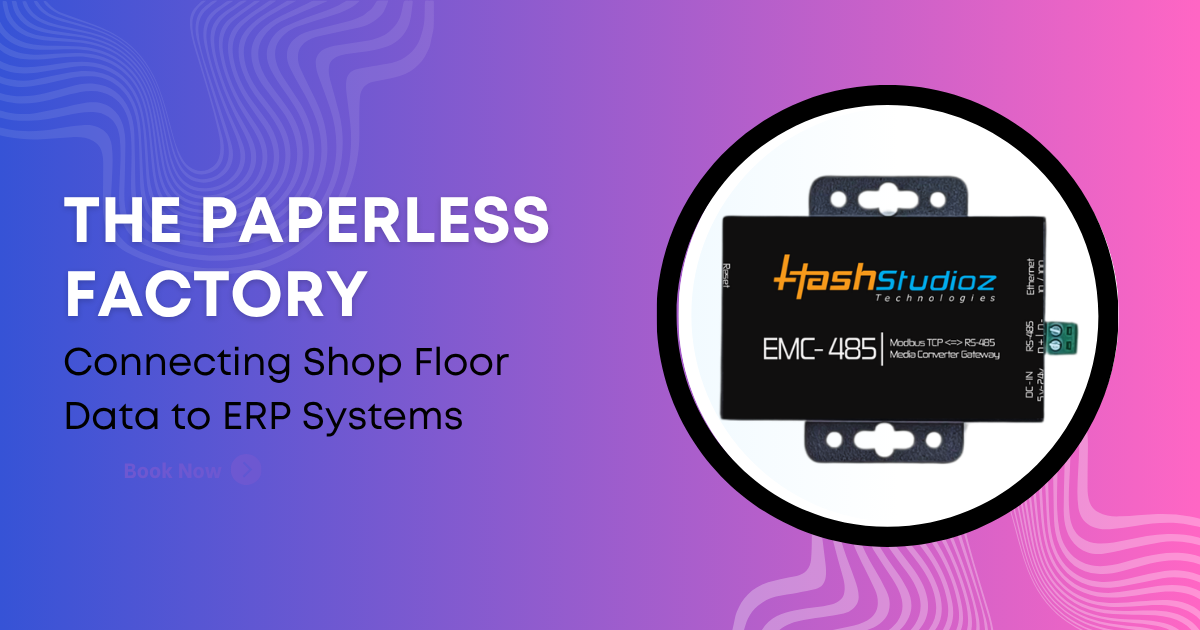
An RS-485 to Ethernet Converter acts as a translator. It takes the serial signals from a machine and wraps them into data packets. These packets travel across standard network cables.
People often call this device an RS-485 to Lan Converter. It provides a physical port for the serial wires and an RJ45 port for the network cable. Inside the device, a processor manages the conversion. It ensures that the timing of the data remains perfect.
Without this converter, your ERP system cannot “see” the PLC (Programmable Logic Controller) or the sensors on the line. The converter makes the machine look like just another device on the company network.
How the Connection Works
The setup process follows a logical path. First, you connect the machine’s data ports to the serial side of the converter. Second, you plug the converter into a network switch.
The RS-485 to Lan Converter usually receives its own IP address. Software on the ERP server then “pings” this IP address. The server asks for specific data points. The converter fetches those points from the machine and sends them back.
Most of these devices support protocols like Modbus TCP. This is the standard language for industrial communication over networks. It allows the ERP to ask for “Total Units Produced” or “Current Machine Temperature” automatically.
Key Benefits of Real-Time Metrics
Connecting machines to an ERP system changes how a factory functions. You no longer guess about your output. You see the truth in real-time.
1. Accurate OEE Calculations
Overall Equipment Effectiveness (OEE) is a vital metric. It measures availability, performance, and quality. Manual OEE tracking is often inflated by 10% because workers ignore small stops. Automated data collection provides the real number.
2. Instant Downtime Alerts
When a machine stops, every minute costs money. A converter sends an alert to the ERP immediately. The system can then text a maintenance technician. This reduces the “response time” portion of downtime.
3. Predictive Maintenance
Constant data flow allows you to track machine health. If a motor’s current draw increases by 15%, the system notices. You can schedule a repair before the part breaks. This prevents unplanned stops that ruin production schedules.
Why Choose RS-485 to Ethernet Over Wireless?
Some managers ask about Wi-Fi. While wireless is convenient, factories are harsh environments. Large metal machines block signals. High-voltage cables create electromagnetic interference.
A wired RS-485 to Ethernet Converter offers superior reliability. It provides a stable connection 99.9% of the time. Wired connections also offer better security. You can physically control who accesses the network ports.
Technical Specifications to Look For
Not all converters are the same. When choosing an RS-485 to Ethernet Converter, check these specs:
- Isolation Protection: Look for at least 2KV isolation. This protects your network if the machine has a power surge.
- Operating Temperature: Factories get hot. Ensure the device handles up to 70°C.
- Mounting Options: DIN-rail mounting is the standard for industrial cabinets.
- Protocol Support: Ensure it supports Modbus RTU to Modbus TCP conversion.
Integration with ERP Systems
Modern ERPs like SAP, Oracle, or Microsoft Dynamics have modules for IoT (Internet of Things). They do not want to talk to serial ports. They want to talk to Web APIs or SQL databases.
The RS-485 to Lan Converter sends data to an intermediate “gateway” or “middleware.” This software cleans the data. It then pushes the clean data into the ERP database.
Example: A sensor detects a completed part. The converter sends this pulse to the middleware. The middleware updates the “Inventory” table in the ERP. The office sees the stock increase instantly.
Security Considerations
Connecting a factory floor to the internet carries risks. You must secure your RS-485 to Ethernet Converter.
- Use VLANs: Put all factory devices on a separate virtual network. This keeps office traffic away from machine controls.
- Password Protection: Never leave the default “admin” password on the converter.
- Firmware Updates: Manufacturers release patches for security holes. Check for updates every six months.
Real-World Example
1. A Bottling Plant
A large bottling plant used paper logs for years. They struggled with a 15% discrepancy in monthly inventory. They installed an RS-485 to Lan Converter on every filling machine.
The results were immediate:
- Inventory Accuracy: Rose to 99.2%.
- Labor Savings: Eliminated two hours of data entry per shift.
- Speed: They found one machine ran 5% slower than the others. They fixed the setting and increased daily output by 2,000 units.
2. Automotive Parts Stamping
A mid-sized automotive supplier operated 15 hydraulic presses. Each press used a serial-based PLC to track stroke counts and pressure levels. Operators manually recorded these stats to track die wear. This led to unexpected tool failures because the data was often 12 hours old.
The results were immediate:
- Maintenance Efficiency: Unplanned downtime dropped by 22% in the first year.
- Tool Longevity: Automated “Maintenance Required” alerts triggered exactly at 50,000 hits, preventing die damage.
- Safety: Real-time pressure monitoring allowed the system to shut down machines before catastrophic failures occurred.
3. Commercial Bakery Monitoring
In food production, temperature logs are a legal requirement for safety audits. A large commercial bakery used 10 industrial ovens. Each oven had multiple thermal sensors using RS-485 Modbus. Employees walked the floor every hour to write temperatures into a logbook.
The results were immediate:
- Labor Recovery: The plant saved 15 labor hours per week previously spent on manual logging.
- Compliance: The ERP now generates perfect, timestamped digital reports for health inspectors.
- Risk Reduction: High-priority phone alerts now trigger if an oven temperature fluctuates by even 2 degrees.
4. Textile Mill Energy Management
A textile factory faced massive electricity bills but could not identify which machines were the most inefficient. Their power meters were located deep inside electrical panels and used RS-485 communication. Reading these meters manually was dangerous and time-consuming.
The results were immediate:
- Cost Discovery: They identified that older weaving machines consumed 40% more power than newer models.
- Investment ROI: Data provided the financial justification to replace three inefficient units.
- Operational Insight: Management linked energy consumption directly to specific production runs in the ERP.
5. Pharmaceutical Packaging
A pharmaceutical company needed to ensure every bottle of medicine contained the correct count. Their high-speed counting machines used serial ports to report “Good” vs “Reject” counts. Because the data was not centralized, the warehouse often faced inventory shortages.
The results were immediate:
- Inventory Sync: Sales teams now see live “Finished Goods” counts directly from the packaging line.
- Order Confidence: Inventory accuracy reached 100% for all tracked medication batches.
- Waste Reduction: The system flagged a recurring sensor error on Line 4 that was falsely rejecting 1% of good product.
The Future of the Paperless Factory
The goal is a “closed-loop” system. In this setup, the ERP sends the daily schedule to the machines. The machines report their progress back. No paper ever touches the floor.
The RS-485 to Ethernet Converter is the first step. It allows old machines to join the modern world. You do not need to buy new machines to get smart data. You only need to give your old machines a way to speak to the network.
Final Thoughts
The transition to a paperless factory is a necessity. Global competition requires high efficiency and low waste. Manual processes are too slow and too quiet. They do not tell you the story of your production.
By using an RS-485 to Lan Converter, you find the hidden losses in your process. You turn physical actions into digital insights. This hardware is small, but its impact on your bottom line is massive. Stop writing numbers on paper. Start sending them to your ERP. Your factory will be faster, smarter, and more profitable.
