
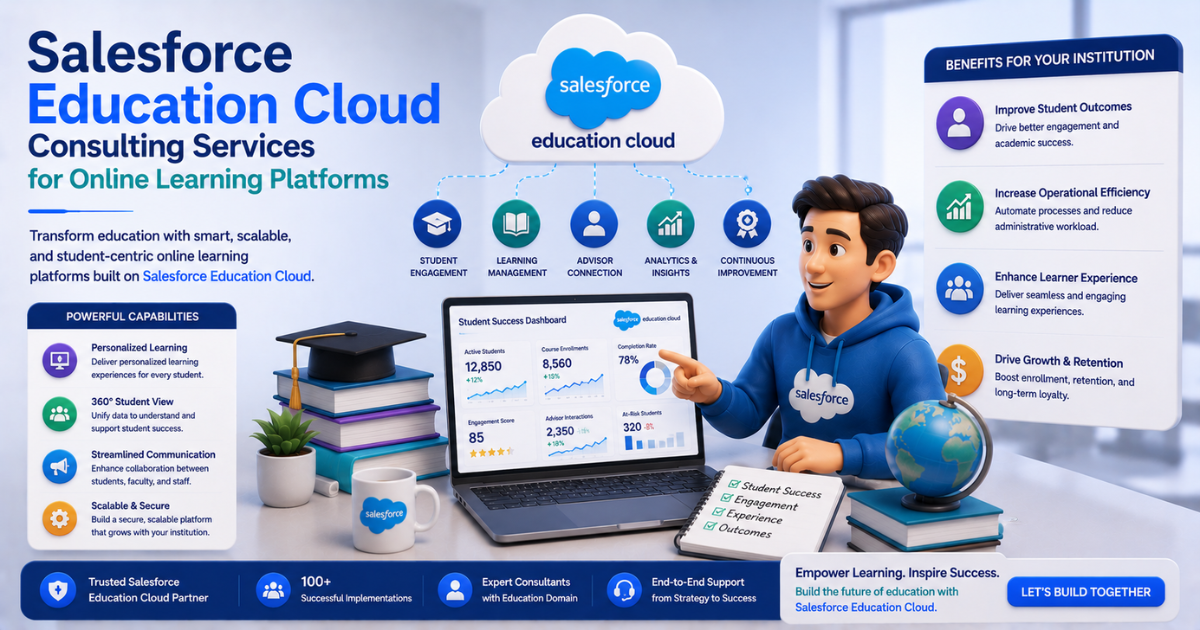
Online learning has moved from a backup option to the main path for many students. Platforms now need to manage enrollment, engagement, and student success at scale. Salesforce Education Cloud Consulting helps online learning providers build the technical backbone for this growth, connecting recruitment, learning data, and support into one system.
This looks at how Salesforce Education Cloud fits online learning platforms. It covers the technical setup, common challenges, and the value Salesforce Education Cloud Consulting Services bring to institutions and ed-tech companies.
Why Online Learning Platforms Need a Stronger Data Backbone
Online education has grown fast. Graduate enrollment in fully online study reached 45 percent in 2024-2025, and that share is expected to climb to 55 percent by 2030. At the undergraduate level, around a third of students take at least one distance course.
This growth brings a data problem. Each learner touches many systems: a website, a learning management system, payment tools, and support channels. Without a shared data layer, teams cannot see the full student picture.
The scale of activity makes this worse. The global e-learning market reached close to $204 billion in 2025, with projections near $280 billion by 2029. As more students enroll, platforms that rely on disconnected spreadsheets and siloed tools fall behind fast.
What Salesforce Education Cloud Actually Offers
Salesforce Education Cloud, built on the core Salesforce platform, gives online learning providers a single object model for students, programs, and engagement. It tracks a learner from first inquiry through enrollment, course progress, and alumni status.
Core capabilities include:
- A unified student profile across recruitment, learning, and support
- Application and admissions tracking with automated workflows
- Program and course management tied to engagement data
- Built-in analytics for retention and completion tracking
- Integration tools for connecting external LMS and payment systems
For online-only platforms, this matters more than for traditional schools, since every interaction happens through digital channels that generate data worth capturing.
Where Salesforce Education Cloud Consulting Adds Value
Buying the platform is the easy part. Configuring it correctly for an online learning model takes technical planning. This is where Salesforce Education Cloud Consulting becomes necessary, not optional.
1. Mapping the Student Journey Correctly
Online learners move through a different journey than campus-based students. A consultant maps each stage clearly:
- Lead capture from marketing campaigns and course landing pages
- Application and enrollment, often instant or near-instant online
- Onboarding into the learning environment
- Active learning, tracked through LMS integration
- Completion, certification, or degree conferral
- Alumni or continued learning engagement
Each stage needs its own data objects and automation rules. Skipping this mapping leads to a system that does not match how the platform actually operates.
2. Integrating the Learning Management System
Most online platforms run a separate LMS, such as Canvas, Moodle, or a custom-built system. Salesforce Education Cloud Consulting Services typically connect this LMS to Salesforce through API integration, so course progress, grades, and login activity flow into the student’s central record.
This integration work includes:
- Setting up secure API connections between LMS and Salesforce
- Mapping LMS fields like course completion and quiz scores to Salesforce objects
- Building near real-time sync for engagement data
- Handling data volume from large course catalogs without slowing performance
Without this connection, support teams cannot see whether a struggling student needs outreach until it is too late.
Common Technical Challenges in Online Learning Implementations
1. High Data Volume from Learner Activity
Online platforms generate constant activity data: logins, video views, quiz attempts, and forum posts. Video-based learning alone now makes up 42 percent of all digital learning content consumed, up sharply from recent years. Capturing all this in Salesforce without overloading the system takes careful object design and selective syncing, not raw data dumping.
2. Multiple Integration Points
A typical online learning platform connects to:
- A learning management system
- A payment or billing platform
- A marketing automation tool
- A video hosting or live class platform
- A communication tool like email or SMS
Each connection needs its own authentication, data mapping, and error handling. Salesforce Education Cloud Consulting teams build middleware or use native connectors to keep these integrations stable over time.
3. Personalization at Scale
Personalized support drives better outcomes. Online learning is shown to increase student and employee retention by as much as 50 percent compared to passive formats, but only when platforms can identify and act on individual learner needs in time.
Salesforce Education Cloud supports this through automation rules that flag at-risk learners, based on engagement drop-off or missed deadlines, and route them to advisors automatically.
4. AI Readiness and Data Quality
AI use in education has expanded fast. Globally, 86 percent of students now use AI tools as part of their learning, up from 66 percent just a year earlier. Many online platforms want to add AI-driven recommendations or chat support inside Salesforce, using Einstein or Agentforce features.
This only works with clean, structured data. A consultant typically audits data quality before activating any AI feature, since AI built on inconsistent records produces unreliable results.
Building Retention Tracking That Actually Works
Retention is the central metric for online learning platforms. Studies show online learners retain between 25 and 60 percent of material, compared to 8 to 10 percent in traditional lecture formats, but this advantage only holds when students stay engaged long enough to finish.
A solid retention tracking setup in Salesforce Education Cloud includes:
- Engagement scoring based on login frequency, content completion, and assessment scores.
- Automated alerts sent to advisors when scores drop below a set threshold.
- A case management workflow for advisor follow-up, tracked inside Salesforce.
- Dashboards showing retention trends by program, cohort, or instructor.
- A feedback loop so program teams can adjust course design based on data.
This structure turns retention from a guess into something a technical team can measure and improve directly.
Admissions and Enrollment Automation
Online programs often see enrollment spikes tied to marketing campaigns or application deadlines. Around half of institutions report that online program enrollment is growing faster than on-campus enrollment, and many say online classes now fill first.
Salesforce Education Cloud Consulting Services typically automate:
- Application form intake directly into Salesforce records
- Document collection and verification workflows
- Automated email and SMS follow-up for incomplete applications
- Scoring rules to prioritize high-intent applicants for advisor outreach
This automation matters most during peak enrollment windows, when manual processing cannot keep pace with application volume.
Supporting Multi-Channel Student Engagement
Students expect to reach support through more than one channel. A consulting team typically configures:
- Email integration tied to the central student record
- SMS or chat tools connected through Salesforce’s communication channels
- A self-service portal for FAQs and account management
- Case routing rules so the right team handles each inquiry type
This setup matters given how students discover and research programs today. Most prospective students start their research online, and a large share use mobile devices throughout the process, meaning support and outreach must work well on mobile, not just desktop.
A Practical Implementation Roadmap
Technical teams planning a Salesforce Education Cloud rollout for an online platform should follow a clear sequence:
- Map the full student journey from inquiry to alumni status.
- Audit existing data sources, including the LMS, payment system, and CRM.
- Design the Salesforce object model around online-specific stages.
- Build LMS integration first, since it feeds the most critical engagement data.
- Set up automation for admissions, retention alerts, and support routing.
- Test with a single program or cohort before a full platform rollout.
- Train admissions, advising, and support teams on their specific workflows.
- Review data quality before activating any AI-driven features.
This order reduces risk and lets teams catch integration issues before they affect the whole student base.
Measuring Success After Launch
A successful implementation should show measurable change within a few months. Useful metrics to track include:
- Time to respond to new applications
- Percentage of at-risk students contacted before dropping out
- Reduction in manual data entry across admissions and support teams
- Accuracy of the unified student profile compared to source systems
Online platforms applying structured engagement tracking often see stronger outcomes, in line with broader research showing interactive courses with active follow-up boost completion rates significantly compared to passive, unmonitored programs.
Conclusion
Online learning platforms run on data, and that data needs a central home to be useful. Salesforce Education Cloud Consulting gives technical teams a structured way to connect recruitment, learning activity, and student support into one system. Done well, it turns scattered engagement signals into a real retention strategy.
As the online learning market keeps growing past $200 billion globally, platforms that invest in strong Salesforce Education Cloud Consulting Services position themselves to manage that growth without losing visibility into the students they serve. The technical groundwork, from LMS integration to retention automation, decides whether a platform scales smoothly or struggles under its own growth.
