
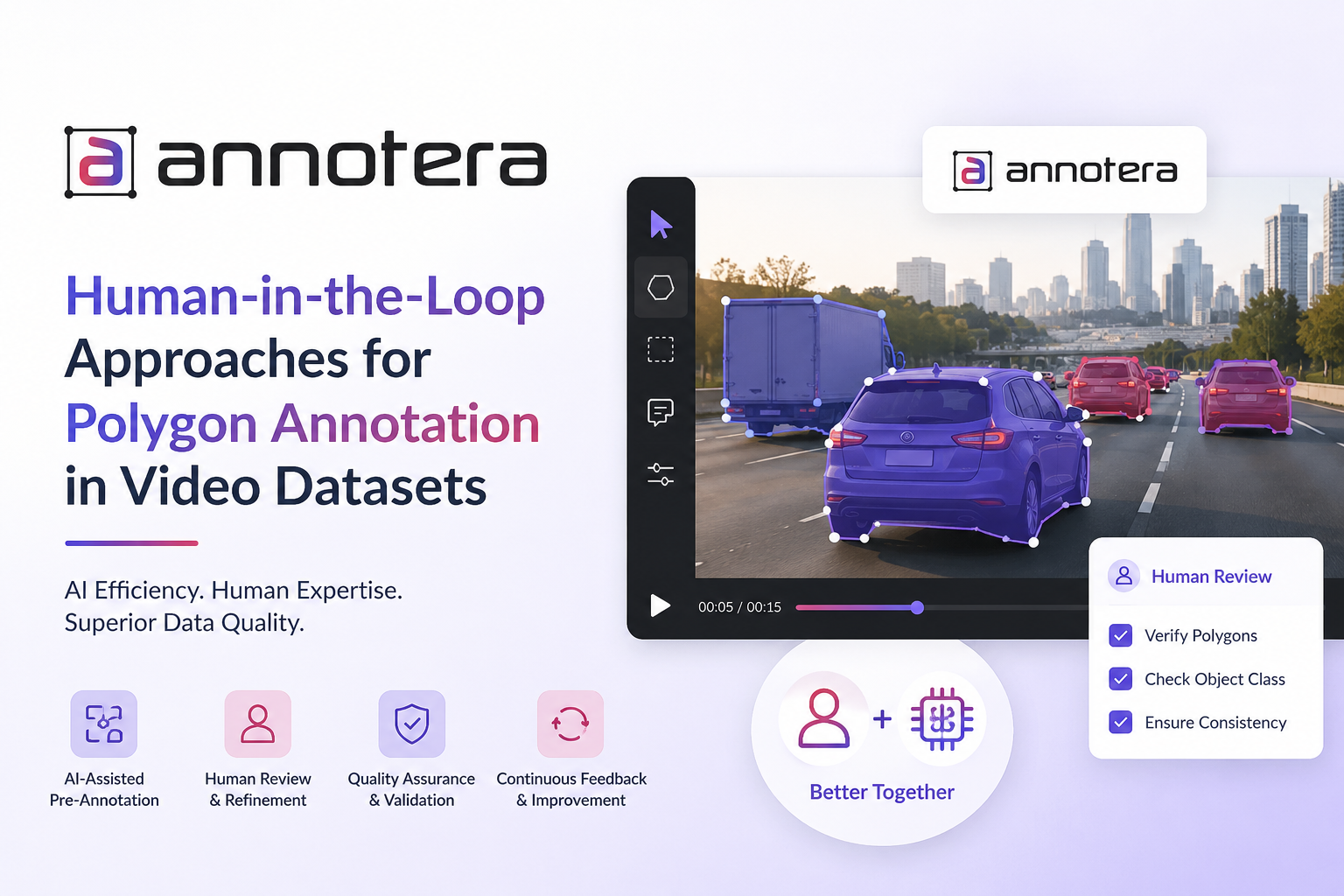
As computer vision applications become increasingly sophisticated, the demand for high-quality annotated video datasets continues to rise. Industries such as autonomous driving, surveillance, robotics, healthcare, retail analytics, and smart cities rely heavily on accurately labeled video data to train artificial intelligence models. Among various annotation techniques, polygon annotation has emerged as one of the most precise methods for outlining complex objects within video frames.
However, creating accurate polygon annotations across thousands of video frames is both time-consuming and resource-intensive. This challenge has led to the widespread adoption of Human-in-the-Loop (HITL) approaches, where human annotators collaborate with AI-assisted tools to improve annotation efficiency and quality.
As a leading data annotation company, Annotera helps organizations leverage Human-in-the-Loop methodologies to achieve scalable, accurate, and cost-effective video annotation solutions.
Understanding Polygon Annotation in Video Datasets
Polygon annotation involves drawing multi-point shapes around objects to capture their exact boundaries. Unlike bounding boxes, which often include unnecessary background pixels, polygons closely follow object contours, making them ideal for instance segmentation and object tracking applications.
In video datasets, polygon annotation becomes even more complex because annotators must maintain object consistency across consecutive frames while accounting for movement, occlusions, lighting changes, and object deformations.
Applications that commonly require polygon annotation include:
- Autonomous vehicle perception systems
- Pedestrian and vehicle tracking
- Medical video analysis
- Industrial inspection systems
- Sports analytics
- Drone and aerial surveillance
The precision required in these applications makes Human-in-the-Loop workflows particularly valuable.
What Is Human-in-the-Loop Annotation?
Human-in-the-Loop annotation is a collaborative process where machine learning algorithms generate initial annotations, and human experts review, correct, and refine those outputs.
Rather than replacing human annotators, AI serves as an assistant that accelerates repetitive tasks while humans ensure accuracy and contextual understanding.
A widely cited observation from AI pioneer Andrew Ng states:
“Data is food for AI.”
The quality of that data directly influences model performance. Human-in-the-Loop systems help ensure that training data remains accurate, diverse, and representative of real-world scenarios.
Why Human Oversight Remains Essential
Despite significant advances in automated annotation technologies, fully automated systems still struggle with many real-world video conditions.
Common challenges include:
Complex Object Shapes
Objects such as pedestrians, bicycles, animals, trees, and machinery often have irregular boundaries that automated systems fail to capture accurately.
Occlusion Handling
When objects overlap or become partially hidden, AI models frequently lose track of object boundaries. Human reviewers can identify these scenarios and correct annotations accordingly.
Fast Motion and Scene Changes
Video datasets often contain motion blur, sudden lighting shifts, and camera movement. Human annotators can interpret these challenging frames more effectively than automated systems.
Edge Cases
Rare events and unusual scenarios are crucial for model training but are often misclassified by automated tools. Human experts provide the contextual judgment needed to annotate such cases correctly.
The HITL Workflow for Polygon Annotation
A successful Human-in-the-Loop framework typically follows several stages.
1. Automated Pre-Annotation
AI-powered tools first identify objects and generate preliminary polygon boundaries. Modern computer vision models can automate a substantial portion of repetitive labeling tasks.
According to industry research from Gartner, organizations increasingly rely on AI-assisted data preparation workflows to improve machine learning deployment efficiency.
2. Human Review and Refinement
Expert annotators inspect generated polygons frame by frame, correcting:
- Boundary inaccuracies
- Missed objects
- Incorrect object classes
- Tracking inconsistencies
This review stage significantly improves annotation quality while maintaining scalability.
3. Quality Assurance Validation
Dedicated QA specialists perform secondary verification to ensure dataset consistency and compliance with project guidelines.
Many leading video annotation company providers implement multi-level quality control systems to achieve annotation accuracy exceeding 95%.
4. Feedback Loop for Model Improvement
Corrections made by human annotators are fed back into the annotation system. The AI model learns from these adjustments, improving future annotation performance.
This continuous learning cycle is the defining characteristic of Human-in-the-Loop systems.
Benefits of Human-in-the-Loop Polygon Annotation
Improved Annotation Accuracy
Human oversight dramatically reduces labeling errors that could negatively affect model training.
Research published by industry analysts consistently shows that high-quality labeled data can have a greater impact on model performance than incremental algorithm improvements.
Faster Dataset Creation
Instead of manually annotating every frame from scratch, annotators refine AI-generated labels, reducing project turnaround times.
Organizations that leverage video annotation outsourcing often report substantial productivity gains through AI-assisted annotation workflows.
Cost Efficiency
Human-in-the-Loop systems optimize labor utilization by allowing annotators to focus on verification and complex corrections rather than repetitive drawing tasks.
This makes large-scale video annotation outsourcing projects more economically viable.
Better Model Generalization
Human reviewers help identify edge cases, rare events, and ambiguous scenarios that automated systems may overlook.
These examples improve model robustness and real-world performance.
Scalability
As video datasets continue to grow in size, Human-in-the-Loop workflows enable annotation teams to scale operations without compromising quality.
Human-in-the-Loop in Autonomous Driving Datasets
One of the most demanding applications of polygon annotation is autonomous driving.
Self-driving systems must accurately identify:
- Vehicles
- Pedestrians
- Cyclists
- Road signs
- Lane markings
- Construction zones
According to McKinsey & Company, autonomous mobility technologies are expected to generate significant economic value over the coming decades, increasing the need for high-quality training datasets.
In these environments, even minor annotation errors can negatively impact model reliability. Human reviewers ensure that complex urban scenes are labeled correctly across thousands of video frames.
Choosing the Right Annotation Partner
Implementing effective Human-in-the-Loop workflows requires more than annotation software alone. Success depends on experienced annotators, robust quality control processes, and scalable infrastructure.
When evaluating a data annotation company, organizations should consider:
- Polygon annotation expertise
- Video dataset experience
- Multi-level QA processes
- Scalability capabilities
- Security and compliance standards
- AI-assisted annotation tools
A reliable video annotation company combines advanced automation with skilled human reviewers to deliver consistently high-quality datasets.
Conclusion
Human-in-the-Loop approaches represent the future of polygon annotation in video datasets. By combining the speed of AI with the judgment and contextual understanding of human experts, organizations can create highly accurate training datasets at scale.
As computer vision applications continue to expand across industries, the demand for precise polygon annotations will only increase. Businesses seeking reliable, scalable, and cost-effective solutions increasingly turn to data annotation outsourcing and video annotation outsourcing providers that employ Human-in-the-Loop methodologies.
At Annotera, we integrate advanced AI-assisted workflows with experienced annotation specialists to deliver high-quality polygon annotations that power next-generation computer vision systems. By leveraging Human-in-the-Loop approaches, we help organizations accelerate AI development while maintaining the accuracy and consistency that modern machine learning models require.
