
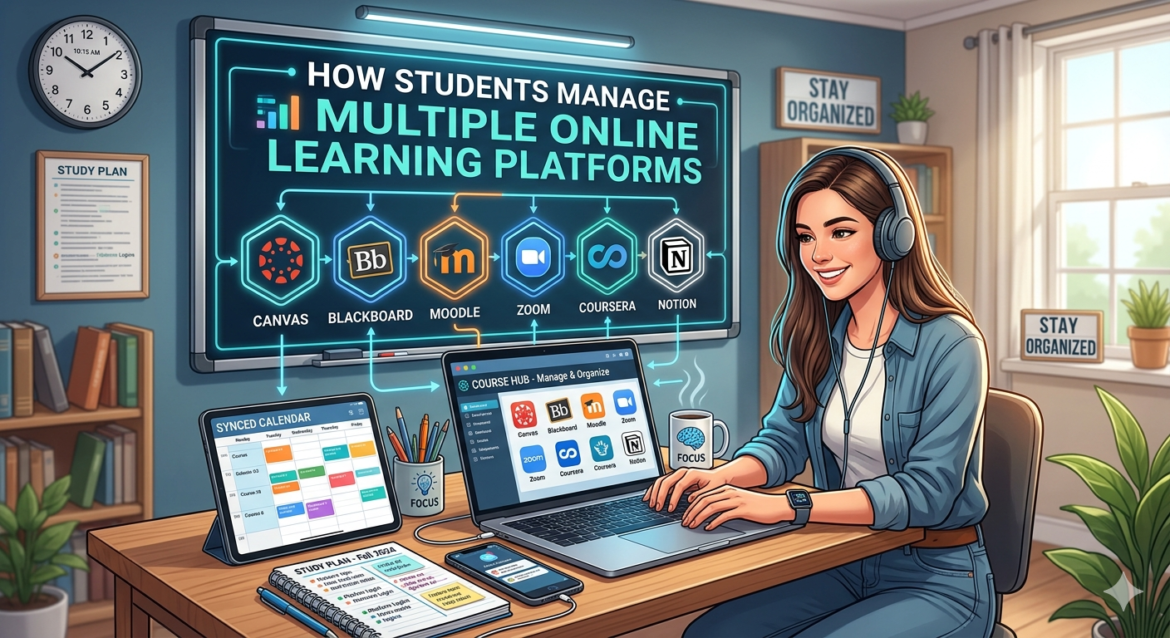
Online learning has provided students with the opportunity to use courses through various platforms simultaneously. Certification programs and even full college degrees in place, today students find themselves often juggling between different systems such as Study.com, Penn Foster, Coursera, and university portals, among others. Though this flexibility is empowering, it also brings about one of the unique challenges, i.e., managing multiple platforms and not losing track of deadlines, content, and progress. Every platform is accompanied by its structure, system of login, course structure, and assessment style that can easily get overwhelming.
Learning course material is no longer a challenge to students; they are also faced with digital environments that require organization and self-discipline. As Kizilcec et al. (2017) have identified, students in online settings tend to struggle with issues such as self-regulation and persistence, particularly when they have to deal with multiple courses. This emphasizes that the success in online education is not only based on intelligence but also on strategy. Knowing how students can successfully cope with these platforms can assist others in being productive, reducing stress, and making the best of their online learning experience.
The First Rush of Dealing with a Multitude of Platforms
As students are initially introduced to a variety of online courses, the experience may seem hectic. The different platforms have various dashboards, navigation styles, and expectations. Alternating between them daily may confuse and result in missed deadlines.
The major problem in this phase is not a problem in academics but rather a problem of organizational overload. The lack of a system in place makes even simple tasks seem unmanageable.
Some students even go on the lookout for shortcuts, such as Pay someone to take my STUDY.COM class when they feel that they cannot cope with everything at the same time. Such a response is indicative of how daunting bad management can be, not incompetence.
The development of a Centralized Study System
Among the most convenient solutions to multi-platform usage, the option of developing a centralized system to monitor all things appears. They do not use personal dashboards but planners, digital calendars, or task management applications to arrange the deadlines and studying sessions.
This would centralize all tasks in a central location, and there would be no need to keep nonstop switching between platforms just to update. It also assists the students in visualizing their workload and planning.
A centralized system will perform the roles of a control panel of the learning process, as you will find it easier to be on top of things and not have to run at the last moment.
Different Platform Time Blocking
To handle several courses, one needs to plan their time. Students tend to separate their day into blocks where certain time slots are allocated to each platform.
As an illustration, the morning could be dedicated to a single course, whereas the evenings could be devoted to another. This will avoid overlapping, and the students will be able to concentrate on a single subject at a time.
Mental exhaustion is also lessened by time blocking. Moving in and out of various platforms and various topics can be exhausting, whereas scheduled time/space gives the impression of being routine and stable.
How to make sure you avoid burnout and remain consistent
When students attempt to do everything simultaneously, they may experience burnout due to the inability to focus on all aspects simultaneously. Online learning is more productive through consistency as opposed to intensity.
Other overloaded students can resort to such measures as Take my online Penn Foster class when they are tired of the incessant coursework. Nevertheless, a more legitimate fix would be to pace, as opposed to outsourcing (BAW, 2022).
Regular breaks, realistic goals, and some rest time are key to ensuring long-term productivity. The middle ground will ensure that the student will not get exhausted as a result of being motivated.
Platform-specific Learning Styles
The teaching style varies on each online platform. Others use video lectures, others use reading materials, and others are overdependent on quizzes and assessments.
Students who excel in various platforms are those who take the time to comprehend the differences. They do not follow the same study method in all places, but depend on the platform and adapt to the approach.
An example is that a quiz-heavy course might require a lot of practice, and a theory-based course may need a lot of reading and taking notes. This flexibility enhances effectiveness and understanding.
Micro-Learning to Use in Staying on Track
Micro-learning is an effective learning technique among students who can handle various platforms. They divide the learning into small, intense pieces as opposed to long learning sessions.
This approach can be applied particularly to busy schedules. Even 20-30 minutes of concentrated study can assist in finishing a lesson, revising notes, or even taking a quiz.
Micro-learning helps to keep the student actively engaged but not too busy. It also ensures it is easier to make study time a part of everyday routines, which ensures that consistent progress is made on all platforms.
Capitalizing on the use of Notifications and Reminders
The online platforms usually give a notification on deadlines, updates, and assignments. Although it may be beneficial, excessive alerts may be distracting.
When successful students receive notifications, they can easily set their notification preferences to only receive critical updates. They also make personal alerts on important deadlines to ensure that they do not entirely depend on the platform alerts.
This managed methodology lowers the flooding of information and aids in staying on track with the actual learning process as opposed to the unceasing alerts.
Developing Self-Discipline in a Digital Age
The work of managing numerous online platforms is based on self-discipline. Having no schedules and without physical classrooms, students have to engage in self-progress.
This involves regular logging in, doing tasks on schedule, and remaining dedicated despite the lack of motivation. Discipline is a long process to develop, but with the habit, it becomes easy to develop discipline.
You can start your studying sessions at the same time every day, or you can set yourself goals that you need to achieve in a day or two.
Conclusion
Managing various online learning sites is not only about the handling of coursework, but also about building organization, discipline, and flexibility. Through organizing systems, adopting various effective time management strategies, and having a balanced approach, students can easily complete various courses without necessarily feeling overwhelmed. Online learning can be easily manageable as well as very rewarding with the right strategies.
