
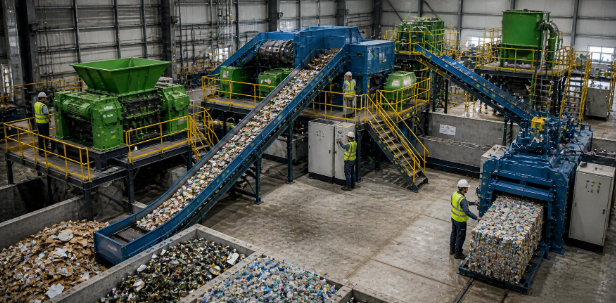
Efficient waste management has become a global priority as industries and communities strive to reduce landfill use and recover valuable resources. Modern recycling systems rely heavily on advanced machinery to handle large volumes of mixed waste. At the centre of these systems is recycling sorting equipment, which plays a critical role in separating materials accurately and efficiently. By automating the sorting process, these systems help improve recovery rates, reduce manual labour, and enhance the overall sustainability of waste management operations.
What Is Recycling Sorting Equipment?
Recycling sorting equipment refers to a range of machines designed to separate different types of waste materials based on characteristics such as size, weight, shape, and composition. These systems are commonly used in recycling facilities to process mixed waste streams, including plastics, metals, paper, and organic materials.
The main goal of such equipment is to ensure that recyclable materials are recovered effectively while minimising contamination. This improves the quality of recycled products and increases the efficiency of downstream processes.
Key Components in a Recycling System
Modern recycling systems use multiple types of equipment working together to achieve accurate sorting. Some of the most common components include:
- Screening machines for size-based separation
- Magnetic separators for extracting metals
- Air classifiers for separating lightweight materials
- Optical sorters for identifying specific materials
Among these, screening machines are often the first step in the sorting process, preparing materials for further separation stages.
How Recycling Sorting Equipment Enhances Efficiency?
The use of recycling sorting equipment significantly improves the efficiency of waste management operations in several ways:
Faster Processing of Waste
Automated systems can handle large volumes of waste much faster than manual sorting. Screens, for example, can process tons of material per hour, making them ideal for high-capacity facilities.
Improved Material Recovery
By separating materials accurately, these systems increase the amount of recyclable material that can be recovered. This reduces waste sent to landfills and improves resource utilisation.
Reduced Labor Costs
Automation reduces the need for manual sorting, lowering labour costs and minimising human error. Workers can instead focus on quality control and system monitoring.
Consistent Output Quality
Machines provide uniform and reliable sorting results, ensuring that recycled materials meet industry standards for reuse.
Applications Across Different Industries
Recycling sorting equipment is used across a wide range of industries, including:
- Municipal waste management for household waste processing
- Construction and demolition for separating debris materials
- Industrial recycling for processing manufacturing waste
- E-waste recycling for recovering valuable metals and components
In all these applications, sorting machines play a key role in ensuring efficient material separation.
Advantages of Modern Sorting Technology
Modern recycling systems are designed to handle complex waste streams with high efficiency. Key advantages include:
- High throughput and scalability
- Ability to process diverse materials
- Reduced environmental impact
- Integration with advanced technologies like automation and data tracking
These benefits make advanced sorting systems essential for sustainable waste management.
Future of Recycling Equipment
As waste volumes continue to grow, the demand for advanced sorting solutions is increasing. Innovations in automation, artificial intelligence, and machine learning are expected to further enhance the capabilities of recycling sorting equipment.
Future systems will likely focus on higher accuracy, faster processing, and improved adaptability to different waste types. This will help industries meet stricter environmental regulations and sustainability goals.
Conclusion
Efficient waste management depends on the ability to separate materials accurately and consistently. Vibrating screen technology remains a core component of modern recycling systems, enabling precise material separation and supporting the overall effectiveness of waste processing operations.
