
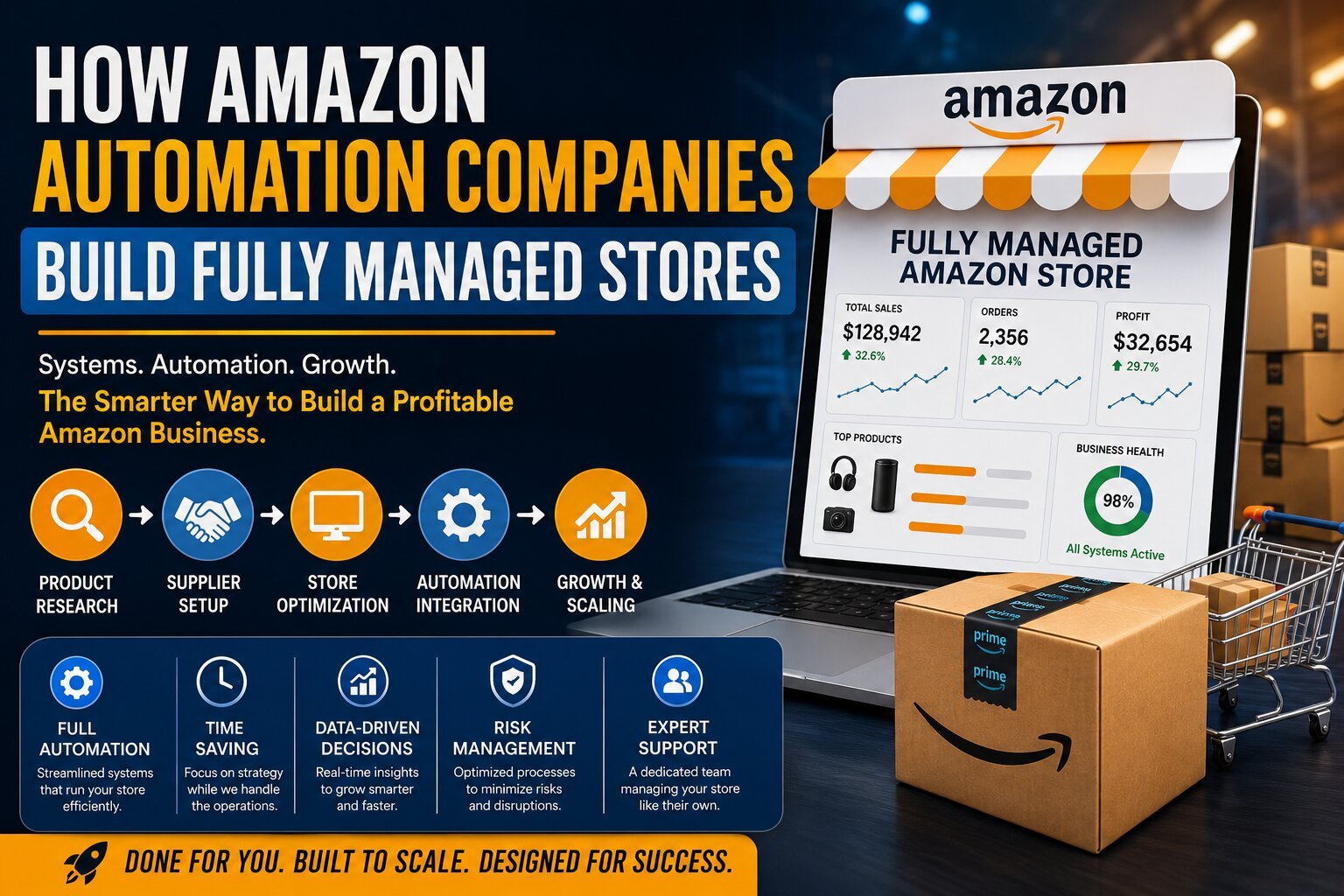
In the modern eCommerce world, selling on Amazon is no longer just about listing products and waiting for sales to come in. The platform has evolved into a highly competitive ecosystem where success depends on strategy, systems, and execution speed.
As more entrepreneurs enter the marketplace, many are looking for structured ways to simplify operations and scale without being overwhelmed by daily tasks. This is where the role of an amazon automation company becomes increasingly important.
These companies specialize in building systems that help sellers run fully managed stores, often referred to as a done for you amazon store, where most of the operational workload is handled through structured workflows and management systems.
But how exactly do these companies build such stores? And what makes this model attractive for modern sellers trying to scale faster?
Let’s break it down in a detailed, practical, and easy-to-understand way.
Understanding the Concept of a Fully Managed Amazon Store
A fully managed Amazon store is a structured business setup where most of the operational tasks are handled by systems or service providers instead of the seller manually managing everything.
This is often associated with the concept of a done for you amazon store, where key business processes are already built and managed through a defined system.
These processes usually include:
- Product research and selection
- Supplier coordination
- Inventory tracking
- Order processing
- Customer communication
- Performance monitoring
- Pricing management
The goal is not to remove the seller from the business but to reduce operational pressure so they can focus on growth and strategy.
An amazon automation company plays a central role in designing and maintaining these systems.
Why Sellers Are Moving Toward Automation Models
The rise of automation in Amazon selling is not random. It is driven by real challenges sellers face in today’s marketplace.
1. Increasing Competition
More sellers are entering Amazon every year, making it harder to stand out using manual methods alone.
2. Time Constraints
Running a store involves multiple daily tasks that consume significant time.
3. Operational Complexity
As stores grow, managing inventory, orders, and customers becomes more complex.
4. Scaling Challenges
Manual systems often break when order volume increases beyond a certain point.
Because of these challenges, many entrepreneurs explore the done for you amazon store model to simplify operations.
How an Amazon Automation Company Builds a Fully Managed Store
To understand the value of automation, it is important to see how the system is actually built.
An amazon automation company typically follows a structured process to design and operate a fully managed store.
Step 1: Market and Product Research
Every successful Amazon store begins with product selection.
Automation companies often analyze:
- Market demand trends
- Competition levels
- Profit margins
- Supplier availability
- Customer demand patterns
The goal is to identify products that have long-term potential rather than short-term hype.
In a done for you amazon store, this step is critical because product selection directly affects profitability and scalability.
Step 2: Supplier and Inventory Setup
Once products are selected, the next step is building a reliable supply chain.
This includes:
- Finding verified suppliers
- Negotiating pricing structures
- Setting up inventory systems
- Establishing restock workflows
A strong supply chain ensures that the store can handle growth without disruptions.
An amazon automation company often uses established supplier networks to streamline this process.
Step 3: Store Setup and Optimization
After product and supplier setup, the actual Amazon store is structured.
This includes:
- Creating product listings
- Writing optimized descriptions
- Setting pricing strategies
- Uploading product images
- Setting up backend configurations
The goal is to ensure that the done for you amazon store is fully optimized for visibility and conversions.
Step 4: Automation System Integration
This is where the concept of automation becomes central.
Systems are implemented to handle:
- Order processing workflows
- Inventory synchronization
- Pricing updates
- Customer messaging
- Performance tracking
An amazon automation company integrates tools that reduce manual intervention and ensure smooth operations.
This is one of the key reasons sellers adopt this model—they no longer need to handle every repetitive task manually.
Step 5: Order Management System
Order processing is one of the most critical parts of Amazon operations.
In a manual system, each order requires attention. In a managed system, automation handles:
- Order confirmation
- Supplier notification
- Tracking updates
- Delivery status monitoring
This ensures faster processing and fewer errors.
A done for you amazon store relies heavily on this structured order flow.
Step 6: Customer Communication Handling
Customer experience plays a major role in Amazon success.
Automation companies set up systems that manage:
- Order updates
- Shipping notifications
- Common customer inquiries
- Feedback requests
This reduces response time and improves customer satisfaction.
An amazon automation company ensures that communication remains consistent even as order volume increases.
Step 7: Inventory Monitoring and Control
Inventory management is one of the biggest challenges in scaling eCommerce businesses.
Automation systems help by:
- Tracking stock levels in real time
- Preventing overselling
- Triggering restock alerts
- Syncing inventory across systems
A done for you amazon store depends on accurate inventory control to avoid disruptions in sales flow.
Step 8: Performance Tracking and Reporting
Data is essential for growth.
Automation companies provide dashboards that track:
- Sales performance
- Product performance
- Profit margins
- Customer behavior
- Market trends
This allows sellers to make informed decisions instead of guessing.
An amazon automation company uses this data to continuously optimize store performance.
Step 9: Pricing Strategy Management
Pricing plays a major role in competitiveness.
Automation helps by:
- Monitoring competitor pricing
- Adjusting prices dynamically
- Maintaining profit margins
- Identifying pricing opportunities
This ensures the done for you amazon store remains competitive in the marketplace.
Step 10: Scaling Strategy Implementation
Once the store is stable, the focus shifts to scaling.
This includes:
- Expanding product catalog
- Increasing ad performance
- Optimizing conversion rates
- Improving supply chain efficiency
An amazon automation company ensures the system is capable of handling increased demand without breaking operations.
Benefits of a Fully Managed Amazon Store
Now that we understand how it is built, let’s explore the benefits.
1. Reduced Operational Stress
Sellers do not need to manage every small task daily.
2. Faster Scaling Potential
Systems allow businesses to handle more orders efficiently.
3. Time Efficiency
Sellers can focus on strategy instead of repetitive work.
4. Better Organization
Everything runs through structured workflows.
5. Improved Decision Making
Data-driven insights improve business planning.
These advantages make the done for you amazon store model attractive for modern entrepreneurs.
Common Misunderstandings About Amazon Automation
There are several misconceptions about this business model.
1. It is completely hands-off
In reality, sellers still need to make strategic decisions.
2. It guarantees success
No system guarantees profit. Execution still matters.
3. It replaces the seller
Automation supports the seller—it does not replace them.
Understanding this helps set realistic expectations.
Challenges in Automation-Based Stores
Even with systems in place, there are challenges such as:
- Market fluctuations
- Supplier delays
- Policy changes
- Competition shifts
An amazon automation company helps manage these challenges, but adaptability is still required from the seller.
The Future of Amazon Automation
The future of this model is expected to evolve further with:
- AI-driven product selection
- Predictive inventory systems
- Automated pricing intelligence
- Advanced customer behavior analytics
- Smarter supply chain automation
As technology improves, the done for you amazon store model will become more efficient and widely adopted.
Final Thoughts
The rise of automation in Amazon selling reflects a major shift in how eCommerce businesses are built and managed.
An amazon automation company helps create structured, scalable systems that allow sellers to operate more efficiently.
A done for you amazon store provides a streamlined approach to launching and managing an Amazon business without being overwhelmed by daily operations.
Together, they form a modern framework for building scalable, data-driven, and efficient Amazon businesses in a highly competitive marketplace.
For entrepreneurs looking to grow faster while reducing operational pressure, this model represents a significant evolution in how online selling works today.
