
If you searched for Cloud Skills US Data Science Jobs, you’re asking one of the most important career questions for 2026.
Only a few years ago, employers mainly looked for candidates who understood Python, SQL, statistics, and machine learning. Those skills are still valuable, but they no longer tell the whole story. Today’s companies expect graduates to understand how machine learning systems operate in real business environments. That means working with cloud platforms, deployment pipelines, monitoring tools, and production-ready infrastructure.
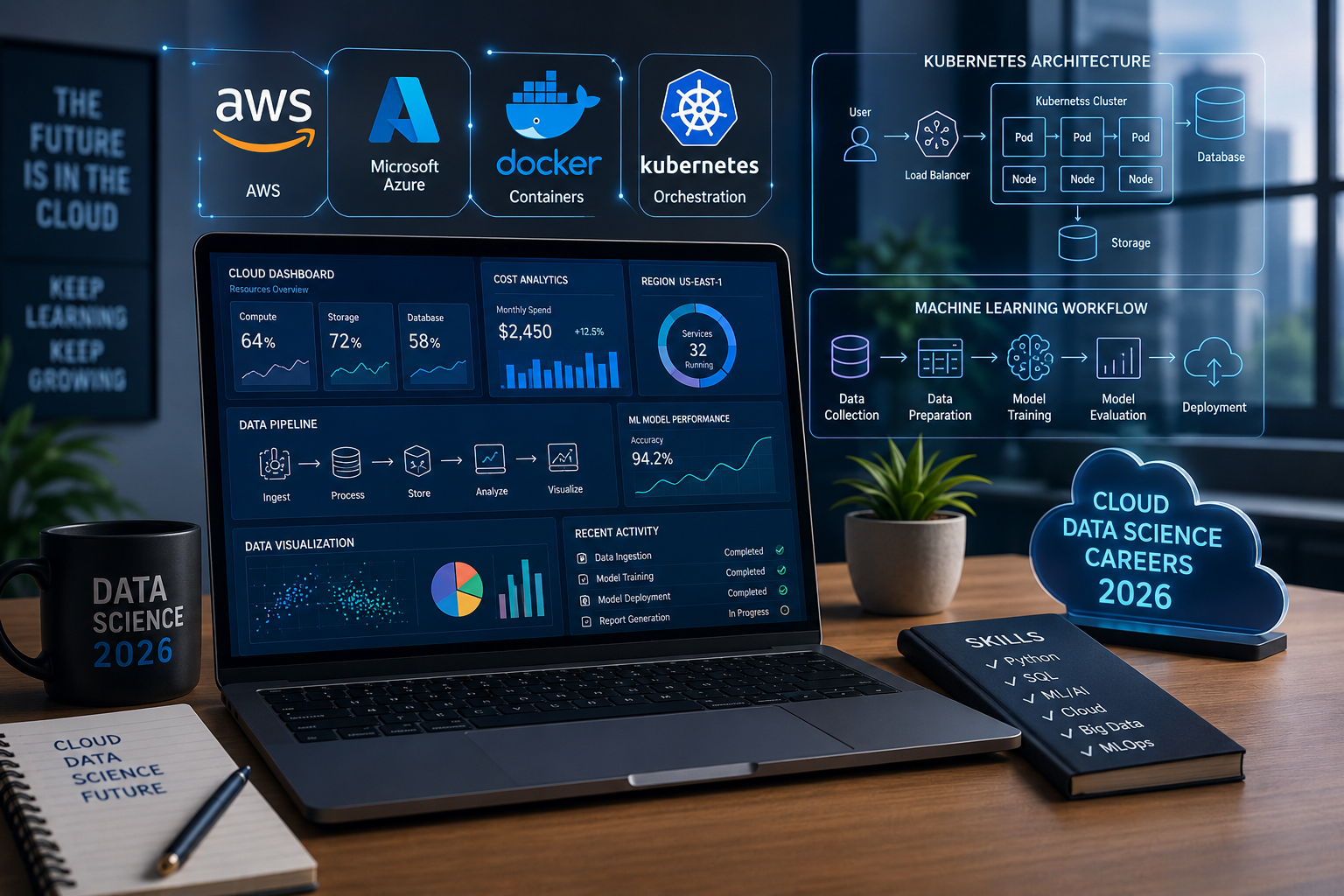
Recent research into US hiring trends shows that cloud computing has moved from an optional skill to a core hiring requirement for many data science and machine learning positions. Employers increasingly expect candidates to understand AWS, Microsoft Azure, Docker, Kubernetes, and modern MLOps practices alongside traditional analytics skills. Students who invest in these areas while studying often enter the job market with a significant advantage over candidates whose experience ends with notebook-based projects.
This shift is changing how universities teach data science, how recruiters evaluate applicants, and how graduates prepare for interviews. Understanding these changes now can help you build skills that remain valuable long after graduation.
Why Cloud Skills Matter More Than Ever
Artificial intelligence is no longer confined to research laboratories or university assignments. Businesses rely on machine learning to support daily operations, improve customer experiences, reduce costs, and automate repetitive work.
Retail companies recommend products in real time.
Banks detect fraudulent transactions within seconds.
Hospitals assist doctors using predictive analytics.
Manufacturing businesses forecast equipment failures before they happen.
Every one of these systems depends on cloud infrastructure.
Machine learning models rarely operate on personal computers after development. Instead, organizations deploy them to cloud platforms capable of handling thousands or even millions of requests every day. These platforms provide storage, computing resources, networking, databases, security, and monitoring services that keep AI applications running around the clock.
This is why recruiters increasingly ask candidates about cloud experience during technical interviews.
Knowing how to build a prediction model is important. Knowing how to deploy, update, monitor, and maintain that model makes you far more valuable.
How Modern Data Science Roles Have Changed
The role of a data scientist has expanded dramatically.
Earlier generations of data professionals focused primarily on analyzing historical information and producing reports. Modern organizations expect much more.
Today’s data scientists often work alongside software engineers, DevOps teams, product managers, cybersecurity specialists, and business analysts. They contribute throughout the complete lifecycle of an artificial intelligence application.
That lifecycle includes collecting data, cleaning information, training machine learning models, deploying applications, monitoring predictions, updating models when performance changes, and communicating results to decision-makers.
Because responsibilities continue expanding, employers increasingly hire professionals with broader technical skills rather than specialists who only understand statistical modeling.
Research into US job postings supports this trend. Cloud platforms such as Microsoft Azure and AWS appear in a large percentage of data engineering and machine learning roles, while production experience is becoming increasingly important for candidates seeking higher-paying positions.
Python Is Still Essential—But It Is No Longer Enough
Python remains the most widely used programming language in data science.
Libraries such as NumPy, Pandas, Scikit-learn, TensorFlow, and PyTorch continue powering everything from exploratory analysis to advanced deep learning systems.
SQL remains equally important because organizations continue storing business information inside relational databases and cloud data warehouses.
These technologies form the foundation of almost every analytics role.
However, they are now considered baseline expectations.
Think of learning Python like earning a driver’s licence.
It proves you understand the basics.
Landing a professional racing job requires much more.
Employers want candidates who understand version control using Git, cloud deployment, APIs, Docker containers, infrastructure automation, and model monitoring.
These additional skills demonstrate that you can build systems people actually use rather than experiments that remain inside development notebooks.
For students preparing for data science careers, this shift represents an opportunity rather than a challenge. Learning cloud computing while studying helps bridge the gap between classroom assignments and real business environments.
AWS and Azure Are Becoming Career Accelerators
Among all cloud providers, AWS and Microsoft Azure dominate discussions around machine learning careers.
AWS offers services covering storage, virtual machines, databases, serverless computing, artificial intelligence, analytics, networking, and security. Microsoft Azure provides similar capabilities while integrating closely with enterprise software used by many large organizations.
Students often ask which platform they should learn first.
The answer is simple.
Instead, they look for people who understand cloud architecture, deployment workflows, storage systems, security, networking, and scalability.
Those principles remain valuable regardless of the specific platform used.
Cloud certifications can certainly strengthen a résumé. However, employers consistently place greater value on candidates who have actually deployed applications using cloud infrastructure.
A working portfolio demonstrates practical ability in ways that certificates alone cannot.
What Is MLOps and Why Does It Matter?
One of the biggest differences between university coursework and professional data science is something called MLOps.
MLOps, short for Machine Learning Operations, combines machine learning, software engineering, DevOps, and cloud computing into one workflow. Instead of stopping after a model achieves good accuracy, MLOps focuses on keeping that model reliable after deployment.
Imagine an online shopping website that recommends products to millions of users every day. Customer preferences change constantly. New products are added every hour. If the recommendation model never receives updates, its predictions gradually become less useful.
MLOps solves this challenge.
Engineers build automated pipelines that retrain models, validate new versions, deploy updates safely, monitor prediction quality, and detect performance issues before customers notice them.
This approach has become standard practice across technology companies because machine learning systems require continuous maintenance rather than one-time development.
Research into current hiring trends shows that employers increasingly advertise roles specifically focused on Production Machine Learning and MLOps Engineering. Companies are investing heavily in professionals who understand deployment, monitoring, cloud infrastructure, and automation—not just model development.
Docker and Kubernetes: Two Skills Worth Learning
Students often hear about Docker and Kubernetes but hesitate to learn them because they sound complicated.
The good news is that you don’t need to become an expert immediately.
Docker packages applications together with all the software they need. Instead of worrying whether your machine learning project works differently on another computer, Docker ensures the application behaves consistently wherever it runs.
Think of Docker as shipping your project inside a sealed container. Everything travels together, reducing unexpected compatibility problems.
Kubernetes works one level above Docker.
When organizations deploy hundreds or thousands of containers, Kubernetes automates deployment, scaling, recovery, and maintenance. If one server fails, Kubernetes automatically moves workloads elsewhere, helping applications remain available without interruption.
Many enterprise AI systems rely on these technologies because they improve reliability while reducing manual work.
Learning their fundamentals gives graduates an advantage during technical interviews, especially when applying for cloud engineering, machine learning engineering, or advanced data science positions.
Build a Portfolio That Recruiters Want to See
Certificates are helpful.
Projects are better.
Employers consistently prefer candidates who demonstrate practical experience solving realistic business problems.
Instead of completing twenty unrelated tutorials, build three or four complete projects that showcase different aspects of modern data science.
For example, you might create a customer churn prediction system for a subscription business. Train the model using Python, package it with Docker, deploy it to AWS, expose predictions through a FastAPI application, and monitor performance using cloud dashboards.
Another excellent project could forecast retail sales using historical business data while automatically retraining the model each month as new information becomes available.
Projects like these demonstrate technical depth, engineering skills, cloud knowledge, and business thinking all at once.
Every project should include documentation explaining the objective, technologies used, deployment process, architecture, challenges, and future improvements.
Recruiters frequently review GitHub repositories before scheduling interviews. Well-documented projects help candidates stand out immediately.
Common Mistakes Students Should Avoid
One of the biggest mistakes beginners make is chasing every new technology they discover.
Artificial intelligence evolves rapidly. Every month introduces another framework, deployment tool, or automation platform.
Trying to learn everything usually leads to confusion.
Instead, focus on mastering core concepts first.
Programming.
Databases.
Cloud deployment.
Containers.
Version control.
Monitoring.
These skills remain valuable regardless of changing technology trends.
Another common mistake involves collecting certificates without applying the knowledge.
Employers appreciate certifications, but practical experience carries far greater weight.
A candidate who has deployed three production-style projects usually attracts more attention than someone with multiple certificates but no portfolio.
Students should also avoid working entirely alone when facing difficult cloud assignments.
Cloud infrastructure introduces networking, security, configuration management, and deployment concepts that many university courses cover only briefly.
When assignments become overwhelming, getting help from experienced professionals can accelerate learning while reducing unnecessary frustration.
If you’re working through machine learning deployment, cloud computing, or MLOps coursework, ExpertsMinds’ Machine Learning Assignment Help offers access to subject experts who understand both academic expectations and real-world cloud engineering practices
Learning from experienced practitioners often helps students complete stronger projects while building practical skills employers actually value.
Cloud Skills Can Lead to Higher Salaries
One reason cloud computing has become so popular is its impact on career opportunities.
Organizations increasingly rely on cloud infrastructure to manage artificial intelligence systems, making experienced professionals difficult to replace.
As demand grows, salaries often reflect that shortage.
Machine Learning Engineers, Cloud Data Engineers, AI Platform Engineers, and MLOps Engineers frequently earn higher salaries than traditional analytics roles because they combine software engineering with machine learning expertise.
Rather than specializing only in predictive modeling, these professionals understand deployment, scalability, infrastructure, automation, and long-term maintenance.
For graduates entering the workforce, adding cloud computing skills can significantly improve both employability and long-term earning potential.
More importantly, these skills remain valuable across industries.
Healthcare.
Finance.
Manufacturing.
Retail.
Cybersecurity.
Logistics.
Almost every sector now depends on cloud-based data platforms.
Learning cloud technologies today prepares students for opportunities across all of them.
The Future of Data Science Careers
The future of data science is becoming increasingly interdisciplinary.
Tomorrow’s professionals will not simply analyze information or train machine learning models.
They will design scalable systems.
Deploy applications.
Maintain cloud infrastructure.
Automate workflows.
Monitor AI performance.
Communicate technical insights to business leaders.
This evolution creates exciting opportunities for students willing to expand their skill sets beyond traditional analytics.
Fortunately, building these abilities does not require years of professional experience.
By learning cloud platforms, experimenting with Docker, understanding MLOps, creating production-ready portfolio projects, and continuously improving technical knowledge, students can graduate with skills that align closely with what employers already expect.
Cloud computing is no longer an optional addition to a data science career.
It has become one of its strongest foundations.
Final Thoughts
The definition of a successful data scientist is changing.
Strong programming skills remain essential, but employers now expect graduates to think beyond notebooks and algorithms. They want professionals who understand how artificial intelligence systems operate inside real businesses.
Cloud computing, MLOps, Docker, Kubernetes, Git, APIs, automation, and deployment are no longer specialist skills reserved for experienced engineers. They are rapidly becoming part of the standard toolkit for modern data scientists.
The encouraging news is that students have never had better access to these technologies. Free cloud tiers, open-source tools, online documentation, and community learning resources make it possible to build professional-level skills while still completing a degree.
Rather than trying to learn every framework available, focus on developing complete solutions.
Learn Python thoroughly.
Master SQL.
Build cloud projects.
Deploy machine learning models.
Monitor their performance.
Document your work.
Continue improving with every project.
When coursework becomes challenging or you need guidance with cloud deployment, machine learning pipelines, or MLOps concepts, ExpertsMind‘ Machine Learning Assignment Help can provide academic support from experienced subject experts while helping you strengthen practical knowledge for future careers.
The students who succeed in 2026 will not simply know how to train a machine learning model.
They will know how to build systems that organizations can trust, scale, maintain, and improve.
That combination of analytical thinking and cloud engineering expertise is exactly what today’s employers are searching for.
