
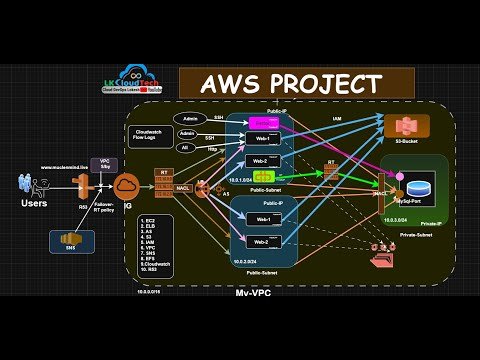
AWS is becoming one of the most widely used platforms for deploying DevOps techniques as businesses use cloud technology more often to speed up software delivery and boost operational effectiveness. Combining the power of cloud computing with automation, continuous integration, and continuous delivery enables businesses to deploy applications faster while maintaining reliability and scalability.
A real-world AWS DevOps project architecture involves integrating multiple services and tools to automate software development, testing, deployment, monitoring, and infrastructure management. By creating a well-structured architecture, organizations can reduce manual effort, improve collaboration between development and operations teams, and deliver high-quality applications consistently. As the demand for cloud and DevOps expertise continues to grow, many aspiring professionals enroll in AWS Training in Chennai to gain practical knowledge of cloud infrastructure, automation tools, and deployment strategies used in modern organizations.
Understanding how to design and implement an AWS DevOps architecture is essential for cloud engineers, DevOps professionals, and software developers. This blog explores the key components, best practices, and steps involved in building a real-world AWS DevOps project architecture.
Understanding AWS DevOps Architecture
AWS DevOps architecture combines cloud infrastructure, automation tools, and development workflows to streamline the software development lifecycle. The primary goal is to automate repetitive processes and enable rapid, reliable application delivery.
A typical AWS DevOps architecture includes source code management, Continuous Integration (CI), Continuous Delivery (CD), Infrastructure as Code (IaC), monitoring and logging, security and compliance, and containerization and orchestration. To ensure effective software deployment and administration, each component is essential.
Define Project Requirements
Before designing the architecture, it is important to identify project requirements and business objectives. Understanding application needs helps determine the appropriate AWS services and deployment strategies.
Key considerations include application type and complexity, expected traffic volume, scalability requirements, security requirements, compliance standards, deployment frequency, and disaster recovery needs. Clearly defined requirements help create an architecture that supports both current and future business goals.
Source Code Management
The foundation of any DevOps project begins with effective source code management. Version control systems enable teams to collaborate efficiently while maintaining code quality and traceability.
For storing source code, AWS CodeCommit offers a scalable and safe Git-based repository. It supports version control, access management, and seamless integration with other AWS DevOps services. Development teams should implement branching strategies, code reviews, and pull request workflows to improve collaboration and maintain code integrity. Proper source code management ensures smooth coordination between development teams and deployment pipelines.
Implement Continuous Integration
Every time a change is committed, the process of creating and testing code is automated thanks to continuous integration. AWS CodeBuild automatically compiles source code, runs tests, and generates deployment artifacts without requiring dedicated build servers.
Integrating unit testing, integration testing, and security testing into the CI pipeline helps identify issues early in the development process. Continuous integration also provides developers with immediate feedback, enabling quicker issue resolution and improved software quality. A robust CI pipeline reduces deployment risks and accelerates software delivery.
Build a Continuous Delivery Pipeline
Continuous Delivery ensures that application updates can be deployed quickly and reliably. AWS CodePipeline automates the movement of code through build, test, and deployment stages, enabling organizations to create fully automated software release workflows.
Automated deployments reduce human errors and ensure consistent application releases across environments. Maintaining separate development, testing, staging, and production environments helps validate changes before deployment. Continuous delivery pipelines improve release efficiency while maintaining system stability.
Use Infrastructure as Code
Infrastructure as Code enables teams to manage infrastructure through code rather than manual configuration. AWS CloudFormation allows organizations to define infrastructure resources using templates, ensuring consistent deployments.
Many organizations also use Terraform to manage multi-cloud environments and automate infrastructure provisioning. Infrastructure as Code provides consistency, repeatability, scalability, faster deployments, and reduced configuration errors. It has become a fundamental component of modern DevOps practices and cloud management.
Containerization and Orchestration
Containers have transformed application deployment by providing portability and consistency across environments. Docker packages applications and dependencies into lightweight containers, ensuring consistent behavior across development and production environments.
Amazon Elastic Container Service (ECS) simplifies container deployment and management on AWS, while Amazon Elastic Kubernetes Service (EKS) provides managed Kubernetes infrastructure for organizations requiring advanced container orchestration capabilities. Containerization improves scalability, resource utilization, and deployment flexibility.
Implement Monitoring and Logging
Monitoring is essential for maintaining application performance and system reliability. Amazon CloudWatch collects metrics, logs, and performance data from AWS resources and applications. AWS X-Ray helps developers trace application requests and identify performance bottlenecks.
Centralized logging enables teams to troubleshoot issues quickly and gain visibility into system behavior. Effective monitoring supports proactive issue detection, performance optimization, and continuous improvement across cloud environments.
Strengthen Security and Compliance
Instead of being viewed as a distinct task, security must be incorporated throughout the DevOps lifecycle. AWS Identity and Access Management (IAM) controls access to AWS resources through user roles and permissions. AWS Secrets Manager securely stores sensitive information such as API keys, passwords, and database credentials.
Automated security scanning helps identify vulnerabilities before deployment, while compliance monitoring ensures adherence to regulatory requirements. Integrating security into DevOps practices helps protect applications and infrastructure from potential threats while maintaining customer trust.
Design for High Availability
Real-world applications must remain available even during infrastructure failures. Elastic Load Balancers distribute traffic across multiple application instances, ensuring optimal performance and fault tolerance.
Auto Scaling automatically adjusts resources based on workload demand, improving efficiency and availability. Deploying resources across multiple Availability Zones further enhances reliability and business continuity. High-availability architectures ensure uninterrupted application performance under varying conditions.
Implement Backup and Disaster Recovery
Planning for disaster recovery is essential for reducing downtime and safeguarding company data. Organizations should schedule automated backups, replicate critical data, define recovery objectives, and regularly test recovery procedures.
AWS services such as Amazon S3, Amazon RDS backups, and AWS Backup simplify disaster recovery implementation. A comprehensive recovery strategy ensures business continuity and minimizes operational disruptions during unexpected events.
Best Practices for AWS DevOps Projects
To maximize success, organizations should follow several best practices, including automating repetitive processes, adopting Infrastructure as Code, implementing continuous testing, and proactively monitoring systems. Scalable cloud services should be used to accommodate expanding company needs, and security should be incorporated throughout the software development lifecycle.
Maintaining detailed documentation and continuously optimizing performance also contribute to long-term project success. Professionals seeking hands-on experience with these practices often look for opportunities at a Best Training Institute in Chennai to strengthen their understanding of DevOps methodologies and AWS services used in real-world environments.
Following these practices improves efficiency, reliability, scalability, and overall software delivery performance.
Building a real-world AWS DevOps project architecture requires a strategic combination of cloud services, automation tools, security controls, and operational best practices. By integrating source code management, continuous integration, continuous delivery, Infrastructure as Code, monitoring, and security into a unified workflow, organizations can streamline software development and deployment processes.
As cloud adoption continues to grow, AWS DevOps architectures play a crucial role in helping businesses achieve faster releases, improved scalability, enhanced reliability, and better collaboration between teams. Educational institutions, including a Business School in Chennai, increasingly recognize the importance of cloud computing and digital transformation concepts in preparing future professionals for technology-driven business environments. Organizations that invest in well-designed DevOps architectures can accelerate innovation, reduce operational complexity, and maintain a competitive advantage in today’s rapidly evolving digital landscape.
