
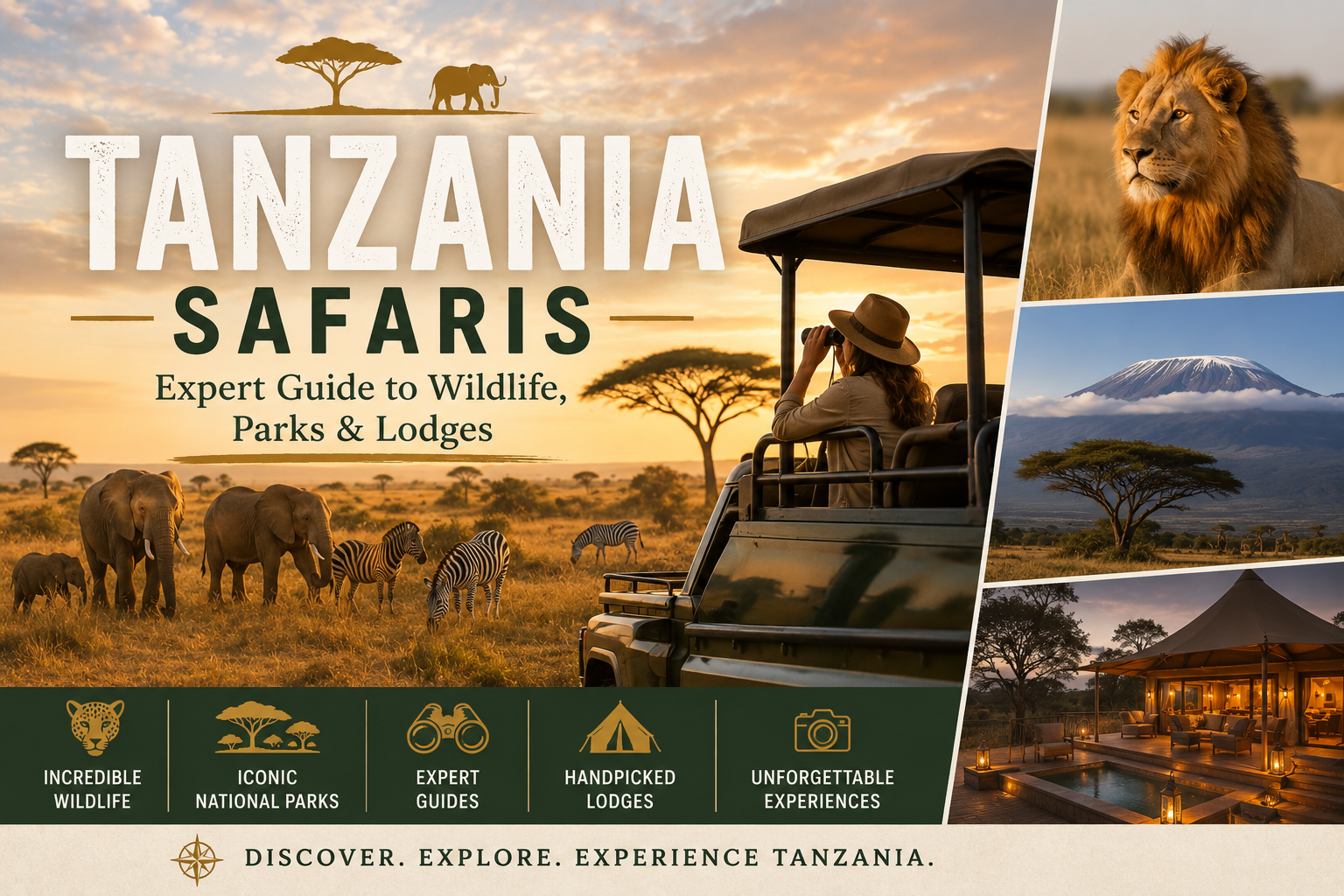
Tanzania holds more UNESCO World Heritage Sites than any other country in sub-Saharan Africa. It is home to the Serengeti, the Ngorongoro Crater, Mount Kilimanjaro, Tarangire, and Ruaha, names that carry weight among wildlife travelers the way Bordeaux does among wine enthusiasts. It hosts the greatest wildlife spectacle on the planet, the Great Migration, in which over 1.5 million wildebeest and hundreds of thousands of zebra move in a perpetual clockwise loop across 1,200 miles of open savannah.
And yet Tanzania remains, by the standards of global tourism, refreshingly unhurried. Its parks are vast, its private conservancies exclusive, its skies enormous. For those who seek luxury Tanzania safaris crafted around genuine wilderness immersion rather than tick-box itineraries, this country delivers at a level very few destinations in the world can match.
This guide covers everything the national parks, the wildlife, the best lodges and camps, the seasonal rhythms, and the practical knowledge that separates a good Tanzania safari from an extraordinary one.
Why Tanzania Remains Africa’s Premier Safari Destination
To understand what makes Tanzania special, you need to understand what it has chosen not to become.
Unlike some African destinations that have leaned heavily into mass tourism, Tanzania has consistently protected the integrity of its wilderness. Conservation fees are deliberately high. Private conservancies are limited to small numbers of guests. Night game drives prohibited in most national parks are reserved for exclusive private concessions, creating a two-tier system in which the deeper your commitment to the experience, the more remarkable it becomes.
Tanzania covers 945,000 square kilometres, of which nearly 40% is protected land. That figure is extraordinary. It means that nearly half the country exists in some form of conservation status national parks, game reserves, forest reserves, and marine protected areas creating an unbroken ecological web that supports wildlife populations of a scale found nowhere else in Africa.
The country’s biodiversity is staggering. Tanzania is home to the Big Five lion, leopard, elephant, buffalo, and rhino as well as cheetah, wild dog, giraffe, hippo, crocodile, zebra, wildebeest, and hundreds of antelope species. Its bird list exceeds 1,100 species. In the forests of the Mahale Mountains, wild chimpanzees have been habituated to human presence across decades of research. In the alkaline shallows of Lake Natron, over two million flamingos breed in one of nature’s most spectacular — and least visited events.
Tanzania is not a destination you visit once and consider done. It is a country people return to, drawn back by the sheer scale of what remains wild here.
The Three Safari Circuits: Northern, Southern & Western
Tanzania’s parks are divided into three distinct safari circuits, each with a different character, wildlife profile, and type of traveler experience. Understanding which circuit suits you is the first decision every Tanzania safari should begin with.
The Northern Circuit — Icon Country
The Northern Circuit is where most Tanzania safari stories begin. It encompasses the Serengeti, the Ngorongoro Conservation Area, Tarangire National Park, Lake Manyara National Park, and Arusha National Park a collection of ecosystems that, together, represent the most concentrated and accessible safari landscape in East Africa.
The Northern Circuit is where the Great Migration plays out. It is where first-time safari guests typically see their first lion kill, their first leopard in a fever tree, their first elephant at close range. The infrastructure is excellent, the guides are experienced, and the landscape open savannah, volcanic craters, ancient baobab forests — is genuinely spectacular.
The trade-off is visibility. During peak season (July through October), the Serengeti draws significant numbers of visitors, and sightings at major river crossings can involve multiple vehicles. This is why the top-tier luxury Tanzania safaris in the northern circuit tend to focus on private conservancies and exclusive concession areas that offer a fundamentally different experience from the main park.
The Southern Circuit — Africa Without the Crowds
The Southern Circuit, centered on Nyerere National Park (formerly the Selous Game Reserve) and Ruaha National Park, is Tanzania’s wild interior and remains one of the most underappreciated safari regions in Africa.
Nyerere is Tanzania’s largest national park, extending across more than 30,000 square kilometres bigger than Belgium. Its defining feature is the Rufiji River, which flows year-round and draws extraordinary concentrations of wildlife during the dry season. Uniquely among Tanzania’s major parks, Nyerere offers boat safaris on the Rufiji, allowing guests to drift alongside hippos and crocodiles, watch elephants cross between banks, and observe a bird list that ranks among the richest in East Africa.
Ruaha, further west, is raw country in the truest sense. Massive granite boulders punctuate a landscape of baobab woodland, seasonal rivers, and rolling hills. The park supports Tanzania’s largest elephant population over 12,000 individuals as well as lions, leopards, cheetahs, and African wild dogs. The density of large predators in Ruaha is exceptional. Sightings of wild dogs, in particular, are more reliable here than almost anywhere else on the continent.
The Southern Circuit rewards the traveler who has already seen the Serengeti and is ready for something less curated and more raw.
The Western Circuit — True Wilderness
The Western Circuit is Tanzania’s final frontier. The parks of Gombe Stream, Mahale Mountains, and Katavi Plains sit in the remote far west of the country, accessible primarily by light aircraft and in some cases by boat across Lake Tanganyika.
Mahale Mountains is the definitive chimpanzee tracking destination. Research into the Mahale chimp communities began in the 1960s under Japanese primatologist Toshisada Nishida, and decades of habituation work mean guests can spend a morning sitting within metres of wild chimpanzees in their natural forest habitat. The experience is visceral and unlike anything available elsewhere in East Africa.
Katavi, immediately south, is one of Tanzania’s most isolated parks. During the dry season, thousands of hippos compete for the shrinking pools of the Katavi and Katisunga floodplains a spectacle of territorial aggression and survival that is unlike anything in the Serengeti. Buffalo herds of several thousand animals are common. Lion and leopard densities are high. And the guest numbers on many days are essentially zero.
View Tanzania Safari Packages →
Tanzania’s Greatest Parks: A Detailed Guide
Serengeti National Park
Area: 14,763 km² | UNESCO World Heritage Site
The Serengeti is the most famous national park in Africa, and that reputation is entirely deserved. Its name derives from the Maasai word siringitu “the place where the land moves forever” and the description holds. The plains stretch to every horizon without interruption, supporting wildlife populations that have sustained themselves across millions of years of evolution.
The park divides naturally into distinct zones. The southern Serengeti the Ndutu area and the short-grass plains is where the Great Migration calves between January and March. Over 400,000 wildebeest calves are born within a three-week window, creating a feast of predator activity that draws cheetahs, lions, hyenas, and jackals in extraordinary numbers.
The central Serengeti, anchored by Seronera, offers year-round wildlife viewing. The Seronera River system supports resident populations of leopard arguably the easiest leopard viewing in Africa along with lions, cheetahs, hippos, and an exceptional bird list.
The western corridor is the Migration crossing zone from May to July, as wildebeest swim the Grumeti River in the face of resident Nile crocodiles. The northern Serengeti particularly the Lamai Triangle hosts the famous Mara River crossings from July to October, when hundreds of thousands of wildebeest pour across the river in one of nature’s most dramatic spectacles.
Best time to visit: Year-round, with specific zones offering different experiences. January–March for calving and predator action in the south; July–October for river crossings in the north and west.
Ngorongoro Conservation Area
Area: 8,292 km² | UNESCO World Heritage Site & Biosphere Reserve
The Ngorongoro Crater is a collapsed volcanic caldera stretching 19 kilometres across and sheltering a self-contained ecosystem of extraordinary density. Approximately 25,000 large animals live within the crater permanently never needing to leave because the grass, water, and minerals they require are all present within its walls.
The crater floor holds one of the highest concentrations of lions in Africa, with an estimated 70 individuals hunting within its walls. It is the most reliable place in Tanzania to see the black rhino — a critically endangered species of which fewer than 70 individuals survive in the NCA. Elephants, buffalo, zebra, wildebeest, hyena, and flamingo (on the soda lake) complete a daily wildlife roster that makes the Ngorongoro Crater one of the most extraordinary wildlife viewing locations in the world.
The crater rim, at over 2,300 metres above sea level, provides a dramatically different environment. Afromontane forest covers the outer slopes, supporting buffalo, leopard, and a range of endemic bird species. The temperatures here are significantly cooler than the crater floor, and the highland lodges that line the rim offer sweeping views of the caldera that are genuinely unlike any view in East Africa.
Beyond the crater itself, the NCA encompasses the Olduvai Gorge — one of the most important paleoanthropological sites in the world, where Mary and Louis Leakey found fossilised remains of early hominids dating back 1.8 million years — and the remote Empakaai and Olmoti craters, accessible on guided walks.
Best time to visit: Year-round. The dry season (June–October) offers the clearest conditions for crater photography; the wet season brings lush green landscapes and newborn wildlife.
Tarangire National Park
Area: 2,850 km² | Northern Tanzania
Tarangire is the most underrated park in Tanzania’s Northern Circuit, and experienced safari travelers know it. During the dry season, the Tarangire River becomes the only permanent water source across a vast area, drawing one of the greatest concentrations of elephants in Africa several thousand individuals alongside enormous herds of buffalo, zebra, wildebeest, and the widest variety of antelope in northern Tanzania.
The landscape is punctuated by ancient baobab trees some estimated to be over 1,000 years old that give Tarangire a visual character entirely distinct from the open Serengeti plains. Lion prides here are large, often numbering 20 or more individuals. Leopard are present but elusive. Ground hornbills and lilac-breasted rollers are found in abundance.
Critically, Tarangire receives a fraction of the visitor numbers of the Serengeti and Ngorongoro. Game drives here have an intimacy and quietness that makes the wildlife experience feel genuinely exclusive even in peak season. For luxury Tanzania safaris that prioritise depth of encounter over volume of sightings, Tarangire consistently outperforms its more famous neighbours.
Best time to visit: July to October, when the dry season concentrates wildlife around the river. The park is also excellent for birdlife during the wet season.
Ruaha National Park
Area: 22,000 km² | Southern Tanzania
Ruaha is Tanzania’s second-largest national park and one of the continent’s best-kept secrets. Remote, raw, and wildly diverse, it covers a landscape of ancient baobab woodlands, seasonal sand rivers, granite outcrops, and rolling miombo hills that looks and feels entirely different from the northern parks.
The wildlife density is exceptional. Ruaha holds Tanzania’s largest elephant population, extraordinary lion numbers, reliable leopard sightings, healthy populations of wild dogs, and a growing cheetah population. The park also holds species not found in northern Tanzania greater and lesser kudu, roan antelope, sable antelope giving it a wildlife diversity that more than compensates for its distance from Arusha.
Night game drives, walking safaris, and fly camping are all available in Ruaha’s private concession areas experiences that are simply not possible within the national park boundaries of the north. This freedom, combined with the near-total absence of other vehicles, creates a safari atmosphere that feels entirely private.
Best time to visit: June to October (dry season), when wildlife congregates around the Great Ruaha River and game viewing is at its most concentrated.
Nyerere National Park (Selous)
Area: 30,000+ km² | Southern Tanzania
Nyerere is the largest national park in Africa, and its scale defines the experience. Unlike the Serengeti’s open plains, Nyerere is a landscape of woodland, wetland, and riverine forest, threaded through by the enormous Rufiji River system. Wildlife here does not congregate on open grassland it moves through dense bush, surfaces at river pools, and reveals itself in ways that reward patient, skilled observers.
The park’s signature experience is the boat safari. Drifting along the Rufiji on a motorised pontoon boat, with hippos submerging ten metres away and crocodiles basking on the banks, offers a perspective on African wildlife that no game drive vehicle can replicate. The birdlife along the river African fish eagles, goliath herons, pied kingfishers, Bohm’s bee-eaters is extraordinary.
Nyerere is also the best place in Tanzania to track African wild dogs. The park holds the largest population of this highly endangered species in the country, and experienced guides with radio-tracking equipment can locate den sites during the denning season with reasonable reliability.
Best time to visit: June to October (dry season). The wet season makes roads difficult and wildlife disperses into the dense bush.
The Great Migration: The World’s Greatest Wildlife Event
No wildlife event on earth compares to the Great Migration. Every year, driven by ancient instinct and rainfall patterns, over 1.5 million wildebeest, 400,000 zebra, and 200,000 Thomson’s gazelle make a perpetual clockwise circuit through Tanzania’s Serengeti and Kenya’s Maasai Mara covering over 1,200 miles across twelve months.
The migration is not a single dramatic moment it is a continuous, year-round movement, with different phases offering different spectacles.
January to March — The Calving Season (Southern Serengeti) The short-grass plains of Ndutu in the southern Serengeti fill with enormous herds of wildebeest in late January, as over 400,000 calves are born within a three-week window. Wildebeest have evolved to calve synchronously flooding the predator market so that statistically, more calves survive. The result is extraordinary predator activity. Cheetahs sprint. Lions stalk. Hyenas circle. It is the most intense wildlife spectacle in Africa.
April to June — The Long Rains (Western Corridor) The herds move northwest through the Serengeti’s western corridor, grazing the fresh growth brought by the long rains. May and June see the crossing of the Grumeti River, where enormous resident crocodiles have been waiting. The Grumeti crossings are less famous than the Mara River but often more dramatic the crocodiles here are among the largest in Africa.
July to October — The Northern Serengeti & Mara River Crossings The migration’s most iconic phase. Hundreds of thousands of wildebeest press northward toward the Mara River, crossing back and forth between Tanzania and Kenya in response to daily changes in grass and water availability. The Mara River crossings — witnessed from low positions along the riverbank are genuinely overwhelming. Thousands of animals throw themselves into a river churning with crocodiles, driven by a collective momentum that nothing can stop.
November to December — The Return (Eastern Serengeti) The short rains trigger the return movement southward through the eastern Serengeti. The herds disperse across a wide front, and sightings can be more scattered — but the landscape, green and recovering after the rains, is at its most beautiful.
Luxury Tanzania Safari Lodges: Where to Stay
Where you sleep on a Tanzania safari shapes the entire experience. The best lodges are not merely comfortable places to rest between game drives they are integral parts of the wilderness experience, positioned for access, designed for immersion, and staffed by people who understand the land around them.
For guests seeking luxury Tanzania safaris at the highest level, the options are world-class.
In the Serengeti
Singita Sasakwa Lodge — Set on a kopje (granite hill) in Singita’s private 350,000-acre Grumeti Reserve, Singita Sasakwa is arguably the finest lodge in Africa. The Edwardian manor house architecture, the private butler service, the off-road driving access across a private reserve with vehicle limits everything about it is calibrated for the most discerning travelers. Wildlife viewing in the Grumeti Reserve is exceptional year-round, with the western migration crossing passing directly through the concession in May and June.
Namiri Plains — An Asilia Africa property in the eastern Serengeti, Namiri Plains was closed to tourism for two decades to allow cheetah populations to recover. The result is a camp positioned in the finest big-cat terrain in the Serengeti, where cheetah sightings are among the most reliable anywhere in Africa. The camp itself elegant tented suites with private verandas overlooking the open plains is contemporary and beautifully considered.
Songa Migrational Camp — A mobile camp that follows the Great Migration across the Serengeti throughout the year, repositioning between two remote concession areas to track the herds. With eight en-suite tents and a maximum of 16 guests, it offers a genuinely intimate, flexible experience for travelers who want to be precisely where the action is, regardless of the month.
andBeyond Serengeti Under Canvas — A mobile camp that moves seasonally across the Serengeti in pursuit of the migration. The camp’s philosophy is total immersion — guests sleep in the bush, eat in the bush, and spend their days as close to the wildlife movement as responsible guiding allows.
In the Ngorongoro
Ngorongoro Crater Lodge — Positioned on the southwestern rim of the crater, this lodge is one of the most architecturally distinctive properties in Africa. Its thatched towers and opulent interiors — banana leaf ceilings, open fireplaces, rose petal baths create a theatrical sense of occasion that complements the drama of the crater below. Private butlers and early-access crater descents before the main park gates open are among its signature offerings.
Lemala Ngorongoro Tented Camp — A more intimate alternative on the eastern rim, Lemala Ngorongoro sits deep in acacia forest with morning mist threading between the trees. Its position allows for some of the earliest crater descents of any lodge on the rim, maximising time on the crater floor during the softest morning light.
In Tarangire
Tarangire Treetops — Built around a spectacular thousand-year-old baobab tree, this lodge positions its elevated rooms among the ancient branches, offering panoramic views of the Tarangire landscape and the wildlife that moves through it. The effect of falling asleep in the canopy of a baobab, with elephants feeding below, is genuinely extraordinary.
Chem Chem Lodge — Positioned in a private conservancy linking Tarangire and Lake Manyara, Chem Chem protects a critical wildlife corridor and offers game drives across a landscape that receives a tiny fraction of the visitor pressure of the main park. Walking safaris, Maasai-guided cultural visits, and flamingo-rich lake excursions complement the game drive programme.
In Ruaha
Jabali Ridge — Built into the granite boulders of Ruaha’s central wilderness, Jabali Ridge is one of the finest small lodges in East Africa. Its suites — with private verandas, sunken lounges, and hammocks overlooking the seasonal Mwagusi River are remarkable. But it is the walking safaris, the night drives, and the sheer quality of wildlife viewing in a park that receives fewer visitors in a month than the Serengeti receives in a day that make it exceptional.
In Nyerere
Sand Rivers Nyerere — Perched on a wide sandy bend of the Rufiji River, Sand Rivers is one of the most romantic lodges in Africa. Open-fronted stone-and-thatch suites overlook the river directly, a swimming pool sits beneath an enormous baobab, and the daily activity list boat safari, walking safari, fly camping, game drive is among the most diverse of any lodge in Tanzania.
Tanzania’s Wildlife: What to Expect and When
The Big Five
Tanzania’s Big Five — lion, leopard, elephant, buffalo, and black rhino are all present, though rhino is the most challenging to locate reliably.
Lions are found in highest density in the Serengeti and Ngorongoro Crater. The Serengeti holds an estimated 3,000 lions the largest population in Africa. Ngorongoro’s crater lions are particularly well-studied, and sightings are virtually guaranteed on any crater visit.
Leopards are most reliably seen in the Serengeti’s Seronera area, where the river system provides the riverine woodland habitat they prefer. Ruaha and Nyerere also offer excellent leopard sightings, particularly from hides near waterholes.
Elephants are present in significant numbers across most Tanzanian parks. Tarangire’s dry-season concentrations are the most spectacular thousands of elephants converging on the river in a daily parade that continues from June through October.
Buffalo are ubiquitous across Tanzania’s major parks. Large herds sometimes several thousand strong are characteristic of Katavi, Ruaha, and the Serengeti.
Black Rhino — Tanzania’s most critically endangered Big Five member. The Ngorongoro Crater holds the best chance of a sighting, with approximately 70 individuals on the crater floor. Mkomazi National Park in northeastern Tanzania also runs a rhino sanctuary with small but growing numbers.
Predators Beyond the Big Five
Cheetahs are found across the Serengeti, with the eastern section particularly the Namiri Plains area holding the highest densities. Ngorongoro Crater also has a resident cheetah population that uses the open crater floor for hunting.
African Wild Dogs are present but nomadic. Nyerere National Park holds the most reliable population, with experienced guides using radio-tracking equipment to locate packs during the denning season. Ruaha also has a strong wild dog population.
Spotted Hyenas are common across most parks. The Ngorongoro Crater holds some of Africa’s largest hyena clan territories, and their social interactions and hunting behaviour are among the most fascinating spectacles on the crater floor.
The Great Apes
Chimpanzees are Tanzania’s most remarkable great ape experience, found in Mahale Mountains and Gombe Stream National Parks on the shores of Lake Tanganyika. Mahale’s habituation programme is considered among the most successful in Africa, and a morning tracking chimpanzees through montane forest eventually sitting within metres of a large male is one of the most profound wildlife encounters on earth.
When to Visit Tanzania: Month-by-Month Guide
Tanzania is a year-round safari destination, but different months offer fundamentally different experiences.
January – February (Green Season, Calving) The Serengeti’s southern plains are lush and green, and the calving season delivers extraordinary predator action. Fewer visitors mean more intimate game drives. Bird life is at its peak, with migrant species in full plumage. Rates at most lodges are lower than peak season.
March – May (Long Rains) Tanzania’s long rains bring occasional road closures in the south and some camp closures, but the Serengeti remains accessible and the landscape is dramatically beautiful. The western corridor sees the Migration building for the Grumeti River crossings. This is Tanzania’s quietest period ideal for guests who want exceptional wildlife with almost no other vehicles.
June – July (Dry Season Begins) Wildlife begins concentrating around permanent water sources. The Serengeti’s wildebeest move north toward the Mara River. Tarangire fills with elephants. Ruaha and Nyerere offer increasingly spectacular dry-season game viewing. This is the beginning of peak season.
August – October (Peak Season) Tanzania’s finest wildlife viewing period. The Mara River crossings are at their most dramatic. Tarangire reaches peak elephant concentration. Ruaha’s Mwagusi River shrinks to a series of pools surrounded by thousands of animals. Rates are at their highest, and advanced booking often more than 12 months ahead for the top lodges is essential.
November – December (Short Rains) The short rains refresh the landscape and send the Migration turning southward. Resident wildlife remains active and visible. Lodge rates drop from peak levels. A genuinely excellent time for guests seeking good wildlife with a slightly quieter atmosphere.
Practical Information: Planning Your Tanzania Safari
Visa & Entry
Most nationalities can obtain a Tanzania visa on arrival at Kilimanjaro International Airport (JRO) or Julius Nyerere International Airport (DAR). An e-visa is available online before departure. Ensure your passport has at least six months of validity beyond your travel dates and two clean pages for stamps.
Getting There
The primary international gateway for Northern Circuit safaris is Kilimanjaro International Airport (JRO), served by flights from Nairobi, Addis Ababa, Amsterdam, and other hubs. For the Southern Circuit, Julius Nyerere International Airport in Dar es Salaam is the main entry point.
Between parks, light aircraft transfers on scheduled or charter flights are the standard for luxury Tanzania safaris reducing ground travel time dramatically and offering extraordinary aerial views of the wilderness below.
Health Precautions
Tanzania is a malaria-endemic country. Anti-malarial medication prescribed by a travel medicine specialist is strongly recommended. Yellow fever vaccination may be required depending on your country of origin; check the specific requirements before travel. Travel health insurance covering medical evacuation is essential.
Packing for Tanzania
Lightweight, breathable clothing in neutral tones (khaki, olive, stone, sand) is the standard safari wardrobe. Bright colours and dark navy or black should be avoided — the latter attracts tsetse flies present in some Tanzanian parks. A warm fleece or midlayer is essential for early morning game drives at altitude. Luggage on domestic light aircraft is restricted to 15 kg total (including carry-on), in soft-sided bags only.
Cultural Encounters: Beyond the Wildlife
Tanzania’s human landscape is as rich as its wildlife. The country is home to over 120 distinct ethnic groups, and several of the most significant offer cultural encounters that meaningfully enrich a safari experience.
The Maasai — perhaps the most widely recognised of East Africa’s pastoral peoples, the Maasai have maintained their traditional way of life with remarkable tenacity across centuries of change. Many luxury camps in the Northern Circuit offer guided Maasai village visits, led by community members who explain the traditions of cattle keeping, age-set ceremonies, and the warrior ethos that defines Maasai identity.
The Hadzabe — living near Lake Eyasi in the Rift Valley, the Hadzabe are one of the last hunter-gatherer communities in Africa still following the traditional lifestyle of their ancestors. A guided encounter with the Hadzabe — joining an early morning bow-hunt, watching them make fire by friction offers a glimpse of human life at its most elemental.
The Datoga — neighbouring the Hadzabe around Lake Eyasi, the Datoga are skilled metalworkers and pastoralists whose beadwork and blacksmithing traditions are rapidly disappearing. Meeting Datoga craftspeople is a less commonly offered experience, but one that rewards the curious traveler who seeks something beyond the safari vehicle.
Zanzibar: The Perfect Safari Extension
No Tanzania safari is truly complete without considering Zanzibar. The island a 45-minute flight from both Arusha and Dar es Salaam offers a beach extension of extraordinary quality that transforms a safari into one of the most well-rounded travel experiences available anywhere.
Zanzibar’s Stone Town is a UNESCO World Heritage Site a labyrinth of coral-stone houses, carved wooden doors, and narrow lanes that carries the layered history of Arab, Persian, Indian, and Portuguese influence that shaped the Swahili coast across a thousand years of trade.
The island’s north and northeast coasts Nungwi, Kendwa, and Matemwe offer white coral sand beaches and clear Indian Ocean waters ideal for snorkelling, diving, and dhow sailing. The reefs around Mnemba Atoll, accessible from the northeast coast, rank among the finest dive sites in the Indian Ocean.
For guests booking luxury Tanzania safaris, combining 7–10 nights in the national parks with 3–4 nights in Zanzibar creates a trip of extraordinary contrast and completeness the raw wilderness of the Serengeti followed by the warm, unhurried rhythm of an Indian Ocean island.
Safari Styles: Choosing the Right Experience
Classic Game Drive Safari
The standard safari format morning and afternoon game drives in open 4×4 vehicles with an expert guide and tracker. Appropriate for first-time safari guests and those who want maximum wildlife access in minimum time. Best experienced from a permanent lodge with a private vehicle arrangement.
Walking Safari
Available in Ruaha, Nyerere, and several private conservancies, walking safaris offer an entirely different relationship with the bush. On foot, with an armed and experienced guide, the scale of the wilderness changes completely. The focus shifts from the large mammals visible from a vehicle to the tracks, dung, plants, insects, and birds that constitute the bush’s everyday life. Walking safaris require reasonable fitness and a tolerance for unpredictability, which is precisely their appeal.
Boat Safari
Available in Nyerere National Park on the Rufiji River. The boat safari is one of Tanzania’s genuinely unique experiences, an hour on the Rufiji delivering wildlife encounters impossible from any land-based vehicle.
Hot Air Balloon Safari
Available in the Serengeti, a sunrise balloon flight over the plains is one of the great aerial wildlife experiences in the world. The Serengeti from 300 metres at dawn with the Migration visible below and Kilimanjaro on the eastern horizon, is a sight that justifies the considerable cost of the experience.
Fly Camping
Available at several luxury lodges in Ruaha and Nyerere, fly camping involves spending a night under canvas in the open bush on a sandbank, beneath a baobab, beside a waterhole with nothing between you and the sounds of the African night. It is an experience for guests who want to feel genuinely immersed in the wilderness rather than merely observers of it.
Frequently Asked Questions
Q: What is the best time to visit Tanzania for a safari?
Tanzania offers excellent wildlife viewing year-round. The dry season (June–October) delivers the most concentrated game viewing as animals gather around permanent water, and coincides with the Mara River crossings of the Great Migration in the north. The calving season (January–March) in the southern Serengeti is arguably the most dramatically active period for predator behaviour. Each season has distinct advantages — the right choice depends on which wildlife experience most appeals to you.
Q: How many days do I need for a Tanzania safari?
A minimum of 7 nights is recommended for a meaningful Tanzania safari, allowing time in at least two or three parks without constant movement. For a comprehensive Northern and Southern Circuit combination, 12–14 nights is ideal. Shorter safaris (5 nights) are possible but tend to involve more transfers and less depth of experience in each location.
Q: What is the Great Migration, and when can I see it?
The Great Migration is the year-round movement of over 1.5 million wildebeest and hundreds of thousands of zebra through Tanzania’s Serengeti and Kenya’s Maasai Mara. Different phases of the migration are visible in different locations: calving in the southern Serengeti (January–March), Grumeti River crossings in the western corridor (May–July), and the famous Mara River crossings in the north (July–October). Migration viewing is possible in Tanzania at all times of year.
Q: Do I need vaccinations to visit Tanzania?
Yellow fever vaccination documentation is required if you are arriving from a yellow fever endemic country. Typhoid and hepatitis A vaccinations are strongly recommended. Anti-malarial medication is essential for all safari destinations in Tanzania. Consult a travel medicine specialist at least 6–8 weeks before departure for personalised recommendations.
Q: Is Tanzania safe for tourists?
Tanzania is considered one of the safest countries in sub-Saharan Africa for tourists. The national parks and private conservancies are remote but professionally managed. Standard travel precautions securing valuables, using reputable operators, following guide instructions in the bush — apply. Travel insurance covering medical evacuation is essential.
Q: Can I combine Tanzania with Kenya on one trip?
Yes — and it is a popular combination. The Northern Serengeti and Kenya’s Maasai Mara share a continuous ecosystem, and the Great Migration moves between the two. Many guests fly between parks in northern Tanzania and the Mara on the same trip, following the herds across both sides of the border.
Q: How far in advance should I book a Tanzania safari?
For peak season travel (July–October), the best lodges and camps book out 12–18 months in advance. For green season and shoulder periods, 6 months is generally sufficient. Private conservancy camps with only 6–12 beds fill particularly fast. Early booking is not just recommended — for the top properties in peak season, it is essential.
Q: Is Tanzania suitable for families with children?
Yes, with appropriate planning. Many luxury lodges in Tanzania are well-equipped for families, offering private vehicles, family suites, and junior ranger programmes. The minimum age for game drives varies by lodge typically 5 or 6 years old and some walking safari activities have higher age requirements. Consult with your safari specialist to identify child-friendly properties that match your itinerary.
Q: What currency is used in Tanzania, and how does payment work at lodges?
The Tanzanian Shilling (TZS) is the official currency, but US Dollars are widely accepted for tipping, small purchases, and incidental expenses. Most luxury lodges operate on an all-inclusive basis accommodation, meals, game drives, and park fees are included in the quoted rate. Payments to the lodge itself are typically settled in advance or by credit card.
Q: What is the luggage allowance on domestic Tanzania flights?
Domestic light aircraft flights the standard transfer method between parks on luxury Tanzania safaris carry a 15 kg total allowance per person, including carry-on. Luggage must be in soft-sided bags; hard-shell suitcases are not permitted on bush planes. Most experienced safari travelers use a 40–50 litre soft duffel as their main bag and a day pack as carry-on.
Plan Your Tanzania Safari with Cheetah Safaris
Tanzania demands more than a booking confirmation. It demands a guide who has stood at the Mara River at 6 AM and knows which bank the wildebeest will cross first. It demands someone who has slept in Ruaha’s fly camps, tracked wild dogs in Nyerere, and watched chimpanzees in Mahale. Someone who can tell you, precisely, which lodge positions you for the best morning light on the Ngorongoro Crater floor and which conservancy in the Serengeti gives you 50,000 acres to yourself.
At Cheetah Safaris, every itinerary is built from personal field knowledge and a genuine belief that a Tanzania safari should be as individual as the traveler taking it. We specialise in privately guided, tailor-made experiences across Tanzania’s full safari circuit from classic Serengeti itineraries to remote southern explorations and western chimpanzee expeditions.
Whether you are planning your first Africa safari or your tenth, our team of East Africa specialists is ready to build your Tanzania journey from the ground up the right parks, the right season, the right lodges, the right guides.