
When it comes to starting an online store, a few years ago the advice was straight-forward: Choose a closed platform, pay the monthly fee, and start selling. It was clear that this would appeal to everyone. All arrangements were made for you. All in one subscription: hosting, security updates, checkout flows and payment processing. No need for a developer. All you had to do was have a credit card and a product.
It’s still a good, basic option for smaller, less advanced shops. However, there is something interesting that is going on as those stores are growing. Not a few of them are hitting walls. Not marketing walls or product walls, platform walls. Those convenience-restrictions that were actually built into their closed systems now pose a significant problem to the business they are trying to create.
And, increasingly, the trajectory those brands are taking is towards WooCommerce.
The Ceiling Problem with Closed Platforms
Closed ecommerce platforms are built to a specific notion of what a store will appear like and exactly how it’ll get the job done. This vision works for most businesses adequately at the outset. As a brand grows, its own demands for a customer experience become more complex and different from what the platform can currently handle, as do its own processes and workflows.
The place where problems typically arise with customization is the first place. In a closed platform you can change what the platform allows for changing. The checkout experience, the product page layout, the navigation logic, the pricing rules, the platform rules and more, none of these are dictated by you. If this is a business model that needs a checkout system that the platform isn’t built on, you’ll have to work around it, develop an expensive app, or live with it.
These compromises are acceptable for small stores. They can be actually costly for growing brands that have particular goals for their customer experience. If the checkout simply cannot be optimized like you want, it’s a conversion rate that won’t reach its potential. A product page which you’re unable to control is a presentation of the brand which you’ve failed to get to represent as you’d like to.
WooCommerce Gives You the Store, Not a Template of One
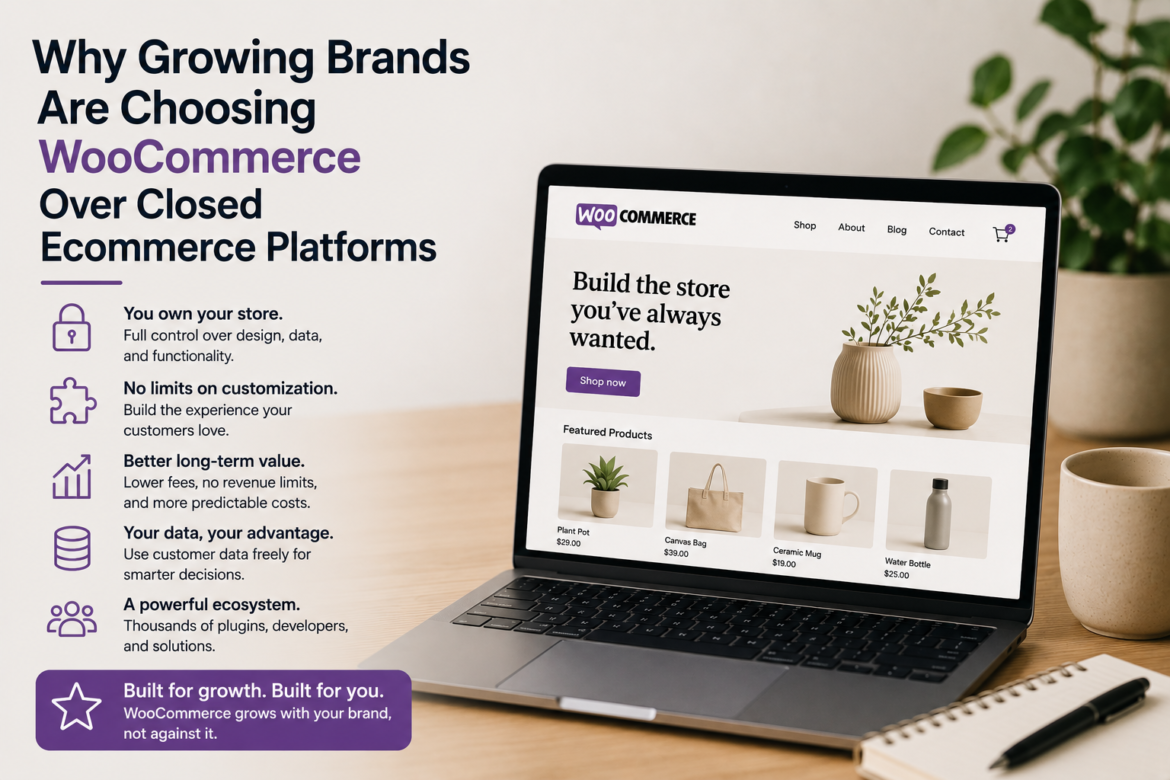
The key distinction between WooCommerce and a closed platform is that WooCommerce is for owners to own, whereas a closed platform is owned by the manufacturer. If you build on WooCommerce, then you own the store. You are the owner of code, design, data and experience. There is no business model, product roadmap, or anything else that dictates how your store will appear or operate.
This is more important than it seems! It means your product pages can be arranged the way your product needs to be displayed, and not in the way a template thinks they should be displayed. Your checkout process can be streamlined, lengthened, made multi-step or even shortened to a single page, depending on your conversion data. Where closed platforms have to resort to complex workarounds, you can incorporate complexity into your pricing logic without needing to spend lots of money.
Brands with a strong identity and a clear idea about how they want to experience their customers have no need for this luxury. It is what makes a store feel like theirs, and not as one of a multitude of other stores on the same platform.
The Cost Conversation Is More Nuanced Than It Appears
The most popular reason for closed platforms is the cost of them. Pay a no-cost monthly charge and you’ll have it all! No devs, no hosting options, no maintenance hassles. At first glance, it appears pretty simple in terms of dollars.
However, the expense of a closed platform for a brand on the rise is rarely that easy to calculate. So as the number of transactions increases, so do the transaction fees and payment processing fees. The added functionality through app subscriptions can cost meaningful monthly overheads, unless the functionality is natively supported by WooCommerce or purchased as a one-off plugin. When the need arises to do something the platform is not designed to do, the cost can be associated with workarounds, trying to build apps within platform boundaries, or not doing the thing at all.
There is a certain amount of initial investment needed for WooCommerce, which involves the correct setup, hosting, and professional configuration. But once you invest it, it is a cost that you will incur regardless of your size of business, your subscription fee or your transaction fee. Where meaningful volumes are being generated, the economics will quickly swing towards being clearly in favour of the open model as the business grows.
Data Ownership Changes What You Can Do with It
When you have a closed platform, your store information is stored on another platform’s infrastructure and on another platform’s conditions. It can be exported into formats that the platform will allow. It’s accessible via APIs that the platform deems fit for publication. You can’t do this, though, and treat it as if it was really yours, as a business asset would be.
WooCommerce stores are based on databases that you own and manage. Each and every customer record, each and every order history, each and every behavioral information point is yours to work with right now. This is important for analytics, customer segmentation, personalization and any external integration you would like to build.
The problem here is that the growing brands that want to do serious work with their customer data are disadvantaged when that data is locked in a closed system. Integrations are more difficult, access is more limited, and there is less freedom to create custom reports or to export data into a specific tool, each of which has tangible business impact.
The Ecosystem Advantage Is Larger Than Most People Realize
A high amount of the web runs on WordPress, and WooCommerce is powered by WordPress. This isn’t just a figure. It suggests that there are a lot of developers, designers, plugins, integrations and documented solutions available unlike a closed platform.
No matter what sort of an ecommerce business you’re looking at, you can almost always find a supported method of doing things in WooCommerce. These aren’t edge cases that should be developed with a ton of custom code in order to price it out, access it, etc.This isn’t when you need to have a ton of expensive custom builds to access it, price it out, etc. There are mature solutions and solved problems in the ecosystem.
This is also the reason why investing in professional WooCommerce development services makes compounding returns with time. A development team that is well-versed in the ins and outs of WooCommerce will be able to leverage these strengths, sidestep common pitfalls in development, and expand the platform’s functionality in a manner that will allow the business to continue to evolve over time. That knowledge builds up like a tree that grows tindered instead of tender.
Migration Is Easier Than Most Brands Expect
One reason that has been making it difficult for growing brands to stay on closed platforms for longer than they’d like, is that it’s perceived as a complicated transition process. Data migration, design rebuild, disruption to live operations – it all sounds like too much risk.
While in practice, migrating WooCommerce from most major closed platforms is a well-documented process that experienced WooCommerce development services teams do routinely, there are some individual steps worth noting. With the proper steps, product catalogs, customer records, order histories and SEO settings are all transferred. The disruption is minimal, provided there is a well organised migration. Simply put, the benefits of relocating to a platform you own and manage begin as soon as you move.
Final Thoughts
The choice of ecommerce platform is one of the most consequential infrastructure decisions a growing brand makes. In the early days, the convenience of a closed platform was a genuine advantage. But as the business develops complexity, ambition, and scale, the limitations of a closed system become a real constraint on what the brand can achieve.
WooCommerce does not offer convenience in the same frictionless way a closed platform does at the start. What it offers instead is something more valuable for a brand with serious growth intentions: complete ownership, unlimited flexibility, and a platform that grows with you rather than one that eventually holds you back.
For brands that have hit the ceiling, the question is not really whether to move. It is when, and whether to do it before or after the ceiling has cost them enough to make the urgency obvious.
