
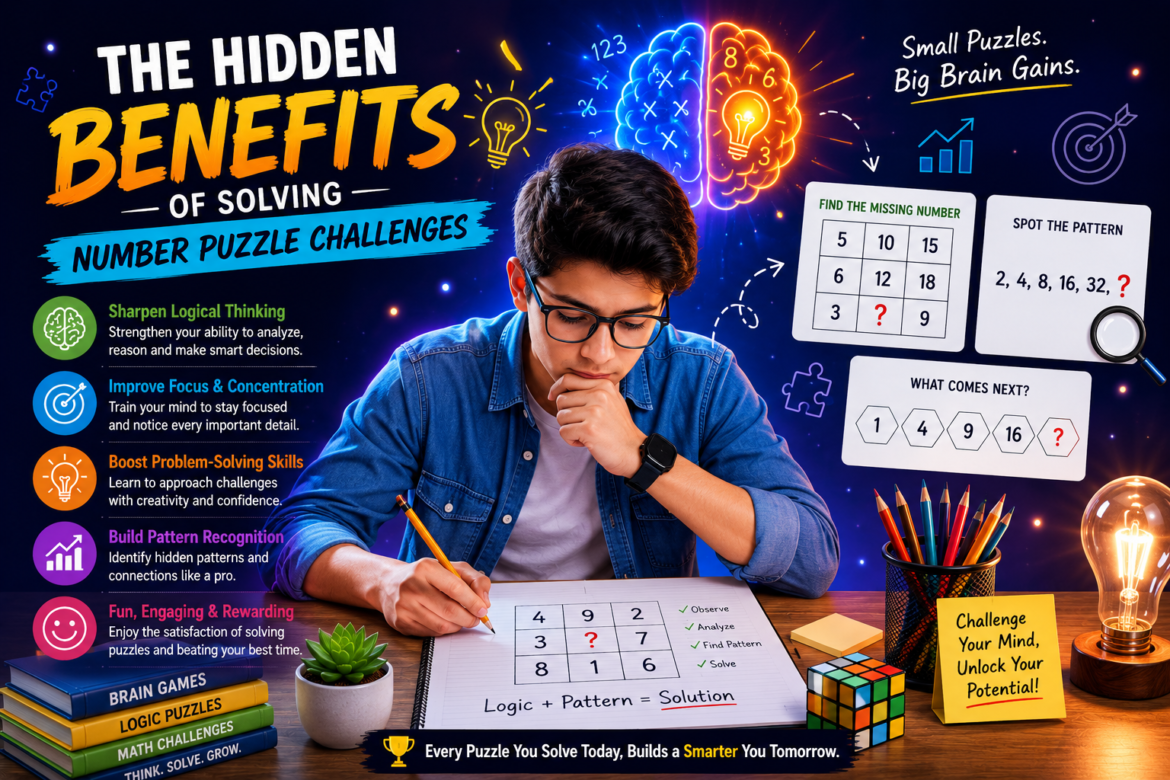
Most people don’t open a number puzzle expecting to learn anything about themselves.
Usually, it starts with curiosity. You see a missing number, an unusual pattern, or a puzzle that seems simple enough to solve in a few seconds. Then a few minutes pass. You’re still staring at it, trying different ideas and wondering what you’ve overlooked.
That experience is exactly why number puzzles have remained popular for generations.
While they’re often viewed as a source of entertainment, the real value of number puzzle challenges goes much deeper. They quietly encourage habits that many of us use every day without thinking about them—careful observation, logical reasoning, patience, and persistence.
The interesting part is that these skills aren’t developed through lectures or textbooks. They’re developed while you’re actively trying to solve a problem.
Number Puzzles Teach You How to Slow Down and Think
We’re used to getting answers quickly.
Search engines provide instant information. Social media delivers endless updates in seconds. As a result, many people have become accustomed to making fast decisions without spending much time analyzing details.
It works differently.
They don’t reward speed alone. In fact, rushing often leads to mistakes. The person who pauses, studies the information carefully, and looks for patterns usually performs better than the person who immediately starts guessing.
Over time, this creates a valuable habit. Instead of reacting to problems, you learn to think through them.
That’s a skill that extends far beyond puzzles.
You Begin Seeing Patterns Everywhere
One of the first things regular puzzle solvers notice is how often patterns appear in everyday life.
At first, pattern recognition seems like a puzzle-specific skill. You’re looking at number sequences, relationships, and hidden rules. But after a while, your brain starts searching for patterns naturally.
You may notice trends in your work, recurring behaviors, or connections between pieces of information that once seemed unrelated.
This is one reason why number pattern puzzles are so engaging. They encourage the brain to look beyond isolated facts and focus on relationships.
The answer isn’t usually hidden in a single number. It’s hidden in how the numbers connect.
Mistakes Become Part of the Learning Process
Many people view mistakes as something negative.
Puzzle solvers tend to see them differently.
If you’ve spent ten minutes following the wrong pattern, you’ve probably experienced that moment when the correct answer suddenly becomes obvious. It can be frustrating, but it’s also educational.
Each incorrect attempt teaches you something about the puzzle.
You learn which assumptions didn’t work. You discover which clues mattered and which didn’t. Gradually, you become more comfortable adjusting your thinking when new information appears.
That flexibility is valuable in everyday problem-solving as well.
Concentration Gets a Natural Workout
A lot of activities compete for our attention.
Messages arrive constantly. Notifications appear every few minutes. Even short periods of focused thinking can feel difficult.
It creates an opportunity to practice concentration without making it feel like work.
When you’re trying to solve a challenging puzzle, your attention naturally narrows. You’re focused on the clues, the patterns, and the possible solutions.
For a few minutes, everything else fades into the background.
Many puzzle enthusiasts describe this as one of the most enjoyable parts of the experience. The challenge is engaging enough to hold your attention, but not so overwhelming that it becomes stressful.
The Satisfaction Comes From Earning the Answer
There’s a major difference between being given an answer and discovering it yourself.
When someone explains a solution, you understand it.
When you solve it on your own, you remember it.
That sense of achievement is one of the hidden reasons people keep coming back to number puzzle challenges. The reward isn’t just the correct answer. It’s the process of finding it.
Every solved puzzle is evidence that patience, observation, and logical thinking can produce results.
Even small successes build confidence over time.
A Brain Exercise That Doesn’t Feel Like Exercise
Most people understand the importance of staying physically active.
Mental activity matters too.
The advantage of puzzles is that they don’t feel like training. You’re not completing an assignment or preparing for an exam. You’re simply trying to solve an interesting challenge.
Yet while you’re doing that, you’re using reasoning skills, memory, concentration, and analytical thinking.
That’s what makes number puzzles unique. They provide mental stimulation in a format that feels enjoyable rather than demanding.
Why People Keep Returning to Number Puzzle Challenges
The popularity of number puzzles isn’t really about numbers.
If it were, only mathematics enthusiasts would enjoy them.
Instead, people are drawn to the feeling of solving a problem. They enjoy discovering hidden relationships, uncovering patterns, and proving to themselves that they can work through a challenge using logic.
That’s why these puzzles appeal to students, professionals, parents, and retirees alike.
The challenge may change, but the satisfaction remains the same.
Final Thoughts
The hidden benefits of solving number puzzle challenges have very little to do with arithmetic and a lot to do with how we think.
They encourage patience in a world that rewards speed. They strengthen observation in environments full of distractions. They help us recognize patterns, evaluate information, and approach problems more thoughtfully.
Most importantly, they remind us that difficult problems don’t always require quick answers. Sometimes the best solution comes from slowing down, paying attention, and giving your brain the time it needs to connect the dots.
And that’s a lesson that remains useful long after the puzzle is solved.
