
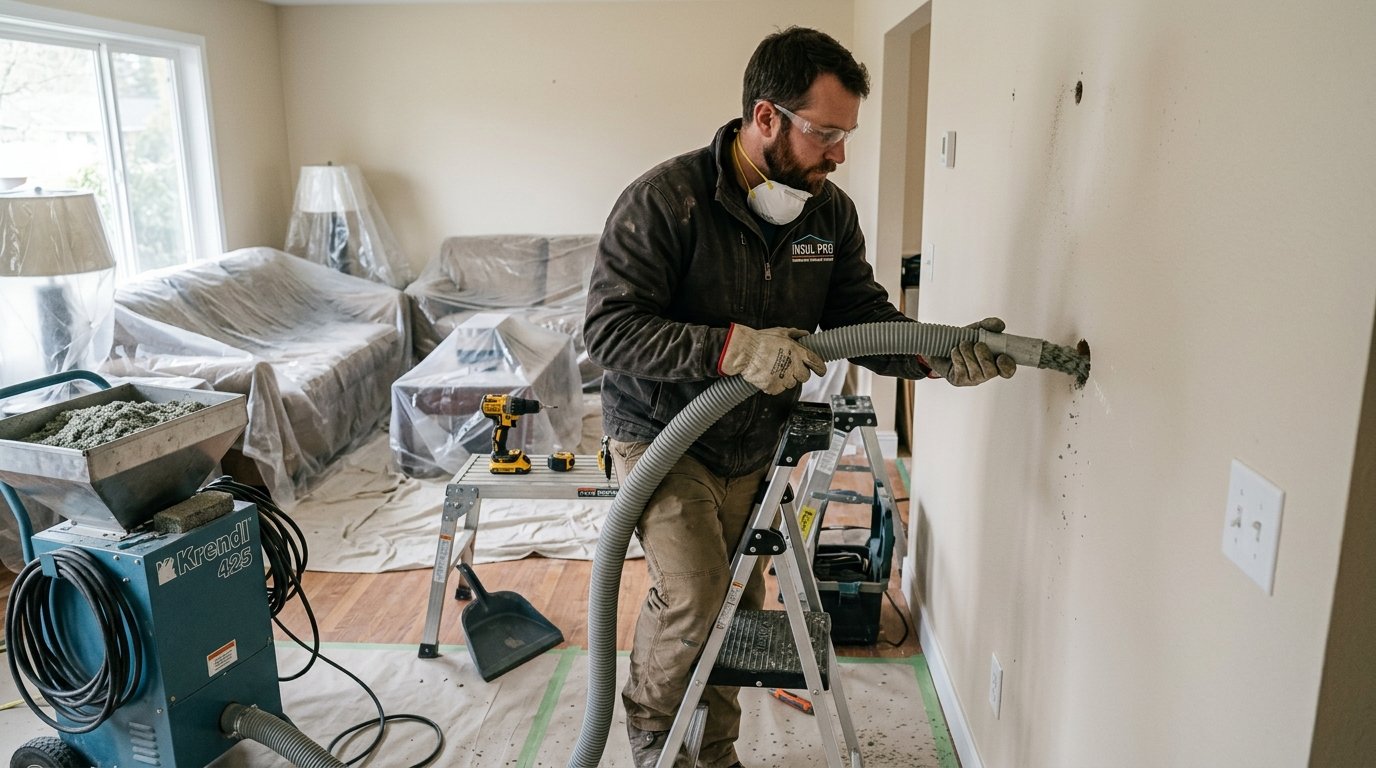
A recent study revealed that 62% of homeowners experience unequal temperatures in their home because of inadequate wall insulation. Fortunately, walls can be insulated without tearing up drywall.
It’s easy to do. Identify the areas of the wall that have no occupancy fill. Then make a few small holes and stuff insulation equally all over. Lastly, close and patch the holes well. If not insulated, heat is lost rapidly, utility costs go up and moisture issues can occur in the future.
It includes wall inspection, cavity preparation, insulation techniques and patching repairs to be able to enhance the energy efficiency of your home, without massive damage to your walls.
Understanding Why Existing Walls Lose Heat So Easily
Many older walls don’t have enough insulation or distribution of insulation. Air can circulate through small gaps in the wall cavities at both seasons of the year. Therefore the temperature changes more frequently indoors.
Such empty spaces are covered with drywall. But there are still undiscovered gaps in comfort, noise control and heating efficiency. May also result in condensation around cooler surfaces due to poor wall insulation.
Exterior walls are the most common place for excessive heat transfer to occur in many residences. Temperature differences are larger in rooms that are exposed to strong sunlight or strong wind.
What Should You Check Before Insulating Existing Walls?
Check the wall structure thoroughly prior to adding insulation. There are various ways to insulate walls, depending on the type of wall.
The following are areas of important inspection:
- Wall thickness
- Electrical wiring locations
- Plumbing lines
- Existing moisture damage
- Stud spacing
- Exterior wall condition
Older homes might have damaged framing, or undetected leaks. Moisture issues can cause water to be retained within walls when trying to insulate over them. This can cause mold formation afterwards.
Understanding Hidden Wall Measurements and Planning
The accuracy in preparing the cavity to prepare the wall is often determined by material calculations and size of cavity. The estimating services are often utilized in many renovation projects for the study of cost estimation, material calculation, volume analysis and project planning support prior to the commencement of insulation work.
How To Insulate Walls Without Removing The Drywall
There are multiple ways to install insulation without tearing up all of the drywall. These methods achieve different results with varying types of walls and accessibility.
Blown-In Insulation Method
One of the most frequent options for finished walls is to blow-in insulation. The principle of this process is to incorporate loose insulation material by way of small wall openings.
The hole is drilled between the wall studs by the installer. Then the cavity is filled with insulation by a controlled air pressure.
Key benefits include:
- Minimal drywall disruption
- Faster installation process
- Better cavity coverage
- Reduced air gaps
Injection Foam Insulation
Once the injection foam enters the cavity of the wall, it swells. The foam is more effective at filling narrow cracks and air spaces than loose materials.
This tactic is suitable for:
- Irregular cavities
- Narrow wall sections
- Hard-to-reach gaps
Dense-Pack Wall Insulation
Dense-pack insulation packs down firmly in the wall opening. This method will prevent further sedimentation and will minimize air movement.
Often the density packing can be improved:
- Sound reduction
- Thermal resistance
- Air sealing performance
Which Areas Of The Wall Need Special Attention?
Some sections of the wall have greater heat loss than others. It’s important to carefully consider the placement of insulation in these areas.
Around Electrical Boxes
Small air leaks can be caused by electrical outlets. There is leakage of outside air into living areas through gaps around switch plates.
Exposed electrical hazards should not be covered by any insulation crews. When filling around wiring, it is important to do it carefully to minimize safety hazards.
Close Proximity To Windows And Doors
The interruption points on the inside of wall cavities are created by window framing. Leaks in the air tend to occur around trim edges and corners.
If there are small spaces around the frames, they can be stopped before the insulation installation.
Exterior Corner Cavities
Insulation flow can be impeded in corner framing in some cases. Older houses frequently will have voids within the corners that cannot be reached. Access holes may be smaller or alternate filling methods may be required for these areas.
Why Insulation Coverage Calculations Matter
Proper placement of insulation is dependent upon cavity depth, air flow and wall space. In some projects the insulation estimation is used to consider material calculation, volume analysis, cost estimation and support for project planning before the access point is drilled.
Step-By-Step Process For Insulating Finished Walls
Step 1: Locate Wall Studs
Stud finders are used to locate framing behind the drywall. These are all designed to avoid the accidental drilling of holes in framing members, which can be avoided with good stud mapping.
Carefully note location of cavity centres before making access points.
Step 2: Drill Access Openings
Typically the small holes are in the upper part of each wall cavity. The size of the holes is determined by the delivery system for the insulation.
Spacing is important because if access is not uniform, then there may be empty pockets of insulation.
Step 3: Stuff Wall Cavities
The insulation hose drips down into each cavity. A good filling pressure can produce a uniform distribution of insulation from the bottom to the top.
Installers measure the resistance of the air to make sure they do not fill it to capacity.
Step 4: Check Coverage Consistency
Cavities must be examined to see if they are filled, or if they are filled, if there are any voids or if the area is not filled. Sometimes, a thermal camera is used to help determine missed sections.
A good long-term thermal performance is achieved with even distribution.
Step 5: Seal and Patch Openings
Once the insulation has been installed, all access holes are patched. Sealing ensures there will be no further air leakage around repair areas.
Also, smooth finishing helps to maintain the appearance of a wall.
Common Problems During Wall Insulation Projects
When finishing wall insulation is not done to completion, it can pose problems.
Moisture Trapping
Those walls that have a leak in the wall need to be insulated ASAP, but not right away. Where wood framing is enclosed with a cavity filled with moisture, it can cause damage. Never insulate leaks.Insulate after repairing leaks.
Uneven Material Distribution
Blocking, pipes or cross braces may be found in some cavities. These barriers prevent insulation flow and result in cold spots. An important point to reduce this is the careful filling techniques.
Drywall Cracking
Too much insulation can cause an excess of pressure in the wall cavity. In certain instances, drywall joints may crack when they are subjected to too much stress. The installation pressure is controlled to avoid surface damage.
Ventilation Confusion
Design airflow systems are not to be obstructed by insulation. Some attic walls that are connected to the interior of the house must be left vented. If air flow is blocked incorrectly, there can be greater risk of condensation.
What is Wall Insulation’s Lifespan?
Properly installed, most wall insulation systems will last for many years. Moisture exposure can, however, cause degradation of insulation time.
There is a possibility for loose insulation to settle slowly in large cavities. The dense-packed methods are more effective in reducing settling problems.
Periodic inspection will enable the identification of:
- Cold wall areas
- Water intrusion
- Air leakage
- Mold development
Signs Your Walls Need Better Insulation
Common symptoms include:
- Cold temperatures will occur on the inside wall surfaces of structures.
- Uneven room temperatures
- Drafts near outlets
- The excessive energy consumption during the season.
- Outdoor noise penetration
- Condensation on walls
Safety Considerations During Insulation Work
There are safety procedures to be taken for wall insulation projects.
Important precautions include:
- Turn off electric circuits in the vicinity.
- Wear breathing protection
- Do not drill into pipes!
- Look for moisture first;
- Close openings in walls properly
Conclusion
Insulating without opening the walls can enhance heating and cooling comfort, minimize temperature swings and prevent potential heat loss inside the finished walls. Long-term insulation performance is influenced by the proper type of inspection, by careful cavity filling, by proper moisture control and by proper sealing.
There are various types of walls and various ways to insulate them, so it is important to be prepared for the various situations before beginning to drill or fill enclosed areas. Over time, tiny gaps in insulation can cause a loss of air flow, energy efficiency and indoor stability.
Informed homeowner decisions for building improvements to enhance long-term building performance can be made by understanding wall structure and the behavior of insulation.
FAQs
What Type Of Walls Are Hardest To Insulate Without Removing Drywall?
Walls containing plumbing or blocking or that do not have a regular framing configuration are more difficult to insulate. Older homes will also present extra difficulties.
Is Wall Insulation Effective At Keeping Noise Out From The Outside?
Indeed, wall insulation can help to minimize external noise by absorbing sound vibrations and preventing sound transfer.
