
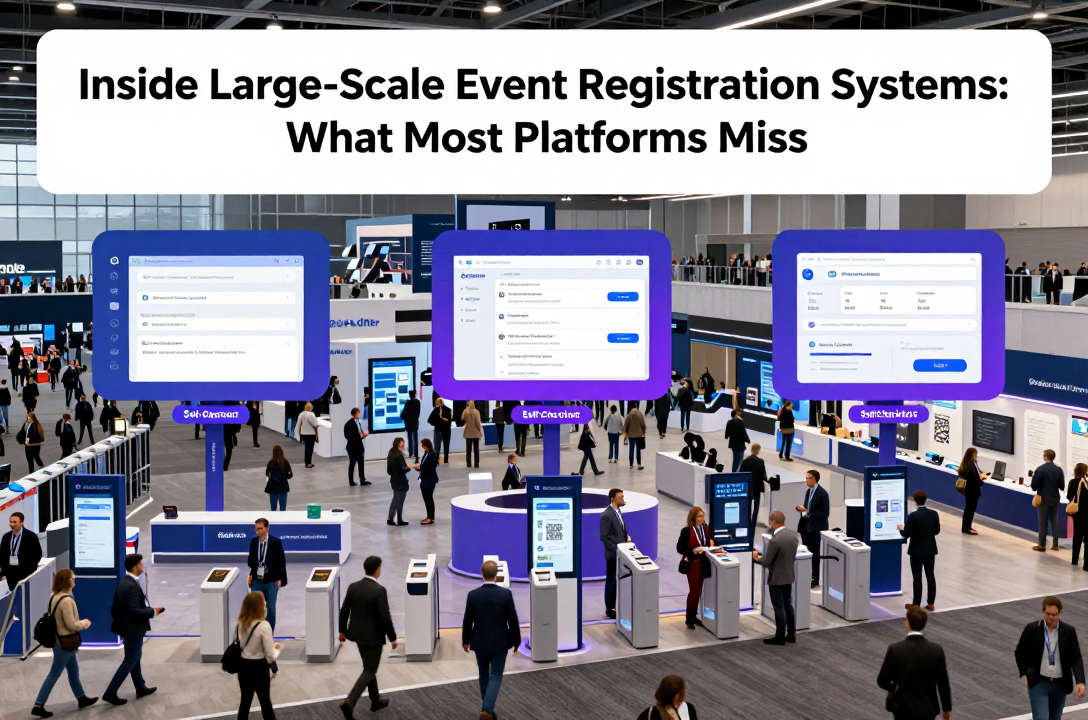
The best event registration software is not optimized for forms but for event ecosystems that go far beyond the basic technologies that collect attendee information. Most platforms want to be in the race to become the ideal solution.
But what they are missing is the understanding of the system. The right solution is not engineered to solve issues but also to prevent any further issues. Registrations act as the door to events, and making them functional should be the goal. A decorative gate will attract the audience, but an effective one will make them go inside it.
What Are Event Registration Systems Prioritizing?
Most registration systems are focused on solving the wrong layer of problems and not the actual ones that lead to real challenges.
The current platforms are invested in:
- Fast Setup
- Ticket Issuance
- Collecting Payments
- Detailed Information Collection
- Building Attractive Landing Pages
- Integrating Marketing Strategies
- Displaying Dashboard Metric
- Basic Attendee Management
But an effective event registration system is not built only to help organizers speed up the event; the right solution is meant to integrate features that make the event experience memorable for attendees. This, in turn, will boost the revenue and make the event a commercial success for businesses while ensuring a seamless flow of processes.
What Do Most Large-Scale Event Registration Platforms Miss?
Handling large-scale event registrations is a demanding task and requires a proper understanding of the event environment to be successful. But most platforms are heavily focused on meeting industry standards that don’t reflect long-term continuity for events.
The industry is targeting factors such as:
- Ease of Depyoment
- Template-driven workflows
- Surface-level UX
- Sales Enablement
- Short Onboarding cycles
- Feature Checklists
These are suitable key areas to focus on when the event is small-scale and involves simple webinars or conferences. But the same pointers are not true for large-scale events.
Dealing with registrations for large audiences requires the focus to shift from planning around an event to building an event registration system that makes the whole event ecosystem reliable and efficient for organizers.
Here are 5 key areas that the current platforms need to conquer to meet the demands of a large-scale event registration platform.
- Stop Treating Attendees Just as Users with Registration Status
Most platforms are still focused on attendees only as simple statuses, registered or not registered.
But large-event environments require more than a status; the attendees are a crucial part and need to be associated with advanced identities that validate them and assign them permissions and access to event software features, and not just be classified into a tag centered around registration.
- Build Infrastructure That Supports the Right Capacity
Event registration systems often miss the accuracy part or fake it. Leading to seats being allocated even after the actual event seating limits are exceeded. Enforce advanced mechanisms that integrate the inventory systems into the platform with precision to prevent overbooking.
- Architecture is Not About Isolated Systems
Platforms are used to treat each event as a separate part of the system, which can be dangerous for large-scale events. The best systems are those looking at the big picture and understand how one system affects the other. Move towards designing event tech solutions that are identity-centric and not event-centric.
- Dashboards With Basic Metrics Aren’t Sufficient Anymore
Event registration solutions in 2026 are not about basic reports and insights that show how many attendees are registered. The technologies now allow the platforms to build systems that are capable of showing advanced trends and ROI based dashboards to analyze the attendee behaviour, and not only the number of attendees.
- Understand Registrations Aren’t Static Decisions
Visitors can come anytime, making it pivotal to engineer systems that are capable of converting those visitors to attendees. Not everyone in the audience will be a pre-registered user when it comes to a large-scale event. Ensure the platform is efficient enough to handle bookings on the spot with effortless and streamlined flow.
Core of a Beneficial Event Registration System for Large-Scale Events?
The core of a truly effective event registration system for large-scale events lies in operational excellence and not in collecting information and issuing tickets. The best platforms are built when the 5 layers of the system work together with seamless coordination.
The 5 Layers to Designing an Ideal Platform
- Identity Layer: Modern systems have to understand who the audience is and how they behave, to make the platform aligned with their needs.
- Orchestration Layer: This layer deals with the dynamic operational workflow, ensuring that different fragments of the system work together as a coordinated ecosystem.
- Real-Time Infrastructure Layer: The actual scalability lies in the architecture. Truly capable platforms are designed to meet real-time needs effortlessly with minimal latencies,
- Intelligence Layer: The layer that defines how the system is going to process the steps by providing advanced insights and patterns of the event data.
- Ecosystem Layer: Platforms are now seamlessly integrating multiple event tools into one system to improve productivity and coordination.
Conclusion
On a final note, most event registration systems are not failing at managing large-scale events because they are unreliable, but the key reason lies in the fact that they are designed to solve problems that don’t align with their requirements for a large crowd. The first step towards building the best system is no longer event thinking but systems thinking.