
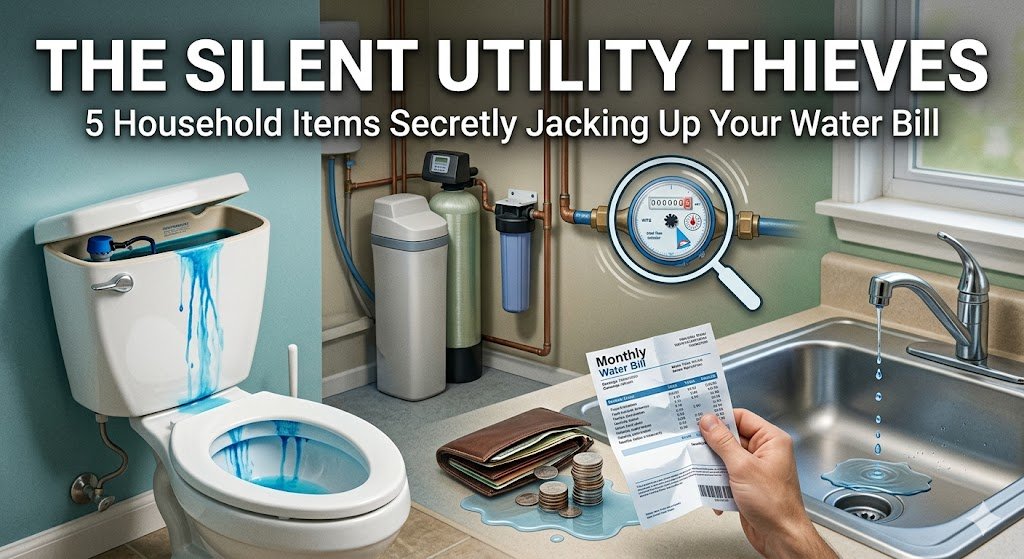
Opening your monthly utility statement shouldn’t feel like watching a horror movie. Yet, thousands of homeowners experience that sudden jolt of panic when their water bill inexplicably spikes. You haven’t filled up a swimming pool, you haven’t taken three-hour showers, and your daily routine hasn’t changed—so where on earth is all that water going?
The truth is, water leaks rarely announce themselves with a dramatic, ceiling-rupturing burst pipe. More often, they act as silent utility thieves: small, hidden failures in everyday household items that quietly bleed gallons of water down the drain every single hour.
If your bills are climbing, it’s time to play detective. Let’s look at the five most common household items secretly draining your wallet and how to stop them.
1. The Running Toilet (The Master Thief)
The absolute king of hidden water waste is the standard household toilet. A single toilet with a degraded internal mechanism can waste up to 200 gallons of water per day. Because the water flows directly down the internal overflow tube and into the sewer line, it is often completely silent.
This is almost always caused by a warped or brittle flapper valve—the rubber disk at the bottom of the tank that seals the water in. Over time, chemical cleaners and hard water minerals cause the rubber to decay, allowing a continuous stream of water to weep through.
The DIY Dye Test: Drop a few drops of food coloring into your toilet tank and leave it alone for 20 minutes without flushing. If the color creeps into the toilet bowl, your flapper is compromised and needs an immediate swap.
2. The Dripping Faucet
It’s easy to ignore a slow, rhythmic drip… drip… drip from a bathroom or kitchen sink. You figure it’s just a couple of drops, right?
In reality, a faucet that drips just 10 times per minute wastes around 350 gallons of water a year. If you have multiple fixtures weeping, or if the drip turns into a steady stream, you are essentially throwing cash right down the drain. This is typically caused by a worn-out O-ring, corroded valve seat, or a failing ceramic cartridge inside the handle. If left unaddressed, the constant moisture will eventually ruin your sink’s finish and cause structural rot inside your cabinetry. Seeking out a timely leaky faucet repair houston can resolve the drip long before it causes structural damage to your counters.
3. Hidden Slab Leaks
The most sinister utility thief doesn’t live under your sink—it lives underneath your entire house. Many modern homes are built on concrete slab foundations, with the main water lines running directly through or beneath the concrete.
When the ground shifts, or when old copper pipes suffer from chemical corrosion, these underground lines can crack. Because the water escapes into the dirt beneath your home, you won’t see a puddle. Instead, you might notice warm spots on your linoleum or tile, a mysterious musty smell, or a water meter that spins frantically even when everything in the house is shut off. Pinpointing this issue early requires professional slab leak repair houston to isolate the broken line before the escaping water undermines your home’s structural foundation.
Water Waste Breakdown by Household Fixture
To put things into perspective, look at how much a minor defect in your daily plumbing fixtures can cost you over time:
| Fixture Issue | Average Daily Water Waste | Severity Level | Primary Cause |
| Warped Toilet Flapper | 100 – 200 Gallons | High | Chemical erosion / Age |
| Dripping Sink Faucet | 1 – 5 Gallons | Low | Worn-out rubber O-rings |
| Stuck Water Softener | 50 – 100 Gallons | Medium | Valve mechanical failure |
| Underground Slab Leak | 200+ Gallons | Critical | Ground shifting / Pipe corrosion |
4. Water Softeners and Whole-House Filters
If your home uses a water softener or an advanced filtration system, it has a built-in backwash cycle designed to flush out accumulated minerals and contaminants. During this cycle, the system naturally directs wastewater straight into your drainage lines.
However, if the system’s internal control valve gets stuck, it can trap the unit in a continuous, endless backwash loop. Because these systems are usually tucked away in a garage, basement, or utility closet, a malfunctioning softener can silently dump hundreds of gallons of treated water down the drain for weeks before anyone notices.
5. Main Line Blockages and Overflow Valves
When deep structural clogs develop within your wastewater system, it changes the internal pressure dynamics of your home’s entire plumbing network. This backpressure can stress joints or force your water heater’s temperature-and-pressure (T&P) relief valve to weep continuously to keep the system from cracking.
Furthermore, recurring backups can hide small hairline pipe fractures that slowly seep water behind your walls every time a fixture drains. If your sinks are draining sluggishly or your toilets frequently gurgle, investing in professional clogged drain repair houston will restore the proper volumetric flow to your system, stabilizing the internal pressure and protecting your fixtures from hidden, stress-induced leaks.
How to Catch the Thieves
The absolute best way to check if your home has a silent leak is to conduct a water meter check.
Turn off every single water-consuming appliance in your home—no washing machines, no dishwashers, and no running faucets. Walk out to your water meter box and look at the dial. If the small low-flow indicator triangle is spinning, or if the digital read-out numbers are actively climbing while your house is completely dark, you have a leak. Finding these hidden utility thieves early is the easiest way to preserve your home’s structural integrity and bring your monthly utility bills back down to earth.
