
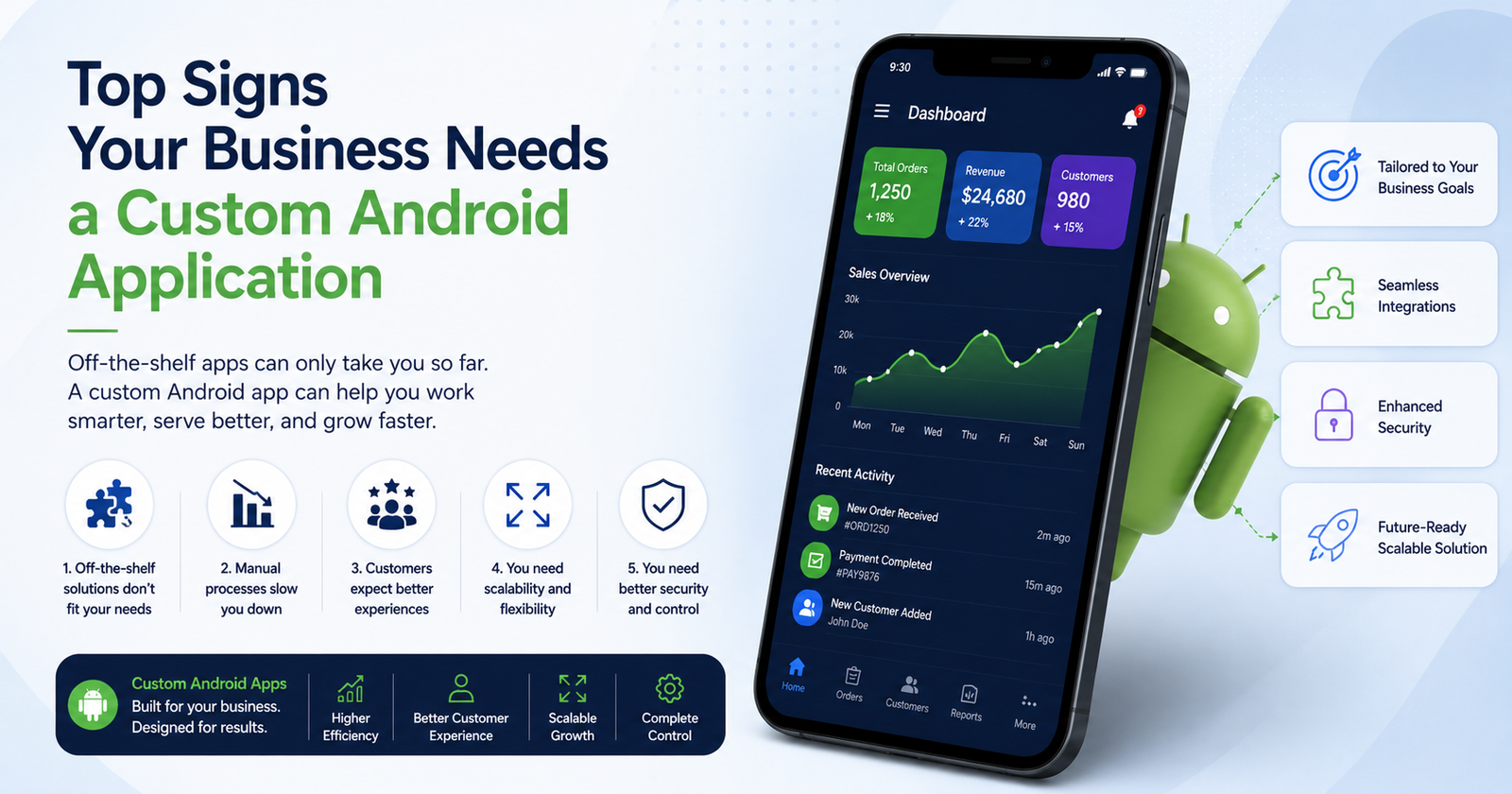
Mobile technology has become a core component of modern business operations. Organizations across industries now rely on mobile applications to improve customer engagement, support employees, manage workflows, and provide access to critical business information from virtually any location.
The market data reflects this growing dependence on mobile platforms. According to StatCounter’s 2025 global operating system statistics, Android continues to dominate the mobile operating system market with a share exceeding 70% worldwide. At the same time, research from Gartner indicates that enterprise mobility remains a top investment priority as businesses seek better operational visibility, workforce productivity, and customer experience. IDC also reports that organizations continue to increase investments in mobile-first digital transformation initiatives to support distributed teams and real-time business operations.
When Standard Software Starts Holding the Business Back
Many organizations begin their digital journey using commercially available applications.
This approach makes sense in the early stages. Generic solutions offer faster deployment and lower upfront costs.
However, as operations grow more complex, businesses often discover that standard software forces them to adapt their processes to the software rather than the other way around.
Employees begin creating workarounds.
Teams rely on spreadsheets alongside existing applications.
Departments use separate tools to compensate for missing functionality.
These are often the earliest indicators that current technology no longer aligns with operational requirements.
A custom Android application becomes relevant when technology starts limiting efficiency instead of supporting it.
Sign #1: Employees Depend on Multiple Systems to Complete One Task
One of the clearest indicators of a technology gap appears when employees constantly switch between applications.
For example, a field technician may need to:
- Access customer information from a CRM
- Retrieve work orders from another platform
- Update inventory records separately
- Submit reports through email
Each additional step increases complexity and creates opportunities for error.
A custom Android application can consolidate these activities into a single interface, reducing friction and improving information accessibility.
Organizations with fragmented workflows often experience productivity losses that remain hidden until operational inefficiencies become significant.
Sign #2: Real-Time Information Is Difficult to Access
Modern business decisions increasingly depend on real-time data.
Managers need immediate visibility into:
- Inventory levels
- Service requests
- Delivery status
- Production metrics
- Customer interactions
- Workforce activity
When employees must wait for reports, access desktop systems, or contact multiple departments to obtain information, decision-making slows considerably.
A custom Android application allows organizations to provide secure mobile access to operational data, enabling employees and managers to make informed decisions based on current conditions rather than historical information.
This capability becomes particularly valuable for industries such as logistics, manufacturing, healthcare, utilities, and field services.
Sign #3: Customer Expectations Have Outgrown Existing Digital Channels
Customer expectations continue to evolve rapidly.
Consumers and business buyers increasingly expect:
- Self-service functionality
- Mobile accessibility
- Real-time updates
- Personalized experiences
- Faster response times
Generic applications may provide basic functionality but often struggle to deliver experiences tailored to specific customer requirements.
Consider a logistics company whose customers require shipment tracking, service requests, document access, and account management through a mobile interface.
An off-the-shelf solution may address some of these needs but rarely all of them.
A custom Android application enables businesses to design experiences around customer expectations rather than software limitations.
Sign #4: Business Processes Are Highly Specialized
Many industries operate with workflows that differ significantly from standard software assumptions.
Examples include:
Manufacturing
Equipment inspections, production reporting, and maintenance workflows often require specialized interfaces.
Healthcare
Organizations must manage patient information, compliance requirements, and operational processes unique to clinical environments.
Logistics
Shipment tracking, fleet monitoring, warehouse operations, and transportation workflows frequently require customized functionality.
Utilities
Field technicians often need access to asset information, maintenance records, and outage reporting tools.
When workflows become highly specialized, custom applications often provide greater operational value than generic platforms.
Sign #5: Existing Software Does Not Integrate Well with Business Systems
Technology ecosystems continue to expand.
Most organizations use multiple systems, including:
- ERP platforms
- CRM systems
- Inventory management software
- Financial applications
- IoT platforms
- Customer support solutions
When these systems operate independently, employees spend significant time transferring information manually.
Data inconsistencies become common.
Reporting accuracy declines.
A custom Android application can serve as a centralized interface that connects multiple systems and provides users with a unified operational view.
This integration capability often becomes a major factor driving custom application development projects.
Sign #6: Field Teams Struggle with Operational Efficiency
Organizations with mobile workforces frequently encounter challenges related to information access and reporting.
Field employees often work in environments where immediate access to business systems is essential.
Examples include:
- Service technicians
- Delivery personnel
- Healthcare professionals
- Utility workers
- Construction teams
When field teams rely on paper forms, manual updates, or delayed reporting processes, operational efficiency suffers.
A custom Android application enables workers to access information, capture data, complete inspections, and communicate with headquarters directly from their mobile devices.
The impact extends beyond productivity and often improves service quality and operational visibility.
A Real-World Example: Coca-Cola’s Mobile Sales Transformation
A notable example of enterprise mobile transformation comes from Coca-Cola bottling operations.
Sales representatives working in the field needed faster access to customer information, inventory availability, sales history, and ordering systems.
Mobile solutions enabled sales teams to perform critical activities directly from customer locations rather than relying on office-based systems.
The result included improved sales execution, better customer engagement, and more efficient field operations.
The example illustrates how mobile applications can become operational tools rather than simply customer-facing products.
Businesses facing similar challenges often discover that mobile technology delivers the greatest value when designed around specific operational requirements.
Sign #7: Business Growth Is Creating Scalability Challenges
Many organizations reach a point where existing software cannot support growth effectively.
Common symptoms include:
- Performance limitations
- Reporting delays
- Increased manual work
- Difficulty onboarding new users
- Inconsistent customer experiences
As transaction volumes increase, operational complexity grows.
Custom applications allow businesses to design scalable architectures that accommodate future expansion without introducing excessive operational overhead.
Scalability should not be viewed solely as a technical concern. It also affects customer satisfaction, employee productivity, and long-term business performance.
Why Businesses Often Choose Custom Android Development
Android’s global market dominance makes it a practical choice for many organizations.
The platform supports a wide range of devices, deployment models, and enterprise use cases.
As a result, businesses frequently partner with an experienced Android app development company to create solutions tailored to their operational needs.
Unlike generic applications, custom Android solutions can:
- Integrate with existing business systems
- Support unique workflows
- Provide stronger control over security
- Enable industry-specific functionality
- Scale alongside business growth
Organizations seeking long-term operational flexibility often find that professional Android app development Services provide greater strategic value than relying exclusively on off-the-shelf software.
Measuring the Business Impact
A custom Android application should deliver measurable business outcomes rather than simply adding another technology platform.
Organizations commonly evaluate success through metrics such as:
Operational Improvements
- Reduced task completion times
- Faster reporting cycles
- Improved workforce productivity
- Fewer manual processes
Customer Experience Improvements
- Faster response times
- Increased engagement
- Better service accessibility
- Higher customer satisfaction
Financial Outcomes
- Reduced administrative costs
- Improved resource utilization
- Increased revenue opportunities
- Lower operational inefficiencies
While results vary across industries, organizations frequently report significant productivity and visibility improvements after replacing fragmented workflows with mobile-first solutions.
Choosing the Right Development Approach
Not every business requires a custom mobile application.
However, organizations experiencing workflow bottlenecks, integration challenges, limited scalability, or increasing customer demands should carefully evaluate their current technology environment.
The most successful projects begin with business objectives rather than technical features.
Companies should identify operational challenges, user requirements, integration needs, security considerations, and future growth expectations before starting development.
This approach ensures that the resulting application supports business outcomes rather than simply introducing new technology.
Final Thoughts
Custom Android applications have become increasingly important as organizations navigate growing operational complexity, evolving customer expectations, and expanding digital ecosystems.
While off-the-shelf solutions can address basic requirements, they often struggle to support specialized workflows, real-time information access, complex integrations, and long-term scalability.
Businesses that experience fragmented processes, limited visibility, inefficient field operations, or growing technology constraints should view these challenges as potential indicators that a custom solution may be necessary.
By working with an experienced Android app development company and leveraging professional Android app development Services, organizations can create mobile applications aligned with their operational goals, customer requirements, and future growth strategies.
The most effective mobile solutions do not simply replicate existing processes. They help businesses improve visibility, simplify operations, and create a stronger foundation for long-term digital transformation.
