
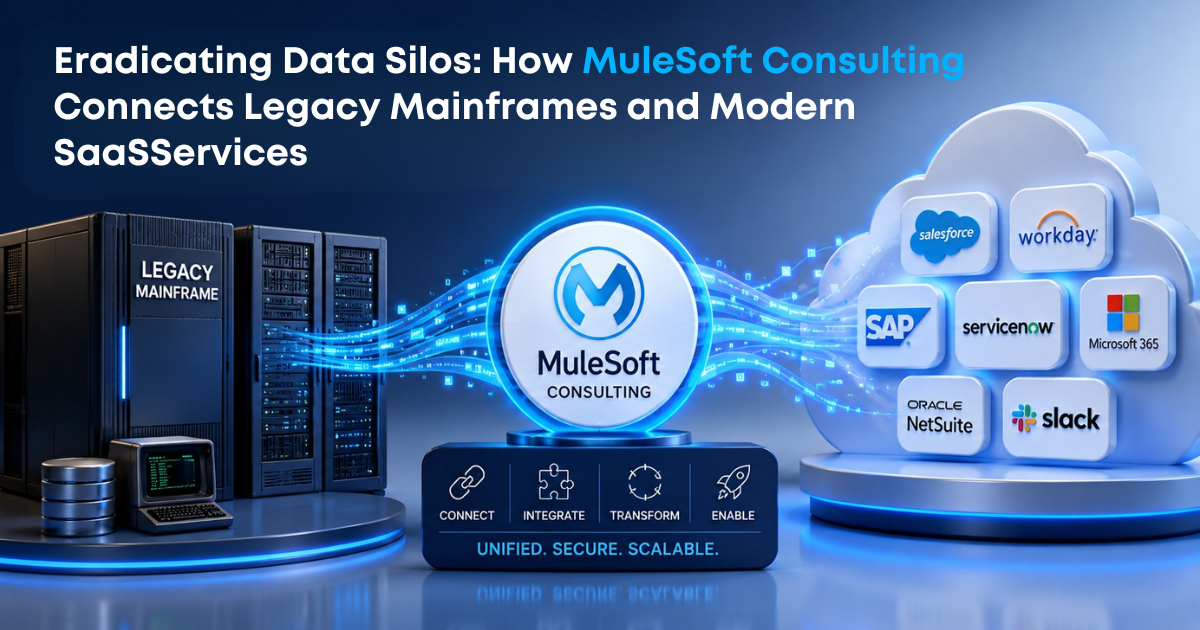
Enterprise data architectures often resemble geological layers. Deep at the foundation lie legacy mainframes. These systems have handled core transactional data for forty years. High above this foundation sit modern Software-as-a-Service (SaaS) applications. These cloud tools manage modern customer engagement and digital workflows.
Unfortunately, these two layers rarely speak the same language. This separation creates permanent data silos. Information stays locked within specific applications. Consequently, business units operate with fragmented views of corporate reality.
Experienced companies utilize specialized MuleSoft Consulting to solve this issue. Professional integration architects construct stable data bridges across the enterprise. This technical guide explains how MuleSoft Consulting Services connect old mainframes with modern cloud ecosystems.
The Technical Challenge of Legacy Mainframe Integration
Mainframes remain highly reliable engines for high-volume transactions. Major banks, insurance firms, and logistics providers run their core operations on IBM z/OS environments. However, these systems present major integration hurdles for modern cloud applications.
1. Understanding EBCDIC and COBOL Data Structures
Modern cloud services transmit data using lightweight JSON payloads encoded in UTF-8. Mainframes use Extended Binary Coded Decimal Interchange Code (EBCDIC). This structural format uses a completely different binary representation for alphanumeric characters.
Additionally, mainframe data lives inside flat files defined by COBOL Copybooks. These files lack the self-describing metadata found in modern schemas. A cloud application cannot parse a raw mainframe data block directly.
2. The Problem of Synchronous Processing Saturation
Mainframes process transactions using programs like CICS (Customer Information Control System). These routines rely on synchronous processing loops.
Modern SaaS applications generate thousands of rapid API requests per second. Flooding an older mainframe with these direct cloud queries causes CPU saturation. This spike increases operational costs and can cause complete system failures.
The MuleSoft API-Led Connectivity Blueprint
To connect these disparate worlds, integration architects reject old point-to-point connections. Instead, they implement the MuleSoft three-layer API-led connectivity model. This architectural framework separates integration tasks into distinct functional layers.
1. The System API Layer
System APIs sit closest to the core data sources. They hide the technical complexity of underlying systems.
A Mainframe System API handles low-level communication details. It manages protocols like IBM MQ or TN3270 terminal emulation. This API exposes clean, standard REST endpoints to the upper integration layers.
2. The Process Layer
The Process Layer isolates specific business logic from the underlying databases. It combines data across multiple System APIs to create a unified data object.
For instance, a CustomerUnification Process API queries the Mainframe System API to retrieve a client’s historical ledger data. Simultaneously, it queries a Salesforce System API to pull current contact records. It merges these inputs into a single, comprehensive customer profile.
3. The Experience Layer
The Experience Layer formats the unified data for specific digital consumption channels. A mobile app requires a compact, stripped-down JSON payload to conserve mobile bandwidth. An enterprise web portal requires an expanded data array.
Experience APIs transform the same underlying process data into different formats. This approach ensures optimal performance across various digital devices.
Technical Mechanisms for Mainframe Data Extraction
Transforming mainframe data requires specialized connector configurations. MuleSoft Anypoint Platform provides multiple technical pathways to interface with legacy hardware.
1. Utilizing the Anypoint Connector for IBM iSeries
Architects use the native IBM iSeries connector to execute remote program calls (Remote Command/Program Call). The connector interfaces directly with the mainframe back-end.
It reads binary data structures and maps them into standard Java objects within the Mule runtime. This eliminates the need to write custom translation code.
2. Parsing Copybooks via DataWeave 2.0
DataWeave 2.0 serves as the primary data transformation engine in Mule 4. It handles complex file conversions with high efficiency.
Consultants load the raw COBOL Copybook schema file directly into the Anypoint Studio environment. DataWeave uses this schema definition to parse flat EBCDIC files. It transforms the positional binary fields into structured JSON arrays automatically.
3. Implementing Event-Driven Architecture with Anypoint MQ
Direct synchronous queries can easily overwhelm legacy mainframes. To protect these older systems, architects implement asynchronous event-driven integration patterns.
When a SaaS platform generates a data update, MuleSoft writes that message to an Anypoint MQ queue. A message consumer flow pulls records from this queue at a controlled rate. This architecture buffers the mainframe from sudden transaction spikes.
Connecting Modern SaaS Applications
Cloud platforms like Salesforce, Workday, and ServiceNow change their schemas frequently. MuleSoft decouples these cloud systems from your core enterprise infrastructure.
1. Leveraging Object Store v2 for State Management
SaaS platforms frequently use webhooks to announce real-time data modifications. MuleSoft flows capture these inbound HTTP notifications instantly.
Architects use Object Store v2 to cache transaction IDs and session states during these events. This caching prevents the processing of duplicate webhooks and maintains data consistency across systems.
2. Managing API Governance via Anypoint Flex Gateway
Connecting internal mainframes to external public clouds creates new security risks. Companies deploy Anypoint Flex Gateway at the edge of their private data networks to mitigate these threats.
The gateway enforces strict security policies on all inbound SaaS traffic. It manages authentication through JSON Web Tokens (JWT) and controls traffic volumes with rate-limiting rules. This technical boundary blocks malicious requests before they ever reach your internal mainframe components.
Real-World Scenario: Core Banking Modernization
Consider a commercial retail bank operating an IBM z15 mainframe running a legacy DB2 database. The institution deploys Salesforce Financial Services Cloud to modernize its customer service operations.
1. The Operational Data Silo
When a retail client updates their physical address on the Salesforce mobile application, the change remains isolated in the cloud. The legacy mainframe continues to print statements using the old address data.
Manual batch synchronizations run only once every 24 hours. This delay results in failed deliveries, security compliance violations, and frustrated consumers.
2. The MuleSoft Integration Solution
The bank engages MuleSoft Consulting Services to build an automated integration pipeline. The consultants construct a bidirectional API architecture.
- A consumer modifies their address profile in the mobile application.
- Salesforce issues a streaming event notification to the MuleSoft Experience API.
- The Process API cross-references the address data against an external postal verification service.
- The Mainframe System API converts the verified JSON string into a structured EBCDIC block.
- The system writes the new data directly to the mainframe database via an IBM MQ message channel.
This entire automated transactional process completes in under two seconds. The system updates both platforms simultaneously without needing human data entry.
Best Practices for MuleSoft Integration Projects
Successfully connecting mainframes to modern SaaS systems requires a disciplined development strategy. Organizations should follow these engineering principles to ensure optimal performance.
1. Implement Caching Strategies
Mainframe computing power is expensive, measured in Millions of Service Units (MSUs). Minimize direct mainframe queries by caching static data within MuleSoft.
Store stable information like product catalog codes or regional branch lists in an enterprise cache layer. This reduces mainframe CPU utilization and lowers overall infrastructure costs.
2. Enforce Automated Error Handling
Distributed cloud architectures encounter frequent network disruptions. Design comprehensive, global error-handling strategies within your Mule application flows.
Use MuleSoft’s Error Mapping tools to categorize technical failures. For instance, separate temporary network timeouts from permanent data validation errors.
Error Condition: Timeout -> Action: Trigger Reconnection Strategy (Retry 3 Times)
Error Condition: Invalid Data Schema -> Action: Send Message to Dead Letter Queue (DLQ)
3. Utilize MUnit for Continuous Integration
Legacy infrastructure changes carry significant operational risks. Build automated testing suites using the MUnit framework for every Mule integration flow.
MUnit allows developers to mock mainframe responses completely. This enables teams to test complex transformation logic without touching real production hardware. Run these automated test configurations inside your CI/CD pipelines to catch bugs before deployment.
Key Performance Indicators Influenced by Modern Integration
Moving from legacy point-to-point connections to an API-led architecture delivers clear business and technical benefits. Organizations track specific metrics to measure their integration return on investment.
| Performance Metric Category | Legacy Architecture Baseline | Optimized MuleSoft Architecture | Average Real-World Improvement |
| New API Asset Reuse Rate | 0% (Custom Point-to-Point) | 35% to 45% shared assets | 40% reduction in build times |
| Data Synchronization Latency | 24-hour batch processing | Sub-second streaming events | 99% faster data availability |
| Mainframe CPU Resource Draw | High unoptimized direct queries | Managed caching and queuing | 20% lower MSU operational costs |
| Project Integration Timeline | 6 to 9 months per project | 6 to 12 weeks via templates | 60% faster time-to-market |
Conclusion
Eradicating enterprise data silos requires a modern architectural strategy. Old point-to-point connections are too fragile to support today’s complex cloud ecosystems. At the same time, replacing core legacy mainframes is often too costly and risky for conservative enterprises.
Partnering with certified MuleSoft Consulting professionals allows organizations to modernize their legacy systems safely. This approach wraps old computing platforms in a secure, scalable layer of modern APIs.
Expert MuleSoft Consulting Services help enterprises connect their legacy back-office systems directly to modern SaaS platforms. This technical integration eliminates manual data entry, reduces operational errors, and creates a unified data foundation. Building a modular, composable architecture ensures your enterprise systems remain stable, agile, and ready for future digital growth.
