
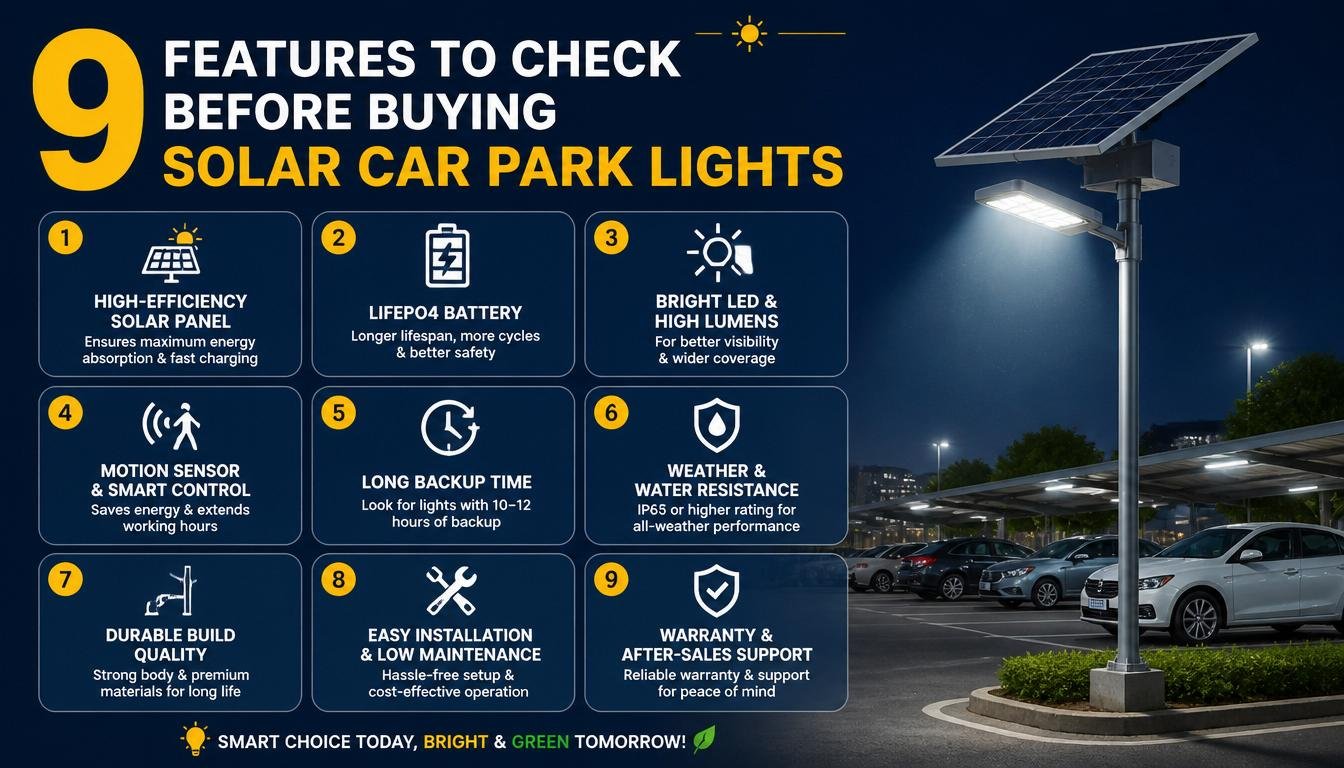
Solar car park lights are outdoor lighting systems powered by solar panels that charge batteries during the day and automatically illuminate parking areas at night. Before buying, check brightness (lumens), battery capacity, solar panel efficiency, motion sensors, weather resistance, compatibility with installation height, light distribution, build quality, and warranty. These features determine performance, safety, and long-term reliability.
Car parks look simple from the outside—just open space, vehicles, and markings. But anyone managing a commercial building, mall, factory, or residential complex knows the truth: a poorly lit parking area creates safety risks, confusion, and security concerns.
That’s why solar car park lights are becoming a popular solution. They reduce electricity costs, eliminate wiring complexity, and offer flexible installation anywhere sunlight is available.
But here’s the catch—not all solar lighting systems perform well in parking environments.
Some fail within months. Others look bright but don’t cover the full area. A few drain too quickly and stop working before midnight.
The difference is in the features you check before buying.
Let’s break down the 9 most important ones so you can choose the right system from the start.
Why Solar Car Park Lights Are Becoming Essential
Parking areas need consistent, wide-area illumination. Traditional lighting systems require wiring, trenching, and ongoing electricity costs.
Solar car park lights solve these problems by offering:
- Off-grid operation
- Low maintenance requirements
- Fast installation
- Automatic dusk-to-dawn lighting
- Better scalability for large spaces
But performance depends entirely on product selection.
1. Brightness (Lumens Output)
Brightness is the first and most important factor.
Why it matters:
Car parks need uniform lighting to ensure safety and visibility for drivers and pedestrians.
Typical requirements:
- Small parking lots: 1500–3000 lumens
- Medium car parks: 3000–6000 lumens
- Large commercial areas: 6000+ lumens
What happens if you ignore it:
- Dark corners between vehicles
- Reduced security visibility
- Uneven lighting zones
Pro tip:
Don’t just buy “high power” labels—always check actual lumen output.
2. Battery Capacity and Type
The battery determines how long your solar car park lights can operate after sunset.
Best battery types:
- Lithium-ion
- LiFePO4 (best for long life)
What to look for:
- Minimum 8–12 hours backup
- High cycle life (2000+ cycles)
- Temperature resistance
Real-world issue:
Cheap batteries may work well initially but degrade quickly, especially during cloudy or rainy seasons.
3. Solar Panel Efficiency
The solar panel is the charging engine of the system.
Key considerations:
- Monocrystalline panels (higher efficiency)
- Fast charging capability
- Proper wattage for battery size
Why it matters:
If the panel is weak, the battery never fully charges—leading to dim or short-night lighting.
Common mistake:
Installing panels in shaded or partially covered areas reduces efficiency drastically.
4. Motion Sensor Technology
Modern solar car park lights often include motion sensors to save energy.
Benefits:
- Extends battery life
- Increases brightness when needed
- Improves security response
Types:
- PIR sensors (infrared motion detection)
- Microwave sensors (more sensitive, wider range)
Best use case:
Security-focused parking areas where activity is intermittent.
5. Weather Resistance (IP Rating)
Parking areas are exposed to rain, dust, heat, and wind.
Look for:
- IP65 or higher rating
- Waterproof sealing
- Dust-proof construction
Why it matters:
Without proper protection, internal circuits can fail during monsoon or dusty conditions.
Real impact:
Weather damage is one of the most common reasons for early solar light failure.
6. Light Distribution Angle
It’s not just about brightness—it’s about coverage.
What to check:
- Wide beam angle (120°–180° preferred)
- Even light spread
- Reduced glare for drivers
Why it matters:
Poor distribution creates dark patches and unsafe zones between parked vehicles.
Pro tip:
Wider angles are better for car parks than narrow spot beams.
7. Mounting Height Compatibility
Height affects both coverage and effectiveness.
Recommended heights:
- Small parking lots: 3–5 meters
- Medium areas: 5–7 meters
- Large commercial zones: 7–10 meters
Common mistake:
Installing lights too low causes glare; too high reduces brightness at ground level.
Best practice:
Match pole height with lumen output and spacing design.
8. Build Quality and Material
Durability is critical for outdoor lighting systems.
Best materials:
- Aluminum alloy housing
- Tempered glass panels
- Corrosion-resistant coatings
Why it matters:
Parking environments often include heat exposure, vehicle emissions, and physical impacts.
What poor quality causes:
- Rusting
- Cracked panels
- Loose fittings
- Reduced lifespan
9. Warranty and After-Sales Support
Many buyers overlook this—but it’s crucial.
What to check:
- Minimum 1–3 year warranty
- Battery replacement policy
- Spare parts availability
- Local support service
Why it matters:
Even good solar car park lights may need maintenance over time. Support ensures long-term reliability.
Common Mistakes Buyers Make
Even with good products available, many installations fail due to planning errors.
Frequent issues:
- Underestimating brightness needs
- Ignoring panel placement direction
- Choosing cheapest battery option
- Poor spacing between lights
- Not considering traffic flow
How to Choose the Right Solar Car Park Lights
A good decision comes from balancing all 9 features:
✔ Bright enough for full coverage
✔ Strong battery backup
✔ Efficient solar charging
✔ Weatherproof build
✔ Proper installation height
✔ Wide light distribution
When all these factors align, performance becomes consistent and reliable.
Final Thoughts
Parking areas are one of the most important safety zones in any property, and lighting plays a key role in how secure and usable they are at night.
Choosing the right solar car park lights is not just about buying a product—it’s about designing a reliable lighting system that works every night without failure.
When you focus on the right features instead of just price, you get:
- Better visibility
- Improved safety
- Lower maintenance
- Long-term energy savings
In the end, smart selection today prevents expensive problems tomorrow.
