
Let me start by answering the question that every parent asks first, usually in a hushed voice across my desk: “Will my child actually get in?” It is a fair question, especially when you are looking at universities in a country you have never visited, with a system you do not fully understand.
Over the years, I have guided dozens of Indian students to the Bangor University in UK for their law degrees. And every single time, the same confusion comes up about acceptance rates. People see different numbers online some low, some high and they panic. So let me clear this up once and for all.
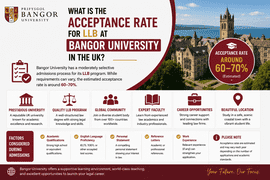
Bangor University does not publish a specific acceptance rate for its LLB program. But based on our placement data and the university’s overall admissions patterns, it falls in the range of 40-60% for international students. That is not Oxford or Cambridge levels of competition. It is a university that is selective in a fair, transparent way.
To put that number in perspective, consider the broader UK law school landscape. At University College London (UCL), the LLB acceptance rate for international students is around 13%. At the London School of Economics (LSE), the overall undergraduate offer rate is about 16.3%. Bangor sits comfortably on the other side of the spectrum—selective enough to matter, but not so cutthroat that it excludes students with decent academic records.
What It Actually Takes to Get In
Instead of obsessing over a percentage that the university does not even publish, focus on the things you can control: your marks, your English score, and your application.
For Indian students applying to study LLB in UK at Bangor, the typical entry requirements are:
Class 12 marks: Between 65% and 85% depending on the board. The standard requirement for most law courses at Bangor is around 75% to 80%. For some combined degrees, the requirement drops to 65% from Central and State Boards.
English language: IELTS 6.5 overall, with no band lower than 5.5 or 6.0. PTE Academic 62 and TOEFL 85 are also accepted.
One thing I really appreciate about Bangor is that they do not make you jump through unnecessary hoops. There is no LNAT requirement, unlike Oxford, Cambridge, or LSE. You simply apply through UCAS with your marks and a strong personal statement.
The LLB degree is a three-year program, though some combined honours courses run for four years. The university also offers a Foundation Year pathway for students who do not meet the standard entry requirements, a genuine lifeline for many Indian students.
The Cost Reality
Now let us talk about money, because that is the other half of the equation.
The standard LLB (Hons) Law tuition fee for international students at Bangor is £18,000 per year for September 2026 entry according to the university’s official fees table. Some online sources quote £17,000 per year, but the official Band A Arts, Humanities, and Law rate for September 2026 is confirmed at £18,000.
For combined honours courses like Law with Politics or Law with Philosophy and Religion, the tuition is around £15,000–£17,000 per year.
That brings your total three-year undergraduate tuition to roughly £45,000–£54,000 (approximately ₹48–57 lakh at current exchange rates). Living costs add another £3,600–£5,000 per year depending on your accommodation and lifestyle.
Compared to a London law school where tuition alone can hit £30,000–£40,000 annually, Bangor’s pricing is competitive without being suspiciously cheap.
Scholarships That Make a Difference
Here is where Bangor becomes genuinely interesting for Indian students on a tight budget.
The university offers a range of scholarships specifically for international undergraduates:
- International Scholarship (Undergraduate) : Up to £4,000 towards tuition
- Vice Chancellor’s Scholarship: £10,000, available for 10 students
- Bangor Deans Scholarship (Undergraduate) : Up to £6,000
- Bangor Alumni Scholarship: £1,000 for returning graduates
What I tell my students is this: apply early. The Vice Chancellor’s Scholarship deadline for September 2026 intake is 30 May 2026. For the International Scholarship, no separate application is required all international applicants are automatically considered when they submit their application through UCAS. That is a detail most students miss, and it costs them nothing to be in the running.
Why Bangor Law School Stands Out
Before I give you my final verdict, let me tell you why Bangor deserves your attention beyond just the numbers.
The LLB degree at Bangor is recognised as a qualifying law degree by the Bar Standards Board and accredited by the Solicitors Regulation Authority. That means if your goal is to qualify as a solicitor or barrister in England and Wales, this degree counts. Full stop.
The law school has climbed significantly in the rankings over the past few years. In the Guardian University Guide 2024, Bangor was ranked 12th in the UK for Law—ahead of many better-known institutions. In the Guardian Law ranking for 2026, Bangor ranks 18th overall. The Complete University Guide places them at 42nd.
The teaching style at Bangor is another factor. The university emphasises small-group teaching and close student-faculty interaction. Students describe the academic staff as “very approachable” with scheduled drop-in sessions outside of lecture timings.
The Verdict From Our Desk
So, what is the final answer? Is the acceptance rate for LLB at Bangor University good for international students?
Yes, it is. But only if your profile matches what they are looking for.
If you have decent Class 12 marks (75% or above), an IELTS score of 6.5, and a well-written personal statement, your chances of admission are genuinely strong. The 40-60% range is a realistic, achievable target—not a lottery.
Where I see students fail is not in the numbers but in the details: incomplete applications, weak personal statements, missing documents, or applying after deadlines. Those are the things that get you rejected, not the competition.
If your marks are on the lower side, Bangor has pathways. The Foundation Year can get you in if you are willing to put in the work. The combined honours courses sometimes have lower entry thresholds. And the scholarships can make the financial burden manageable.
Bangor is not for everyone. If you need the buzz of a London campus or the prestige of a Russell Group name on your CV, look elsewhere. But if you want a solid, professionally recognised LLB degree from a university that has climbed the law rankings, in a location that is peaceful, affordable, and genuinely supportive of international students Bangor University in UK deserves a serious look.
The application window for September 2026 intake is open. The deadlines are approaching. If you are serious about this path, start your UCAS application now. And do not skip the personal statement. That is where you show them not just your marks, but your story.
That is how you win. Not by chasing an acceptance rate, but by being the kind of student any university would want to accept.