
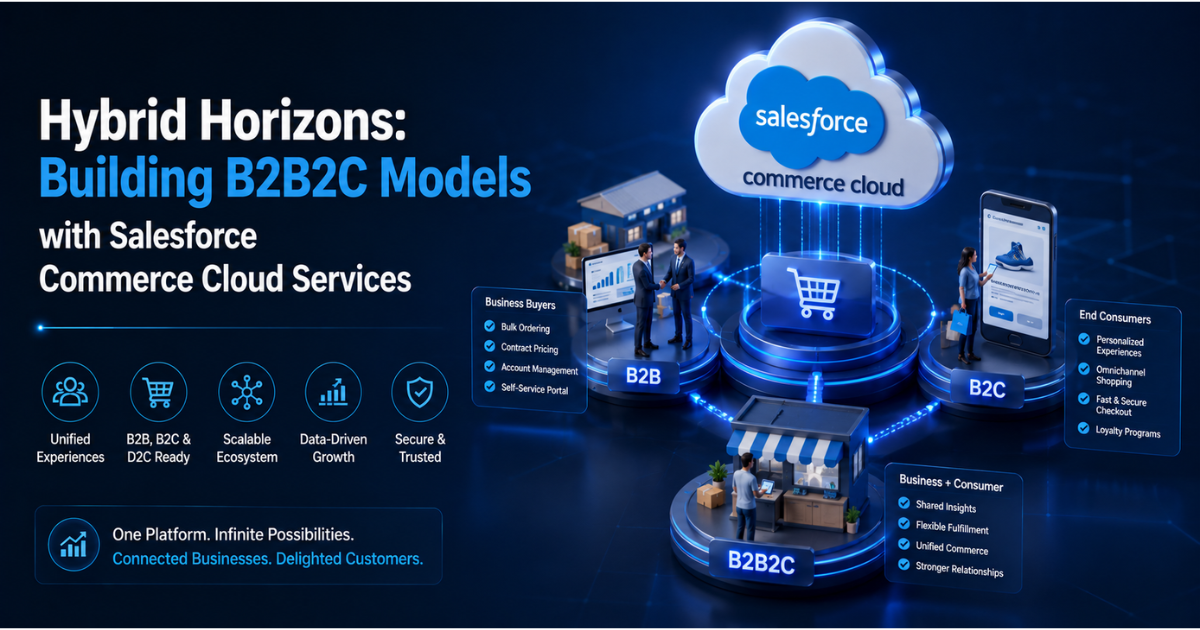
The digital economy is moving away from simple, linear sales models. In the past, companies identified as either Business-to-Business (B2B) or Business-to-Consumer (B2C). Today, these lines are blurry. Many manufacturers now want to reach end consumers without bypassing their loyal distributors. This is the B2B2C (Business-to-Business-to-Consumer) model. It allows a brand to provide products through an intermediary while maintaining a direct relationship with the end-user.
Building this hybrid model requires a sophisticated technical foundation. Salesforce Commerce Cloud acts as the core engine for this evolution. However, a successful rollout requires specialized Salesforce Commerce Cloud Development.
The Rise of the B2B2C Model
Market dynamics are driving the shift to hybrid commerce. Recent statistics from 2024 and 2025 show that 57% of B2B companies now offer some form of direct-to-consumer (D2C) or B2B2C option. Furthermore, 70% of consumers prefer to buy directly from a manufacturer if they can still receive local support or service.
The B2B2C model offers several strategic advantages:
- Access to Consumer Data: Manufacturers gain insights into how end-users interact with products.
- Brand Control: Brands ensure that their story and pricing remain consistent across all channels.
- Partner Loyalty: Distributors receive a commission or service fee for orders placed on the brand’s site.
- Lower Acquisition Costs: Brands leverage the existing customer base of their partners.
Technical Architecture of a Hybrid Storefront
A B2B2C site must handle the complexity of a B2B back-end with the simplicity of a B2C front-end. This requires a unique approach to Salesforce Commerce Cloud Development Services.
1. Unified Data Model
In a standard setup, B2B and B2C data often sit in separate silos. In a hybrid model, these must merge. You need a “Single Source of Truth” for your product catalog, inventory, and pricing.
- Shared Catalog: Use a master catalog that holds all product information. Use “Category Entitlements” to show specific products to specific users.
- Dynamic Pricing Engine: The system must calculate prices in real-time. A distributor might see a wholesale price, while a consumer sees the Suggested Retail Price (SRP).
- Account Hierarchies: Technical teams must configure complex account structures. This ensures that a consumer order is correctly associated with a specific local dealer.
2. Headless Commerce for Flexibility
Many hybrid models use a “headless” approach. This involves decoupling the user interface from the commerce logic.
- Front-End: Use Lightning Web Components (LWC) or React to build a high-speed, consumer-friendly interface.
- Back-End: Use Salesforce Commerce APIs (SCAPI) to pull data from the core engine.
- Agility: This allows you to launch different “heads” for different regions or partner types without rebuilding the core logic.
Strategic Integration Patterns
A B2B2C platform does not live in a vacuum. It must connect to a wide range of external systems. Expert Salesforce Commerce Cloud Development ensures these connections are robust and scalable.
1. ERP and Inventory Integration
Inventory visibility is the biggest technical hurdle. In a B2B2C model, the manufacturer might hold the stock, or the local dealer might hold it.
- Global Inventory View: The system must pull real-time data from the manufacturer’s ERP and multiple dealer systems.
- Order Routing: When a consumer buys a product, the system must decide who ships it. If the local dealer has it in stock, the order routes to them for “Buy Online, Pick Up In Store” (BOPIS).
- Automated Reconciliation: The platform must automatically calculate the dealer’s cut and the manufacturer’s revenue for every transaction.
2. Salesforce Order Management (SOM)
Managing the lifecycle of a hybrid order is complex. SOM acts as the “traffic controller.”
- Order Capture: The platform records the sale.
- Order Orchestration: The system applies logic to determine the best fulfillment path.
- Payment Splitting: Salesforce Payments can split a single transaction. It sends the wholesale portion to the manufacturer and the margin to the dealer.
Personalization Through Data Cloud and AI
Personalization is the key to B2C success. However, in a B2B2C model, it must be informed by B2B data. Salesforce Commerce Cloud Development Services now include deep integrations with Data Cloud and Einstein AI.
1. Creating the Unified Profile
Data Cloud ingests data from every touchpoint. It combines a user’s browsing history on the consumer site with their interaction history at a local dealership.
- Identity Resolution: It links a user’s email address to their offline service records.
- Segment Discovery: AI identifies groups of high-value consumers who are likely to need a replacement part soon.
2. Einstein for B2B2C
AI agents now drive the shopping experience.
- Predictive Recommendations: Show the consumer the right accessories based on what other buyers in their region purchased.
- Agentforce Commerce: Use AI agents to handle complex B2B2C queries. For example, “Is there a local dealer near me who has this specific model in stock for a test drive?”
- Automated Merchandising: The system automatically promotes products that have high stock levels across the dealer network.
Overcoming Technical Challenges
Building a hybrid horizon is not without risks. Developers must address three primary technical challenges.
1. Performance and Latency
Querying multiple dealer inventories in real-time can slow down the site. To prevent this, use a “Caching Strategy.” Cache the inventory data at the “Edge” using an eCDN. Only perform a live check during the final checkout phase.
2. Security and Data Privacy
B2B2C models involve sharing sensitive data between manufacturers and partners. You must implement strict “Sharing Rules” in Salesforce.
- Field-Level Security: Ensure dealers only see data relevant to their customers.
- Consent Management: Use a centralized system to track user preferences across the entire brand ecosystem.
3. Integration Tax
Connecting dozens of different dealer ERPs can lead to “Integration Tax.” This refers to the high cost of maintaining many custom connectors. Instead, use a standardized “API Specification.” Require dealers to push data to a common endpoint. This simplifies the architecture and lowers long-term maintenance costs.
Case Study: Industrial Equipment Manufacturer
Consider a company that sells tractors. Traditionally, they sold only to independent dealerships. By using Salesforce Commerce Cloud, they launched a B2B2C portal.
- The Consumer Experience: A farmer visits the manufacturer’s site. They configure a tractor and choose a local dealer for delivery.
- The Dealer Experience: The dealer receives a pre-configured order. They don’t have to spend hours on a sales pitch. They focus on the delivery and future maintenance.
- The Technical Result: The manufacturer saw a 30% increase in lead conversion. They also gained data on which tractor features were most popular in different climates.
Comparing Models: B2B, B2C, and B2B2C
| Feature | B2B Commerce | B2C Commerce | B2B2C Hybrid |
| Primary Goal | Efficiency & Reordering | Conversion & Brand Loyalty | Partner Enablement & Data |
| Pricing | Contract-based / Tiered | List Price / Promotional | Dynamic based on User Type |
| Order Complexity | Bulk / High Volume | Single Items / Impulse | Single Items with Partner Logic |
| Fulfillment | Single Warehouse | Multi-Node / Carrier | Dealer Network / Hybrid |
| Data Ownership | Account-Level | Individual-Level | Unified Constituent View |
The Future of Hybrid Horizons
The B2B2C model will continue to evolve toward “Hyperautomation.” In the near future, the system will not just route orders. It will predict demand across the entire partner network.
- AI-Driven Stock Rebalancing: If one dealer has too much stock and another has too little, the system suggests a transfer.
- Virtual Showrooms: Using AR (Augmented Reality) to let consumers “place” a product in their home before choosing a local dealer for the final purchase.
- Sustainability Tracking: Consumers increasingly want to know the carbon footprint of their purchase. The platform can calculate the emissions saved by choosing a local pickup over a long-distance shipment.
Conclusion
Building a B2B2C model is a strategic pivot for any modern enterprise. It requires a move away from simple transactions toward a complex, integrated ecosystem. Salesforce Commerce Cloud provides the flexibility to manage these competing needs on a single platform.
Success depends on high-quality Salesforce Commerce Cloud Development Services. You must build a unified data model that respects both the partner and the consumer. You must integrate your back-end systems to provide real-time visibility. And you must use AI to deliver a personalized experience that justifies the shift.
The companies that master the hybrid horizon will own the customer relationship. They will gain the data needed to innovate faster. Most importantly, they will build a resilient business model that thrives in an era of constant change. Are you ready to bridge the gap between your partners and your consumers?
