
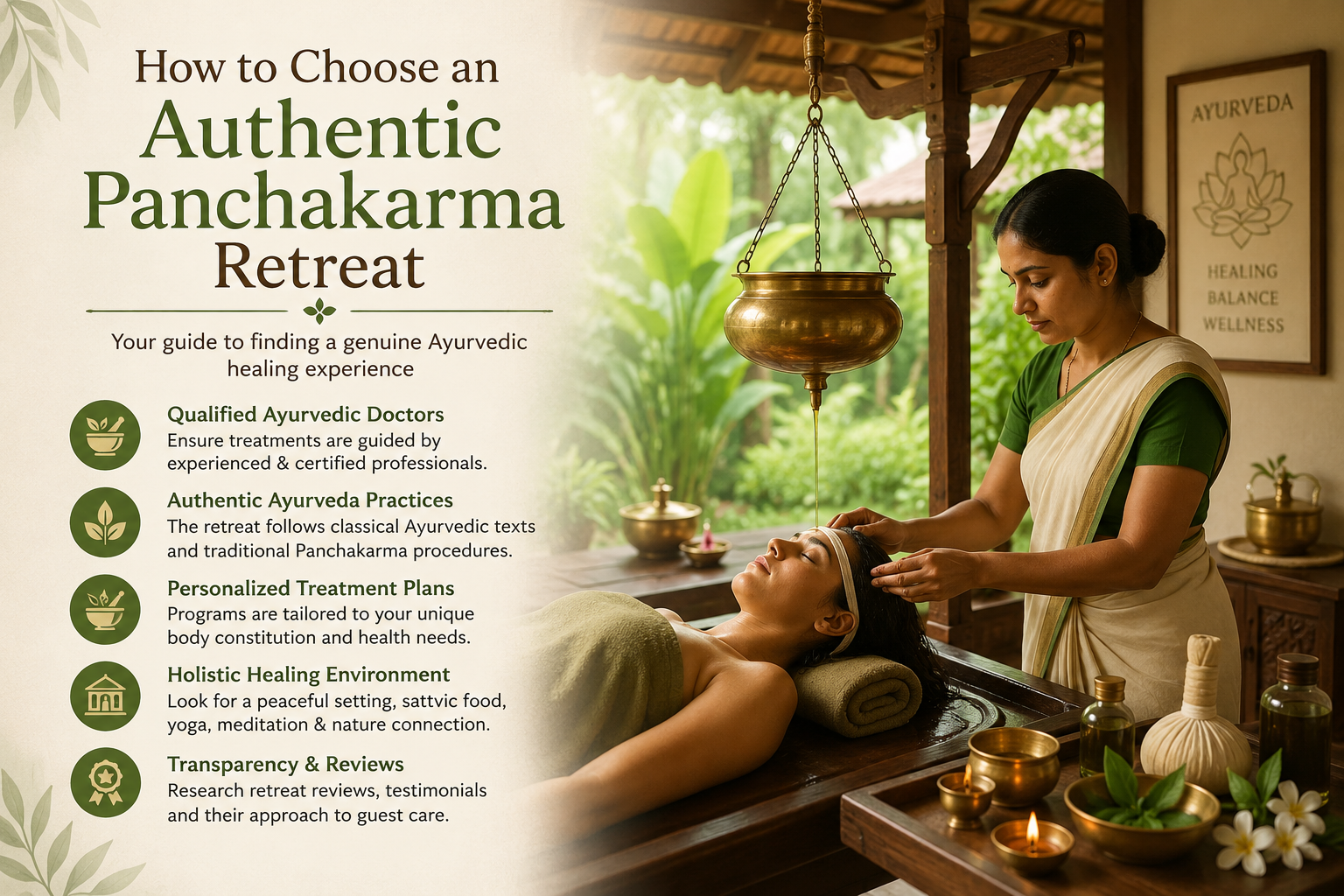
Panchakarma has become one of the most searched wellness terms in the world – and one of the most misused. Walk into almost any spa menu today and you’ll find “panchakarma massage,” “panchakarma detox day,” or “panchakarma package” listed alongside hot stone treatments and facials. The problem is that real panchakarma was never meant to be a spa add-on. It’s a complete, doctor-supervised medical protocol from classical Ayurveda, and when it’s done properly, it works very differently from a relaxing oil massage.
If you’re considering a panchakarma retreat, knowing how to tell the authentic from the diluted version isn’t just about getting your money’s worth – it’s about safety, and about whether you actually get the results you’re looking for. Here’s what to look for.
What Panchakarma Actually Is
Panchakarma literally means “five actions.” In classical Ayurveda, it refers to five therapeutic procedures – Vamana (therapeutic emesis), Virechana (purgation), Basti (medicated enemas), Nasya (nasal administration of herbs), and Raktamokshana (bloodletting, rarely used today) — designed to remove deep-seated toxins (ama) from the body’s tissues.
These aren’t relaxation treatments. They’re targeted medical interventions, prescribed based on your prakriti (constitution), your current imbalance, and your health history. That’s why an authentic panchakarma retreat always begins with a clinical assessment, not a treatment menu.
Red Flags That Signal a Diluted Program
Before you book anything, watch for these warning signs:
No doctor, no diagnosis. If a “panchakarma program” starts with you simply picking treatments à la carte, with no consultation, no pulse diagnosis, and no assessment of your dosha – it isn’t panchakarma in the classical sense. It’s a spa menu wearing an Ayurvedic label.
Everything is optional and interchangeable. Authentic panchakarma follows a sequence – preparation, the main procedures, and recovery — in a specific order, tailored to you. If a retreat lets you swap therapies in and out like a buffet, the therapeutic logic has been lost.
Unrealistically short timelines. A genuine panchakarma cycle, including preparation and recovery, typically needs at least 7–14 days to do anything meaningful. A “3-day panchakarma detox” is, at best, a partial introduction – not the real protocol.
No attention to diet. Classical panchakarma is inseparable from a specific therapeutic diet before, during, and after treatment. If a program offers the therapies but serves a generic resort menu alongside them, it’s missing half the protocol.
Therapies performed by general spa staff rather than trained Ayurvedic practitioners. Procedures like Basti and Nasya, done incorrectly, can be ineffective or even counterproductive. They should be administered by people trained specifically in classical Ayurvedic medicine.
Questions to Ask Before You Book
- Is the program designed and supervised by a qualified Ayurvedic doctor?
Look specifically for a BAMS (Bachelor of Ayurvedic Medicine and Surgery) qualification — not just a “wellness consultant” or spa therapist. You can usually find this information on a retreat’s team or doctor profile page. - Will I receive an individual assessment before treatment begins?
Your dosha, digestive strength (Agni), and current health concerns should shape the entire plan – not a fixed package applied to everyone. - What does the daily structure actually include?
Ask whether therapies like Abhyanga, Shirodhara, Nasya, Kati Vasti, and steam therapies like Swedana are sequenced purposefully, or simply offered as standalone spa sessions. - Is the food part of the treatment?
A program built on Ayurvedic food philosophy – seasonal, dosha-specific, and prepared with therapeutic intent – is a strong sign of authenticity. - Is there aftercare?
Panchakarma doesn’t end the day you leave. Authentic programs include guidance for reintroducing food, rebuilding strength, and maintaining results once you’re home.
The Three Phases of a Real Panchakarma Program
Authentic panchakarma always unfolds in three stages, and a retreat that skips or compresses any of them is cutting corners:
- Purvakarma (preparation): Internal and external oleation (oiling) and gentle sweating therapies that loosen toxins from deep tissues and bring them toward the digestive tract for elimination.
- Pradhanakarma (the main procedures): The actual cleansing therapies – Virechana, Basti, Nasya, and others – selected based on your specific imbalance.
- Paschatkarma (recovery): A carefully graded return to normal diet and activity, allowing Agni (digestive fire) to rebuild and the body to stabilize the changes.
Skipping preparation or recovery isn’t a time-saving shortcut – it can undermine the entire purpose of the cleanse, and in some cases cause more imbalance than it resolves.
Why Location and Duration Genuinely Matter
Climate, food sourcing, and the surrounding pace of life all influence how well a panchakarma program works. Many people now look beyond traditional centers in Kerala toward places like Bali, where access to fresh, seasonal produce, a slower environment, and warm climate support the deep-rest requirements of the protocol.
That said, location is secondary to two non-negotiables: medical supervision and adequate duration. A retreat offering structured 7–21 day programs – long enough to complete all three phases – will almost always outperform a shorter, more convenient option, no matter how scenic the setting.
What Authentic Panchakarma Should Feel Like
It’s worth setting expectations honestly: panchakarma is not always comfortable. Purification phases can bring up fatigue, emotional release, or temporary digestive changes before things improve. A retreat that promises only relaxation and glow, with no mention of a cleansing or adjustment phase, likely isn’t running the real protocol – or isn’t being transparent about it.
What you should expect from an authentic program is closer medical attention than a typical spa stay: regular doctor check-ins, herbal formulations adjusted to your response, and a team that can explain why each therapy is happening, not just what it is.
Choosing With Confidence
The simplest filter, when comparing retreats, is this: could a staff member explain the medical reasoning behind your specific treatment plan? If the answer is yes – supported by a real consultation, a sequenced protocol, therapeutic nutrition, and aftercare — you’re likely looking at the genuine practice. If the explanation stops at “it’s detoxifying and relaxing,” you’re likely looking at a diluted version.
Panchakarma, done properly, is one of Ayurveda’s most powerful tools for resetting digestion, hormones, skin, and the nervous system. It’s worth taking the time to find a program – like a doctor-led Panchakarma retreat – that treats it with the seriousness it deserves.
