
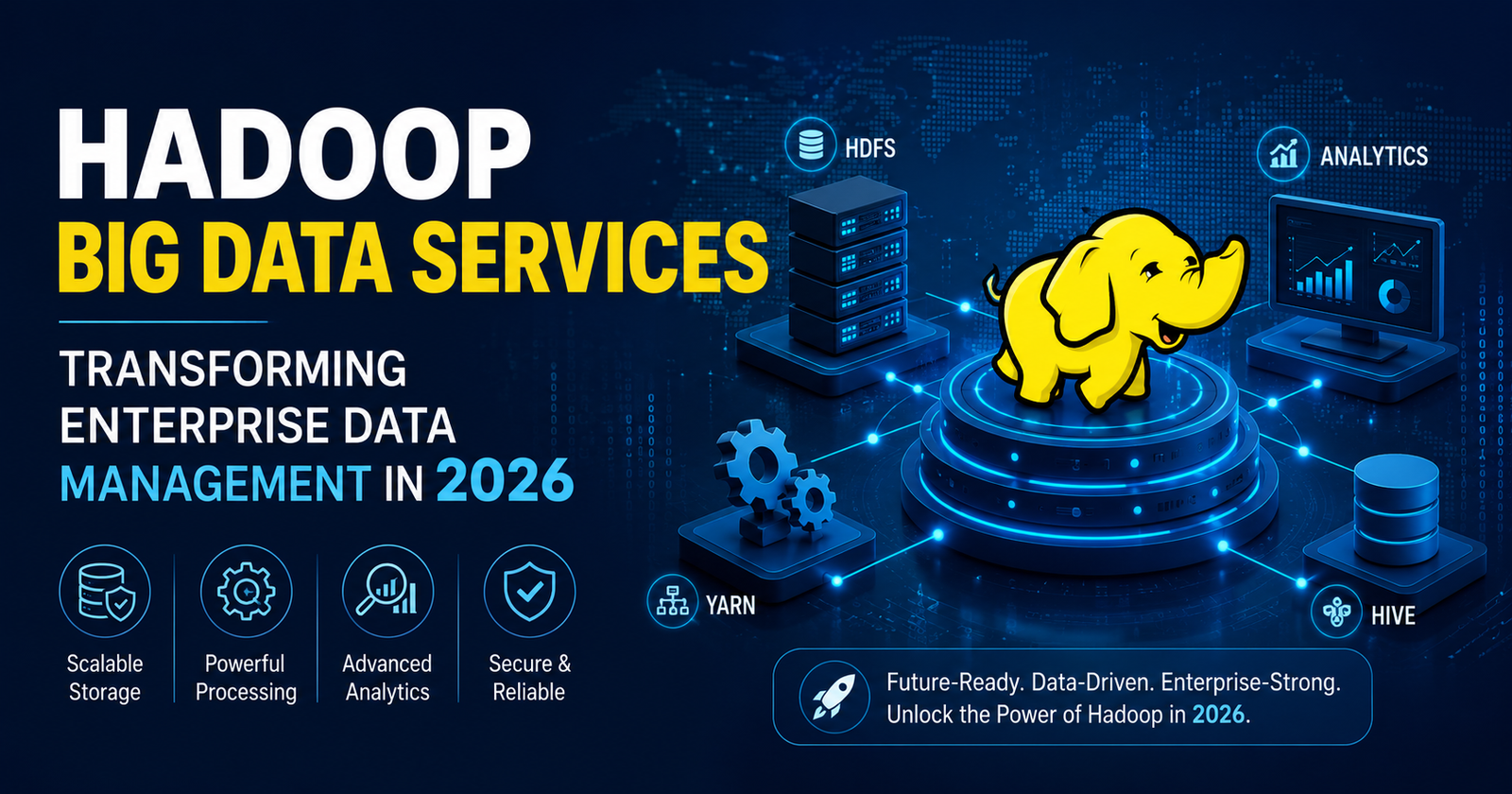
Data has become one of the most valuable assets for modern businesses. Every day, organizations generate enormous volumes of structured and unstructured data from websites, mobile applications, IoT devices, social media platforms, customer interactions, and enterprise systems. Managing and extracting meaningful insights from this vast amount of information has become a major challenge.
This is where Hadoop Big Data Services play a critical role. Hadoop provides a scalable, cost-effective, and highly reliable framework for storing, processing, and analyzing massive datasets. Organizations across industries leverage Hadoop-based solutions to gain valuable business insights, improve operational efficiency, and make data-driven decisions.
What Are Hadoop Big Data Services?
Hadoop Big Data Services refer to a collection of solutions, consulting, implementation, integration, management, and analytics services built around the Hadoop ecosystem. These services help organizations collect, store, process, and analyze large-scale datasets efficiently.
The Hadoop framework enables distributed storage and parallel processing of data across multiple servers, making it possible to handle petabytes of information without relying on expensive traditional databases.
Hadoop services typically include:
- Hadoop consulting and strategy
- Hadoop cluster setup and deployment
- Data migration services
- Hadoop application development
- Big data analytics
- Data warehousing solutions
- Hadoop administration and support
- Performance optimization
- Security implementation
- Cloud Hadoop integration
Understanding the Hadoop Ecosystem
To understand Hadoop Big Data Services, it’s important to know the major components of the Hadoop ecosystem.
Hadoop Distributed File System (HDFS)
HDFS serves as the storage layer of Hadoop. It distributes data across multiple nodes and ensures fault tolerance through data replication.
Key features include:
- High scalability
- Distributed storage
- Automatic fault recovery
- Cost-effective infrastructure
- High availability
MapReduce
MapReduce is Hadoop’s processing framework that allows data processing across distributed clusters.
Benefits include:
- Parallel processing
- Faster execution
- Large-scale data handling
- Improved resource utilization
YARN (Yet Another Resource Negotiator)
YARN manages cluster resources and scheduling.
Advantages include:
- Efficient resource allocation
- Better cluster utilization
- Multi-application support
- Enhanced scalability
Apache Hive
Hive provides SQL-like querying capabilities for Hadoop.
Organizations use Hive for:
- Data warehousing
- Reporting
- Analytics
- Business intelligence
Apache Pig
Pig simplifies big data processing through a scripting language called Pig Latin.
Benefits include:
- Simplified coding
- Faster development
- Data transformation capabilities
- Reduced complexity
Apache Spark
Although not originally part of Hadoop, Spark integrates seamlessly with Hadoop ecosystems.
Advantages include:
- Real-time analytics
- In-memory processing
- Machine learning support
- Faster performance
Apache HBase
HBase is a NoSQL database built on top of HDFS.
Features include:
- Real-time data access
- Massive scalability
- Flexible schema design
- High throughput
Why Businesses Need Hadoop Big Data Services
Traditional data management systems struggle to process today’s rapidly growing datasets.
Hadoop services help businesses overcome challenges such as:
- Managing large volumes of data
- Processing diverse data formats
- Reducing storage costs
- Scaling infrastructure efficiently
- Extracting actionable insights
- Supporting advanced analytics
Organizations can transform raw data into strategic assets using Hadoop-powered solutions.
Key Hadoop Big Data Services Offered by Providers
Hadoop Consulting Services
Consultants help organizations design a roadmap for big data adoption.
Services include:
- Business requirement analysis
- Infrastructure assessment
- Architecture design
- Technology selection
- Cost estimation
Hadoop Implementation Services
Implementation specialists deploy Hadoop environments based on business needs.
Tasks involve:
- Cluster installation
- Configuration management
- System integration
- Testing and validation
- Performance tuning
Data Migration Services
Many businesses migrate from traditional databases to Hadoop platforms.
Migration services include:
- Data extraction
- Data cleansing
- Data transformation
- Secure migration
- Validation testing
Hadoop Application Development
Custom application development enables organizations to maximize Hadoop capabilities.
Applications may include:
- Data processing tools
- Analytics platforms
- Reporting systems
- Machine learning solutions
- Business intelligence applications
Hadoop Integration Services
Integration ensures seamless communication between Hadoop and enterprise systems.
Common integrations include:
- ERP systems
- CRM platforms
- Cloud environments
- Data warehouses
- IoT devices
Hadoop Support and Maintenance
Continuous support helps organizations maintain optimal performance.
Services include:
- Cluster monitoring
- Issue resolution
- Security updates
- Backup management
- Performance optimization
Major Benefits of Hadoop Big Data Services
Massive Scalability
Organizations can expand storage and computing capacity simply by adding more nodes to the cluster.
Benefits include:
- Flexible growth
- Lower infrastructure costs
- Improved resource management
Cost Efficiency
Hadoop uses commodity hardware, significantly reducing operational expenses.
Cost-saving factors include:
- Open-source architecture
- Reduced licensing costs
- Lower hardware investments
- Efficient resource utilization
Fault Tolerance
Data replication across multiple nodes ensures reliability even during hardware failures.
Advantages include:
- Business continuity
- Reduced downtime
- Enhanced data protection
High Processing Speed
Parallel data processing allows organizations to analyze large datasets rapidly.
Results include:
- Faster reporting
- Real-time insights
- Improved decision-making
Data Flexibility
Hadoop can store and process:
- Structured data
- Semi-structured data
- Unstructured data
This flexibility makes it suitable for diverse business requirements.
Industries Benefiting from Hadoop Big Data Services
Healthcare
Healthcare organizations use Hadoop for:
- Patient record analysis
- Predictive healthcare
- Medical research
- Disease detection
Benefits include improved patient outcomes and operational efficiency.
Banking and Financial Services
Financial institutions leverage Hadoop for:
- Fraud detection
- Risk management
- Customer analytics
- Regulatory compliance
Retail and E-commerce
Retailers utilize Hadoop for:
- Customer behavior analysis
- Inventory optimization
- Demand forecasting
- Personalized marketing
Telecommunications
Telecom providers analyze large datasets to:
- Improve network performance
- Predict customer churn
- Optimize services
- Enhance customer experience
Manufacturing
Manufacturers use Hadoop for:
- Predictive maintenance
- Quality control
- Supply chain optimization
- Production monitoring
Hadoop and Cloud Integration
Modern enterprises increasingly deploy Hadoop in cloud environments.
Popular cloud platforms include:
- Amazon Web Services (AWS)
- Microsoft Azure
- Google Cloud Platform (GCP)
Cloud-based Hadoop offers:
- Elastic scalability
- Lower infrastructure costs
- Faster deployment
- Enhanced accessibility
- Improved disaster recovery
Hadoop Big Data Services and Artificial Intelligence
The combination of Hadoop and AI creates powerful data-driven ecosystems.
Organizations use Hadoop to support:
- Machine learning models
- Predictive analytics
- Natural language processing
- Recommendation engines
- Fraud detection systems
AI applications require vast amounts of data, making Hadoop an ideal foundation.
Common Challenges in Hadoop Implementation
Despite its advantages, Hadoop implementation may present challenges.
Skills Gap
Finding experienced Hadoop professionals can be difficult.
Solutions include:
- Training programs
- Managed services
- Expert consulting
Security Concerns
Protecting sensitive data remains a priority.
Organizations should implement:
- Encryption
- Access controls
- Authentication mechanisms
- Compliance frameworks
Data Quality Issues
Poor data quality can reduce analytical accuracy.
Best practices include:
- Data cleansing
- Validation processes
- Governance frameworks
Infrastructure Complexity
Large Hadoop deployments require careful planning.
Partnering with experienced Hadoop service providers helps simplify deployment and management.
Best Practices for Successful Hadoop Deployment
Organizations should follow these best practices:
Define Clear Business Objectives
Identify measurable goals before implementation.
Start with a Pilot Project
Test Hadoop capabilities on a smaller scale before full deployment.
Invest in Data Governance
Establish policies for data quality, security, and compliance.
Optimize Cluster Performance
Regular monitoring and tuning improve efficiency.
Ensure Scalability
Design infrastructure that can support future growth.
Prioritize Security
Implement robust security measures from the beginning.
Future Trends in Hadoop Big Data Services
As technology evolves, Hadoop services continue to adapt.
Key trends shaping the future include:
Cloud-Native Hadoop Solutions
Cloud-first deployments are becoming standard across enterprises.
AI-Driven Analytics
Machine learning integration will enhance predictive capabilities.
Real-Time Data Processing
Organizations increasingly demand instant insights.
Hybrid Data Architectures
Combining Hadoop with modern analytics platforms will improve flexibility.
Enhanced Data Security
Advanced security frameworks will protect growing data ecosystems.
Edge Computing Integration
IoT and edge devices will generate massive data streams processed through Hadoop environments.
Choosing the Right Hadoop Big Data Services Provider
When selecting a Hadoop service provider, consider:
- Industry experience
- Technical expertise
- Cloud capabilities
- Security standards
- Support services
- Scalability options
- Client references
- Cost structure
A reliable partner can significantly accelerate your big data transformation journey.
Conclusion
In today’s data-driven economy, organizations need powerful solutions to manage and analyze ever-growing volumes of information. Hadoop Big Data Services provide the scalability, flexibility, and performance required to unlock valuable business insights from complex datasets.
From data storage and analytics to machine learning and cloud integration, Hadoop continues to serve as a cornerstone technology for enterprise big data initiatives. Businesses that invest in Hadoop services can improve decision-making, enhance customer experiences, reduce operational costs, and gain a significant competitive advantage.
As big data continues to expand in 2026 and beyond, Hadoop Big Data Services will remain a vital component of successful digital transformation strategies, helping organizations turn data into measurable business value.
