
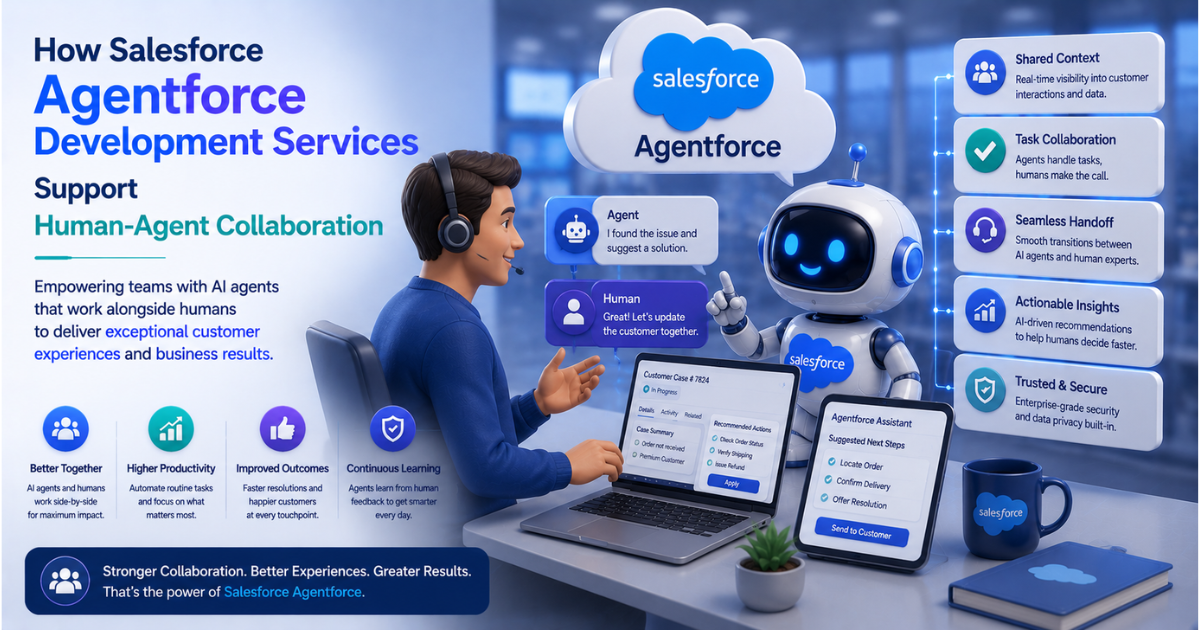
AI agents now handle a large share of customer interactions, but they rarely work alone. Salesforce’s own Agentforce platform has processed more than 380,000 support interactions, resolving 84% without human involvement. The remaining cases still need a person. That gap is exactly where Salesforce Agentforce Development Services prove their value.
AI Agents Now Work Alongside Human Teams
Customer service has shifted fast. About 30% of customer service cases are currently handled by AI, and that share is projected to reach 50% by 2027. This growth sounds like full automation, but the reality looks different on the ground.
Most successful deployments run as a partnership between AI agents and human staff. The agent handles routine, high-volume requests. A person steps in when a case needs judgment, empathy, or authority the agent does not have. Building that handoff correctly takes real technical work, not a simple toggle switch.
What Salesforce Agentforce Actually Does
Agentforce gives businesses a platform for building autonomous AI agents inside the Salesforce ecosystem. These agents handle customer chats, internal employee requests, and routine task execution across Sales, Service, and Commerce functions.
Core technical pieces include:
- Agent Builder: A tool for defining what an agent can do and how it responds.
- Topics and Actions: Structured units that tell an agent which tasks it can perform and under what conditions.
- Atlas Reasoning Engine: A multi-step decision layer that breaks customer requests into smaller tasks.
- Omni-Channel Flows: Routing logic that passes a case to a human when an agent cannot resolve it.
- Einstein Studio: Houses predictive models, including a “Propensity to Escalate” tool that flags cases likely to need human help.
These pieces work together, but only when configured with real business logic. Default settings rarely match how a specific company actually wants to balance automation and human oversight.
Why Human-Agent Collaboration Matters More Than Full Automation
Full automation sounds appealing, but the data shows real risk in pushing too far too fast. About 88% of AI agent deployments report incidents in production. Gartner projects that more than 40% of agentic AI projects will get cancelled by 2027 if companies skip proper governance and oversight.
These numbers point to a clear lesson. Agents work best as part of a system that includes human checkpoints, not as a fully independent replacement for staff. Salesforce Agentforce Development builds this balance directly into the technical architecture.
A well-built collaboration model gives a business:
- Faster response times on routine requests handled by agents.
- Lower error risk on complex cases routed to qualified humans.
- Clear audit trails showing why an agent made a decision or escalated a case.
- Room to adjust automation levels as trust in the system grows.
Core Technical Mechanisms for Collaboration
A few specific technical mechanisms make human-agent collaboration work in practice.
1. Confidence Thresholds and Escalation Triggers
An agent should know its own limits. Development teams configure confidence thresholds that trigger escalation when a request falls outside an agent’s defined scope. In financial services, for example, an agent managing customer transactions follows strict compliance rules. When a transaction exceeds its confidence threshold, the agent flags it and routes it to a human rep without delaying the customer.
2. Propensity to Escalate Models
Salesforce’s Einstein Studio includes a machine learning model built specifically to predict which open cases are likely to need human attention. This model scans case details and surfaces a priority list for support teams, rather than waiting for a case to fail outright.
3. Omni-Channel Routing Logic
When an agent decides a case needs a human, it has to land somewhere specific. Omni-Channel flows define which queue receives the case and which skills a human agent needs to handle it well. Development teams build these routing rules around real team structures, not generic defaults.
4. Context Handoff
A poor handoff forces a customer to repeat information they already gave the AI agent. Development teams configure context transfer so a human rep sees the full conversation history immediately. This step alone changes how a customer experiences the switch from agent to person.
5. Governance and Audit Trails
Every agent’s decision needs a record. Development teams set up logging that captures what data the agent used, what action it took, and why it escalated a case when it did. This record matters for compliance, training, and ongoing trust in the system.
Why Businesses Need Salesforce Agentforce Development Services
None of these mechanisms work well out of the box. Each requires configuration tied to a specific business process, compliance requirement, or team structure. This is the core reason businesses turn to Salesforce Agentforce Development Services rather than attempting a self-managed rollout.
Common reasons businesses bring in development support include:
- Limited internal experience configuring Agent Builder and Atlas Reasoning Engine.
- Complex escalation rules tied to industry compliance requirements.
- A need to integrate agent workflows with existing Service Cloud processes.
- Pressure to launch quickly without sacrificing oversight and safety.
- Ongoing tuning needs as agent performance data comes in after launch.
How Development Services Build Collaboration Into Agent Workflows
A development team approaches collaboration as a structured design problem, not an afterthought added after deployment.
- Mapping escalation paths: Defining exactly which case types, confidence levels, or compliance flags trigger a handoff to a human.
- Designing context-rich handoffs: Building the technical pipeline that passes full conversation history to the receiving human agent.
- Setting up feedback loops: Capturing outcomes from escalated cases to improve agent decision-making over time.
- Configuring audit logging: Recording agent actions and reasoning for compliance review and quality checks.
- Testing edge cases: Running scenarios that push an agent toward its limits to confirm escalation triggers fire correctly.
This work determines whether a deployment builds trust with staff and customers, or creates friction that pushes teams back toward manual processes.
A Real-World Example of Collaboration in Action
Consider a financial services company deploying an AI agent for routine account questions. The agent handles balance checks, transaction history requests, and simple transfers without issue.
A development team configures the agent to flag any transaction request above a set dollar threshold or one that triggers a fraud risk signal. The case routes instantly to a human representative, along with full conversation context. The customer experiences no delay, since the handoff happens before they even notice a problem.
This setup reflects the actual design pattern used in regulated industries today. The agent absorbs routine volume. The human handles judgment calls that carry real financial or compliance risk.
Measurable Impact on Human Teams
Human-agent collaboration changes daily work for support staff in measurable ways. Hybrid programs combining AI and human agents report a first-call resolution rate of 71%, compared to 58% before AI adoption. The AI layer absorbs routine noise, leaving humans to focus on harder cases.
Staff retention also improves under this model. Agent attrition runs at 17% in hybrid programs, compared to 26% in all-human programs, according to Boston Consulting Group research. Lower repetitive workload appears to reduce burnout among support staff.
Work itself shifts toward higher-value tasks. Time spent by senior agents on quality assurance, escalation review, and AI tuning rose from 9% to 27% of their workday. Senior CX engineer roles focused on agent tuning and integration grew 28% year over year, even from a small starting base. Meanwhile, junior tier-one agent postings dropped 21% in 2025, with a further 24% decline planned for 2026.
These shifts show collaboration is not just a customer-facing design choice. It reshapes internal team structure and skill demand across the support organization.
Common Mistakes That Break Collaboration
Several recurring mistakes weaken human-agent collaboration after launch.
- No clear escalation path: Agents continue attempting tasks beyond their reliable scope instead of handing off early.
- Missing context in handoffs: Customers repeat information already given to the agent, which damages trust.
- No human review of agent decisions: Teams skip audits, missing patterns that signal a need for retraining.
- Ignoring governance requirements: Compliance gaps surface later, often during an audit or customer complaint.
- Treating launch as the finish line: Agent performance drifts without ongoing tuning based on real outcomes.
A development partner with production experience flags these risks during setup, not after a costly failure.
Choosing the Right Agentforce Development Partner
Salesforce Agentforce Development Services vary widely in depth and quality. Look for a partner with:
- Hands-on experience configuring escalation logic and Omni-Channel routing for real production environments.
- Industry-specific knowledge, especially for regulated sectors like financial services or healthcare.
- A clear testing methodology for edge cases before go-live.
- Post-launch monitoring support, since agent performance needs ongoing review.
- Transparent reporting on resolution rates, escalation patterns, and customer satisfaction.
Ask for examples of how a partner has handled past escalation design work, not just general AI agent setup.
The Future of Human-Agent Collaboration
Salesforce continues expanding Agentforce capabilities, including deeper integration with Flow and Orchestration tools expected through 2026. New operational roles are emerging inside organizations, focused specifically on agent performance monitoring, governance design, and ongoing tuning.
Expect these trends to continue shaping collaboration models:
- Wider adoption of confidence-based escalation across more business functions.
- Growth in dedicated “agent operations” roles, similar to existing DevOps functions.
- Tighter integration between agent decision logs and compliance reporting tools.
- Continued investment in context-rich handoffs as a baseline expectation, not a premium feature.
Conclusion
AI agents bring real efficiency gains, but the data shows clear risk in pushing automation past what governance and oversight can support. Salesforce Agentforce Development Services build the technical structure that lets agents and humans work together safely and effectively.
Businesses that invest in proper escalation design, context handoffs, and ongoing tuning see the real benefit: faster service, lower staff burnout, and a support system that customers and employees actually trust.