
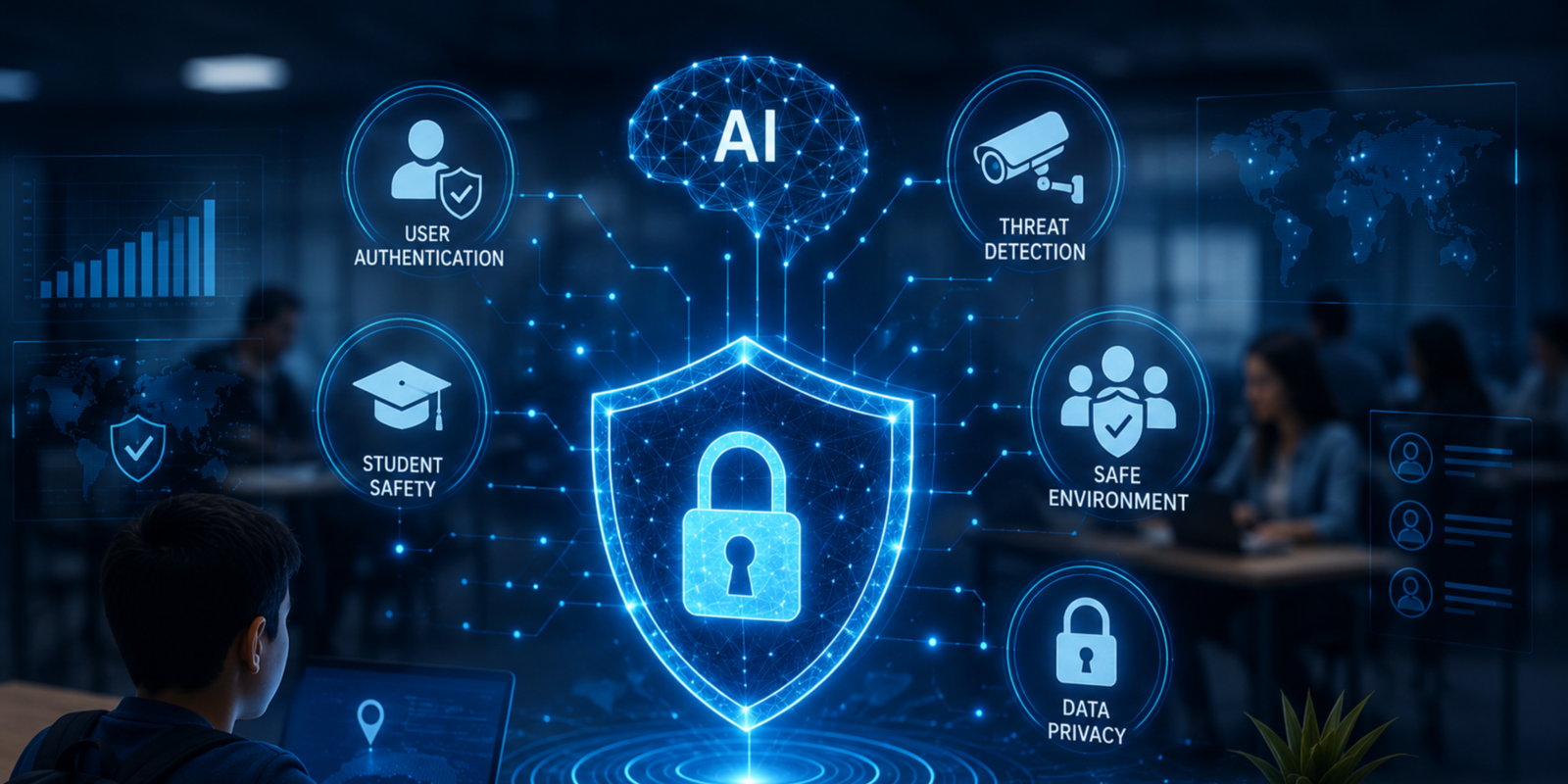
There’s a quiet shift happening inside organizations right now. Whether it’s a mid-sized company rolling out AI tools to boost team productivity, or a school district trying to keep students safe on collaboration platforms – the common thread is the same: the digital environment has gotten a lot more complex, and traditional security approaches are simply not keeping up.
AI tools are everywhere now. Employees use them for drafting, summarizing, and analyzing data. Students and teachers rely on platforms like Webex for live classes, group projects, and one-on-one conversations. But with that convenience comes a new set of risks – data leakage, inappropriate content, uncontrolled AI usage, and compliance gaps that can quietly become serious problems.
This blog breaks down three areas that IT leaders, compliance officers, and school administrators are paying close attention to: AI security suite solutions, private AI smart search, and Webex student safety controls.
What Does an AI Security Suite Actually Do?
Most organizations already have some form of cybersecurity in place – firewalls, endpoint protection, maybe a DLP tool. But when AI enters the picture, those tools often fall short. They weren’t built to handle AI-specific risks like prompt injection, sensitive data being fed into external AI models, or rogue AI agents operating without oversight.
An AI security suite addresses these gaps specifically. At its core, it gives organizations the ability to monitor, control, and enforce policies around how AI is used – in real time.
Think about what that means in practice. When an employee types a confidential client proposal into an external AI chatbot, does your current system catch that? When an AI agent is given access to a company database, is there any governance over what it can retrieve or share? These are the kinds of questions that an AI security suite is designed to answer.
The best solutions in this space offer features like prompt inspection, AI gateway controls, behavioral monitoring, and the ability to enforce data protection policies across both internal and third-party AI tools. The goal isn’t to block AI adoption – it’s to make it safe and auditable.
Is Private AI Smart Search Worth It for Enterprises?
Here’s a situation many companies run into: employees spend a huge chunk of their workday searching for information -digging through shared drives, email threads, wikis, and project management tools. Traditional search tools return keyword matches, which often surface outdated or irrelevant results.
Private AI smart search takes a different approach. Instead of matching keywords, it understands meaning – what the user is actually looking for, not just the words they typed. It searches across connected data sources and returns contextually relevant results, almost like asking a well-informed colleague rather than typing a query into a search bar.
What makes the “private” part critical is where the data stays. Unlike consumer AI tools that send your queries and documents to external servers, private AI smart search operates within your own environment – whether that’s on-premises, a private cloud, or an air-gapped setup. Your company’s data doesn’t leave your control.
This matters enormously for legal teams, healthcare organizations, financial institutions, and any business that handles sensitive client data. You get the intelligence of modern AI search without trading away your data sovereignty.
Why Webex Student Safety Controls Have Become a Priority for Schools
Schools adopting Webex for remote learning and communication have found it to be a powerful platform – but one that comes with real risks if left unmanaged. Students communicating without teacher oversight, inappropriate content being shared in group spaces, or even bullying happening through direct messages are all scenarios that IT teams in education are dealing with.
Webex student safety controls exist to give schools the ability to set firm boundaries on how the platform is used. Some of the most important capabilities include:
- Ensuring a teacher is always present in student communication spaces, preventing unsupervised student-only interactions
- Blocking cross-grade communication that administrators don’t want to happen
- Detecting and filtering inappropriate content – including profanity, violent imagery, and adult material — using AI-based inspection
- Assigning moderator roles automatically to teachers, so they maintain oversight without manual setup
- Archiving and analyzing communication to ensure compliance with school policies and educational standards
Platforms like AGAT Software have built these capabilities specifically for educational institutions using Webex, recognizing that schools have a fundamentally different compliance and safety profile than corporate organizations.
The underlying technology uses real machine learning – not simple keyword blocklists – to identify genuinely unsafe content while avoiding false positives that would flag ordinary student conversations.
How These Three Things Connect
On the surface, AI security suites, private AI smart search, and Webex student safety controls might seem like three separate products for three separate problems. But they share a common philosophy: give organizations visibility and control over their digital environments without slowing down the people using them.
For a business, that means adopting AI tools confidently, knowing there’s a governance layer in place. For a school, it means using Webex as an effective teaching tool without putting students at risk. In both cases, the goal is the same – create an environment where technology actually works the way it should.
Frequently Asked Questions
Q: Is an AI security suite only for large enterprises?
Not at all. While large organizations often have more complex needs, mid-sized companies and even growing startups benefit from having governance controls in place as they adopt AI tools. The risks – data leakage, uncontrolled AI usage, compliance gaps – exist at every scale.
Q: How is private AI smart search different from just using ChatGPT?
Consumer AI tools like ChatGPT process your queries on external servers. Private AI smart search runs in your own environment, meaning sensitive company data never leaves your control. It also connects to your actual internal knowledge sources – not generic internet content – so the results are far more relevant to your specific work.
Q: Can Webex student safety controls be customized per school or district?
Yes. Most robust solutions let administrators set policies at the organizational level and adjust them based on grade level, user groups, or specific communication channels. What’s appropriate for a high school might be different from what’s needed for an elementary school, and good controls reflect that.
Q: Do these tools slow down the platforms they’re monitoring?
When implemented well, the impact on performance is minimal. Real-time inspection happens in the background. Most users won’t notice any difference in their day-to-day experience – they just work in a safer, more governed environment.
