
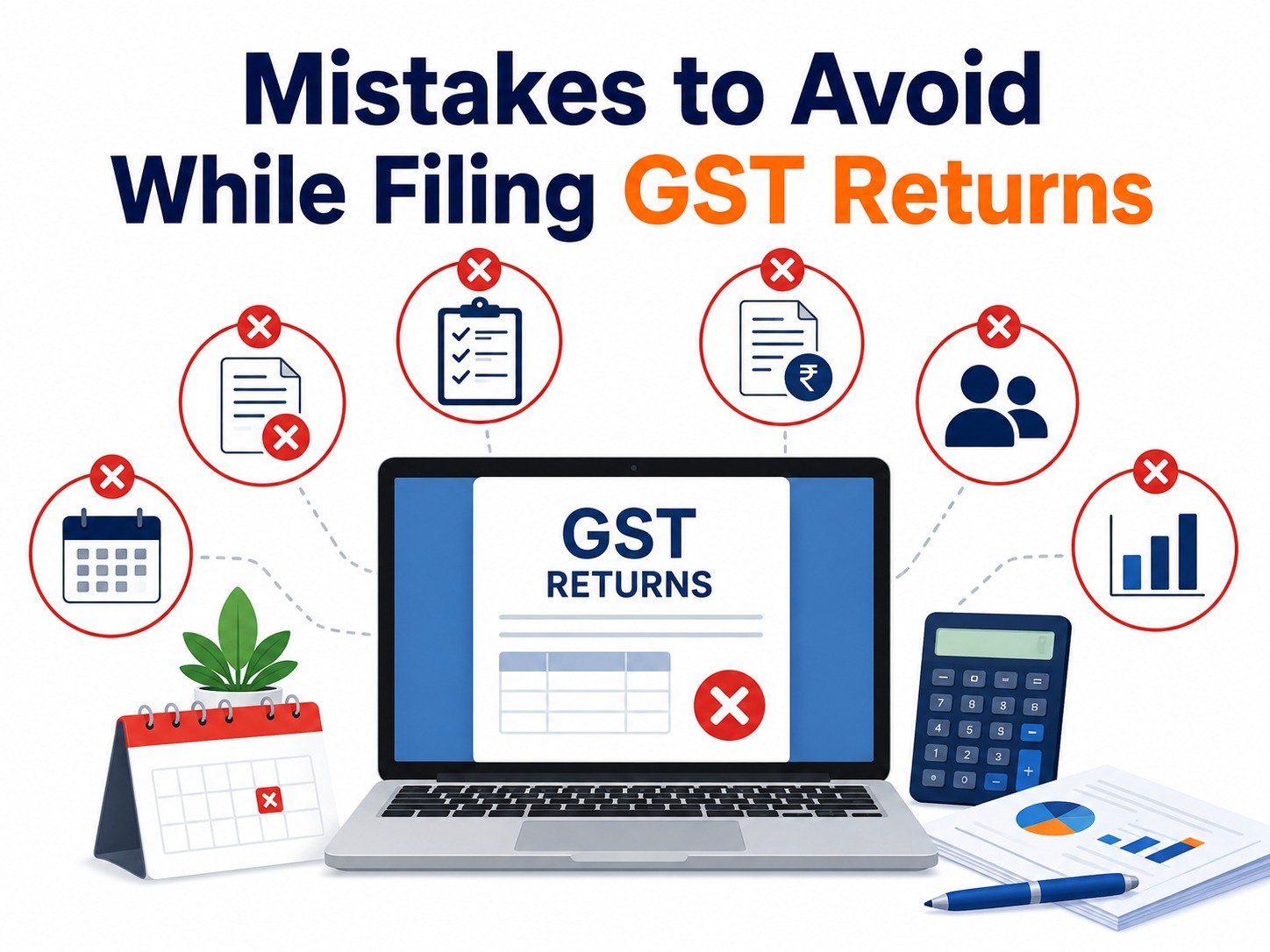
The Goods and Services Tax (GST) regime is a technology-driven indirect tax system where accuracy in compliances as well as in returns is crucial. Every registered taxpayer is required to furnish periodic returns such as GSTR-1, GSTR-3B, GSTR-9, and other applicable statements within prescribed timelines which are monthly, quarterly or annually. While GST compliance appears straightforward, even small error or mistakes in return filing can result in notices from department, interest liability, attract penalties, denial of Input Tax Credit (ITC), litigation, and also can be departmental scrutiny.
Common mismatches between GST returns or Bills like GSTR-1, GSTR-3B, GSTR-2B, e-way bills, and annual returns have become major triggers for scrutiny proceedings.
This blog post discusses the most common mistakes taxpayers make while filing GST returns, their practical implications, relevant legal provisions, and important judicial precedents.
Why Accurate GST Return Filing Matters
Incorrect GST return filing raise following consequences:
- Demand notices under Sections 61, 73, or 74 of the CGST Act issue by department.
- Attract interest liability under Section 50.
- Penalties for misreporting.
- Blocking of ITC.
- Suspension or cancellation of registration under GST.
- Due to ITC mismatch an adverse impact on customer trust relationships.
- GST audits or investigations imitative by department.
Therefore, GST return filing should not be treated as a mere compliance formality but as a critical business function in India.
1. Mismatch between GSTR-1 and GSTR-3B
One of the most common errors is reporting mismatch in turnover figures in GSTR-1 and GSTR-3B. Taxpayers often upload invoices in GSTR-1 but fail to discharge corresponding tax liability in GSTR-3B and then taxpayer face serious consequences.
Practical Example
A company reports taxable sales of ₹50 lakh in GSTR-1 but reports only ₹45 lakh in GSTR-3B now difference is ₹5 lakh. The GST system automatically identifies such discrepancies and may generate notices under Rule 88C.
Consequences
- Short payment demand.
- Interest charge under Section 50.
- DRC-01C proceedings.
- Scrutiny notice from department.
To avoid mismatch between GSTR-1 and GSTR-3B taxpayer should do following things before filing GSTR-3B
- Reconcile turnover with GSTR-1.
- Match sales register with GST liability.
- Verify amendments and credit notes.
2. Claiming ITC without reconciling GSTR-2B
Many taxpayers claim Input Tax Credit based solely on purchase invoices without verifying whether the same appears in GSTR-2B or not. This has become one of the most common scrutinized areas under GST.
Practical Example
A supplier issues an invoice in March but uploads it in June and the recipient claims ITC in March itself. Now invoice does not appear in GSTR-2B and that result in Excess ITC claim.
Consequences of same are notice under Rule 88D, ITC reversal, Interest liability and also Litigation costs.
Best Practice to avoid above issue is-
Conduct monthly reconciliation of purchase register and vendor invoices and GSTR-2B. Never claim ITC solely on the basis of possession of invoice.
3. Claiming Blocked Credits under Section 17(5)
Taxpayers often avail ITC on expenses which are specifically blocked under Section 17(5) of the CGST Act such as:
- Personal motor vehicles.
- Club memberships.
- Personal expenses.
- Certain food and beverage expenses.
Practical Example
Director purchases a luxury vehicle for personal use and the company claims GST credit on vehicle. Such credit is generally ineligible because vehicle is not use for business purpose.
Consequences
- Reversal of ITC.
- Interest demand.
- Penalty proceedings.
Best Practice to avoid error is preparing a blocked-credit checklist and reviews every major expense before claiming ITC.
4. Incorrect GSTIN of Customers
Entering wrong GSTIN of customer while filing GSTR-1 and this is a very common practical error.
Practical Example
ABC Ltd. enters one incorrect digit in customer’s GSTIN. And that results-
- Invoice does not appear in buyer’s GSTR-2B.
- Buyer cannot claim ITC.
- Business disputes arise.
- Customer dissatisfaction.
Best Practice
Use GSTIN validation software or cross check on GST portal before uploading invoices.
5. Wrong Classification of B2B and B2C Supplies
The Mistake
Many taxpayers mistakenly report B2B transactions as B2C or vice versa.
Practical Example
Sale to registered dealer is reported under B2C category and that results buyer loses ITC and Amendment required. Adopt Practice toreview customer master data before filing returns.
6. Incorrect HSN/SAC Codes and GST Rates
Using incorrect HSN or SAC codes of goods and services or applying wrong GST rates.
Consequences of incorrect HSN/SAC code and GST rate are-
- Differential tax demand.
- Interest rate.
- Attract Penalty.
Best Practice
Maintain updated HSN and GST rate database also review GST Council notifications regularly.
7. Ignoring E-Way Bill Reconciliation
Many businesses file GST returns without reconciling e-way bill data. Now as per recent amendment recipient (Ship-To) GSTIN will be compulsory in applicable transactions for better tracking of goods movement and also reduced chances of mismatch between Invoice, E-Way Bill and GST returns.
GST authorities now compare E-way bills, GSTR-1, GSTR-3B through automated systems.
Practical Example
E-way bills indicate movement of goods worth ₹1 crore and under GSTR-1 reports turnover of only ₹75 lakh and this discrepancy can trigger scrutiny.
Best Practice is Monthly reconciliation of E-way bills, Sales register and GST returns.
8. Filing Nil Return by Mistake
Taxpayers occasionally file Nil GSTR-1 or GSTR-3B despite having transactions in particular tax period. Real-world discussions show that this continues to happen, particularly where multiple GST registrations are managed by the same taxpayer.
Consequences
- Additional compliance burden.
- Interest exposure.
- Possible notices.
Best Practice
Review return summary carefully before filing. Implement maker-checker approval system.
9. Delay in Filing GST Returns
The Mistake
Late filing remains one of the most frequent compliance failures.
Consequences
Late Fees :
₹50 per day generally.
₹20 per day for Nil returns.
Interest
18% per annum on tax liability.
Additional Risks
E-way bill restrictions.
Registration suspension.
Best Practice
Maintain GST compliance calendar.
Automate reminders.
Failure to Reconcile Annual Returns
The Mistake
Many taxpayers file monthly returns but fail to reconcile annual data before filing GSTR-9.
Practical Issues
Differences may arise in:
• Turnover.
• ITC.
• Tax payments.
• Credit notes.
Consequences
- Audit observations.
- Departmental notices.
Best Practice
Conduct year-end GST health check before filing annual return.
Recent GST Compliance Trends
Recent GST scrutiny focuses on following issues:
| Area of scrutiny | Department Focus |
| GSTR-1 vs GSTR-3B | Tax liability mismatch |
| GSTR-2B vs ITC | Excess credit claims |
| E-Way Bill vs Turnover | Under-reporting detection |
| HSN Codes | Wrong classification |
| Annual Return | Reconciliation differences |
| Refund Claims | Incorrect ITC utilization |
Automated notices under Rule 88C and Rule 88D CGST rules have significantly increased due to system-driven validations.
Practical GST Return Filing Checklist
Before filing any GST return:
1) Reconciliation of sales register with GSTR-1
2) Match GSTR-1 and GSTR-3B of relevant tax period
3) Verify GSTR-2B before claiming ITC
4) Check blocked credits list mentioned under Section 17(5)
5) Verify GSTINs of customers from GST portal
6) Match e-way bills with turnover
7) Review HSN/SAC codes and GST rates
8) Verify amendments as well as credit notes
9) Check cash ledger and credit ledger balances
10) Obtain management approval before filing
Conclusion
GST return filing is no longer a simple data-entry exercise but with increasing automation, AI-based scrutiny, and interlinking of various GST forms, even small errors can result in significant financial and legal consequences. The most GST notices issued today arise not from deliberate tax evasion but from avoidable mistakes/ errors while filing return such as mismatches between GSTR-1 and GSTR-3B, incorrect ITC claims, wrong GSTIN entries and inadequate reconciliations.
The businesses or taxpayers should establish robust internal controls, perform monthly reconciliations, and seek professional assistance before filing GST returns, issue e-way bill etc. A proactive compliance approach not only minimizes litigation risk but also protects your business from cash flow, vendor relationships, and overall business reputation.
For businesses, the golden rule related to GST as well as other returns is reconciling first, file later.
