
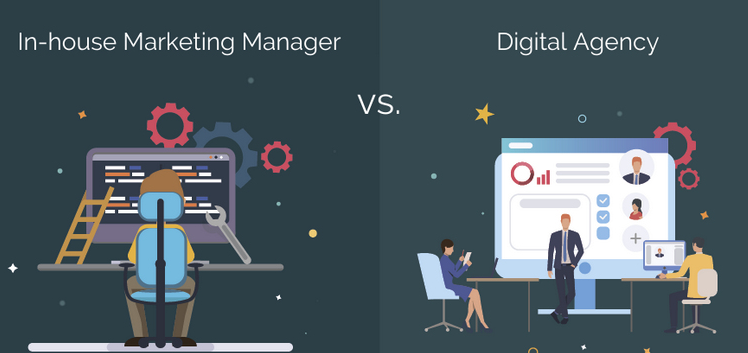
Marketing plays an important role in generating leads, building brand awareness, and supporting business growth. However, results depend on marketing activities as well as how those activities are managed. Many organizations often need to make a choice between building an internal team and working with a marketing agency. Both options have their own advantages and challenges. Being aware of their impact on costs, expertise, efficiency, and long-term growth can help businesses make a more informed decision and improve Return on Investment (ROI).
What Influences Marketing ROI?
Marketing ROI measures the value generated from marketing efforts compared to the resources invested. While revenue is an important indicator, businesses also assess ROI through lead quality, customer acquisition costs, customer retention, and overall growth.
A successful strategy should support both short-term and long-term goals. A campaign may generate immediate leads but fail to build lasting brand awareness. Similarly, a lower-cost solution may not provide the expertise needed for sustainable growth. Due to this, businesses should assess both financial and operational factors when measuring ROI.
In-House Marketing Team: Advantages and Limitations
An internal marketing team can help organizations maintain consistency and respond quickly to changing priorities by offering:
- Deep Brand Understanding: Internal teams work closely with products, services, and company values to create messaging that aligns with business goals.
- Direct Communication: Team members can collaborate with stakeholders quickly, reducing delays in campaign execution.
- Greater Control: Businesses can more closely oversee priorities, timelines, and marketing activities.
However, businesses should also consider some limitations of in-house marketing, such as:
- Higher Employment Costs: Salaries, benefits, recruitment expenses, and retention efforts can increase marketing budgets.
- Training Requirements: Marketing trends, platforms, and technologies continue to evolve, requiring ongoing learning.
- Limited Specialist Expertise: Smaller teams may lack dedicated experts in areas such as SEO, paid media, analytics, and content strategy.
These factors can affect results unexpectedly and make it difficult to access a wide range of skills without increasing costs.
Marketing Agency: Advantages and Limitations
Working with a marketing agency can provide access to broader resources and expertise. Some of the main advantages are:
- Specialized Skills: Agencies often employ professionals across multiple disciplines, including SEO, content marketing, paid advertising, analytics, and social media.
- Scalability: Businesses can increase or reduce support as campaign needs change without hiring new employees.
- Cross-Industry Experience: Agencies draw on insights gained from working with diverse clients and industries.
These benefits can help businesses execute campaigns efficiently while gaining access to proven marketing knowledge.
However, there are certain challenges that should be considered as well:
- Learning Curve: Agencies need time to understand a company’s products, customers, and goals.
- Dependence on Communication: Effective results require regular collaboration and clear expectations.
- Less Immediate Access: External partners may not have the same day-to-day visibility as internal employees.
Many of these challenges can be reduced through strong onboarding and ongoing communication.
In-House Team vs Agency: Key ROI Comparison
The differences between the two models become clearer when comparing the factors that directly affect ROI:
| Factor | In-House Team | Marketing Agency |
| Cost Structure | Fixed employment costs | Flexible service-based costs |
| Expertise | Limited to internal skills | Access to multiple specialists |
| Scalability | Requires additional hiring | Can scale resources more quickly |
| Technology Access | Requires separate investments | Often includes advanced tools |
| Industry Knowledge | Deep understanding of one business | Experience across industries |
| Campaign Execution | Dependent on team capacity | Broader resource availability |
Organizations that want complete control may prefer an internal team. However, those looking for broader expertise and flexibility may benefit more from agency support. The choice depends on business objectives, available resources, and expected outcomes.
Which Option Makes More Sense for Different Businesses?
The most suitable model often depends on company size and growth stage, such as:
- Startups: Early-stage businesses may benefit from external expertise without the cost of building a full team.
- Small and Mid-Sized Businesses: Agencies can provide specialized skills while helping businesses remain flexible.
- Large Enterprises: Many larger organizations combine internal teams with external partners.
- Businesses Entering New Markets: External providers, field marketing and retail execution companies like PPMS Field Marketing can offer additional support and market knowledge.
Carefully evaluating business needs can help determine which model is likely to generate stronger returns.
Can a Hybrid Model Improve ROI?
Many organizations combine internal and external resources rather than choosing a single approach. Internal teams often manage brand strategy and business alignment, while agencies provide specialized expertise and additional capacity.
This model allows companies to maintain control over key functions while accessing skills that may be costly to develop internally. For businesses with evolving marketing needs, a hybrid approach can strike a balance among efficiency, expertise, and cost management.
Conclusion
There is no universal answer to whether an in-house team or an agency delivers better ROI. Internal teams offer stronger brand knowledge and greater control, while agencies provide broader expertise and flexibility. The right choice depends on business goals, budget, growth plans, and available resources. By evaluating both short-term costs and long-term value, organizations can select the approach that best supports their objectives and maximizes marketing performance over time.
